Beyond “Self-Love”: The 3 Relationship Styles That Decide How Close You’ll Ever Get
Most people don’t avoid intimacy because they’re cold or commitment-phobic.
They avoid it because their relationships have been training them—quietly, repeatedly—to expect power, bargains, or performance, but not mutuality.
A useful way to understand this is to see that many relationships fall into three broad patterns:
-
Hierarchical
-
Transactional
-
Mutual
And here’s the uncomfortable truth: most relationships fall short of deep intimacy because they never make it to mutual.
Let’s unpack this in a patient-friendly, real-world way.
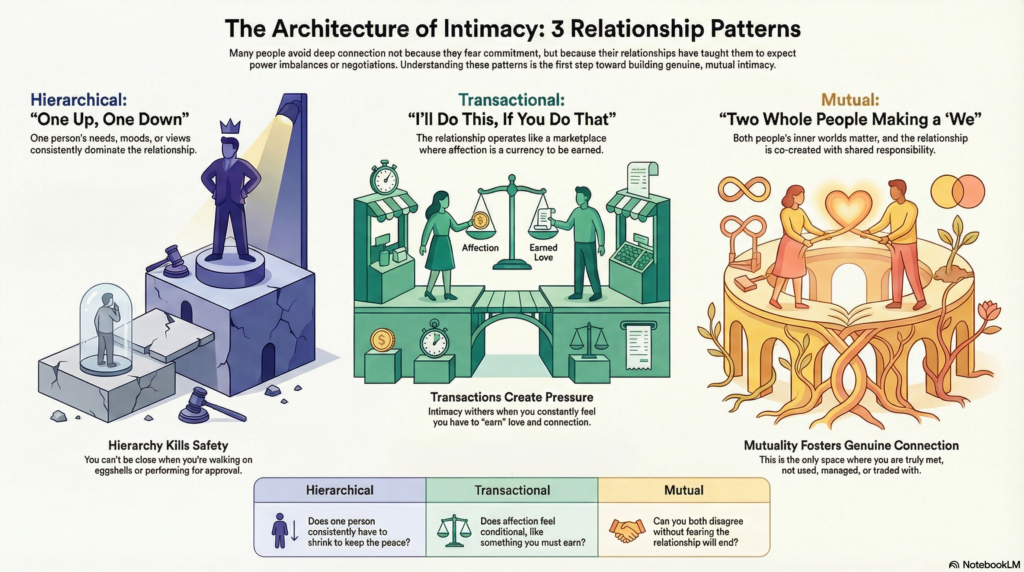
1) Hierarchical relationships: “One up, one down”
In a hierarchical relationship, one person’s needs, wishes, comfort, or worldview reliably matter more.
Sometimes it’s obvious:
-
controlling partner
-
emotional intimidation
-
financial dominance
But often it’s subtle:
-
one person’s moods set the temperature of the home
-
one person is always “the fragile one,” the other is always “the responsible one”
-
one person is allowed to be human; the other must be endlessly understanding
Common signs
-
You feel you must manage the other person to keep peace
-
Your “no” creates punishment (anger, withdrawal, guilt)
-
You are valued more for compliance than for truth
-
You keep shrinking to fit
What it does to intimacy
Intimacy needs safety. Hierarchy breeds monitoring, performing, and walking on eggshells. You can’t truly relax into closeness when the power isn’t shared.
The tragic twist:
When people get tired of being “one down,” they often don’t imagine mutuality. They imagine becoming “one up.” Roles reversed, same game.
2) Transactional relationships: “I’ll do this, if you do that”
Transactional relationships aren’t always bad. In fact, adult life requires some negotiation:
-
dividing chores
-
managing money
-
supporting each other’s careers
The problem begins when the relationship itself becomes a marketplace.
Affection becomes currency. Attention becomes reward. Vulnerability becomes a risky investment.
Common signs
-
Love feels conditional: “I’ll be warm when you behave”
-
You do kindness with an invisible invoice attached
-
Conflict becomes accounting: “After all I did for you…”
-
Apologies are replaced by deals
-
You feel like you’re always trying to “earn” connection
What it does to intimacy
Intimacy needs generosity and presence. Transactional relating creates performance pressure: I must do the right things to deserve closeness.
And when people want “more,” they don’t imagine mutuality. They imagine better terms—a more favorable contract.
3) Mutual relationships: “Two whole people making a ‘we’”
Mutual relationships are not “perfect relationships.” They are living relationships.
Mutuality means:
-
both people’s inner worlds matter
-
both can influence the relationship
-
both take responsibility for impact
-
both can be real, not staged
This is where genuine intimacy happens—because you are not being used, managed, or traded with. You are being met.
What mutuality looks like in daily life
-
You can disagree without fearing abandonment or punishment
-
Repair happens: “I hurt you. I see it. I’m here.”
-
You don’t need to perform to be loved
-
Needs are expressed without shame
-
Each person can say “no” and still feel connected
-
The relationship feels co-created: not “me vs you,” but “us vs the problem”
Philosopher Martin Buber called this an “I–Thou” relationship (as opposed to “I–It,” where the other becomes an object: a role, a resource, a function).
Mutuality is the opposite of using someone—even in subtle, socially acceptable ways.
Why many people can’t even imagine mutuality
Some people have never experienced mutual relationships—so they can’t picture them.
Like a fish trying to imagine “not water.”
If your early relationships taught you:
-
love comes with power,
-
or love must be earned,
-
or love is unsafe,
…then mutuality feels unfamiliar and sometimes even suspicious.
People often confuse mutuality with:
-
being “too needy”
-
losing independence
-
weakness
-
chaos
-
giving up boundaries
But mutuality is not boundaryless merging.
It’s connected individuality.
Why “self-love” advice often feels hollow
A lot of pop-psych content over-focuses on the solitary self:
-
self-love
-
self-healing
-
self-care
These can be helpful—up to a point.
But here’s the deeper psychodynamic idea:
Our sense of self is formed in relationship, and it often requires relationship to change.
We don’t become whole by staring into a mirror and repeating affirmations forever.
We become more fully ourselves when we are seen accurately, when we can be real, when we can impact someone and survive it, when repair is possible.
That’s relational healing. Not just self-improvement.
A quick self-check: which pattern is running your relationship?
-
If one person consistently matters more → Hierarchical
-
If affection feels conditional and negotiated → Transactional
-
If both can be real, influence, repair, and grow → Mutual
Most relationships contain all three at times. The question is: which is the default?
Your default decides the ceiling of intimacy.
The psychotherapy angle: why the therapy relationship matters
One distinguishing feature of psychodynamic psychotherapy is that it doesn’t only “talk about relationships.”
It uses the therapy relationship itself to explore:
-
power dynamics
-
fears of closeness
-
shame and withdrawal
-
people-pleasing
-
control and compliance
-
how needs are expressed or hidden
Over time, this builds the capacity for mutuality—so that mutual relationships become thinkable and then possible outside therapy.
Closing thought
Mutual relationships are not found by demanding the perfect partner.
They are built by becoming someone who can:
-
tolerate difference,
-
hold boundaries,
-
stay present through discomfort,
-
and repair without humiliation.
That’s not influencer content.
That’s actual intimacy.
About the Author
Dr. Srinivas Rajkumar T, MD (AIIMS,New Delhi)
Consultant Psychiatrist,
Apollo Clinic Velachery (Opp. Phoenix Mall),
✉ srinivasaiims@gmail.com 📞 +91-8595155808