Can EEG Artefacts Be Useful ? Listening to the “Noise” Without Losing the Signal
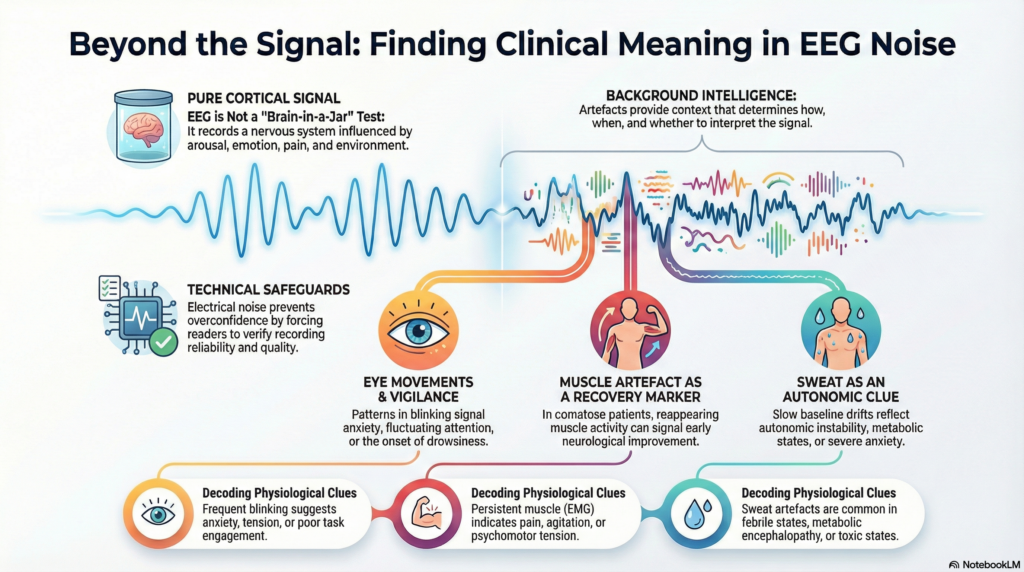 In EEG training, we are taught a simple reflex: identify artefacts, suppress them, move on. Eye blinks, muscle activity, sweat, electrode pops, electrical hum—these are framed as intrusions that obscure the “true” cerebral signal.
At face value, this makes sense. EEG is meant to reflect cortical activity, not blinking eyelids or clenching jaws.
And yet, clinical EEG—especially when practiced at the bedside rather than in textbooks—reveals a quieter truth: sometimes the noise is telling us something important.
Not about neurons firing—but about the state of the human being whose brain we are recording.
EEG Is Not a Brain-in-a-Jar Test
EEG does not record an isolated cortex. It records a nervous system embedded in a body, influenced by arousal, emotion, fatigue, pain, medication, illness, and environment.
Artefacts emerge from this interaction. When recognised and contextualised, they provide background intelligence—information that shapes how, when, and whether the EEG should be interpreted.
Ignoring them completely risks missing the forest for the trees.
Eye Movements: Early Signals of Vigilance
Eye-blink and eye-movement artefacts are usually filtered out mentally. But their pattern and frequency matter.
Frequent blinking or excessive eye activity may reflect:
-
anxiety or internal tension
-
fluctuating attention
-
poor task engagement
Slow rolling eye movements often precede drowsiness—sometimes appearing before clear EEG slowing is evident. In long recordings, these artefacts quietly signal when vigilance has shifted and interpretation must adjust.
The eyes often announce the brain’s state before the cortex does.
Muscle Artefact: Tension, Arousal, Recovery
High-frequency muscle activity is a common frustration in EEG reading. Yet muscle artefact can be clinically revealing.
-
Persistent EMG activity may indicate anxiety, pain, agitation, or psychomotor tension.
-
Sudden bursts may align with movement disorders or behavioural arousal.
-
In comatose or ICU patients, the reappearance of muscle artefact can be an early physiological marker of neurological improvement—sometimes preceding purposeful movement.
What appears as interference may actually be the nervous system reasserting itself.
Sweat Artefact: Autonomic Clues
Slow baseline drifts from sweating are not cerebral delta waves—but they are not meaningless.
Sweat artefacts reflect autonomic activity and may accompany:
-
febrile states
-
metabolic or toxic encephalopathy
-
autonomic instability
-
severe anxiety
They describe the physiological terrain in which cortical activity is unfolding.
Electrical Noise: A Necessary Reality Check
Line noise and electrode artefacts rarely offer diagnostic insight—but they serve a critical role: preventing overconfidence.
They force the reader to ask:
-
Is this recording technically reliable?
-
Am I interpreting pathology or poor signal quality?
-
Should this EEG be repeated?
Artefacts here act as safeguards against false positives—especially mislabeling noise as epileptiform activity.
The Discipline of Listening Without Mishearing
Listening to noise does not mean elevating artefacts to pathology. That path leads to misdiagnosis.
Artefacts become useful only when:
-
their source is clearly identified
-
their physiology is understood
-
they are interpreted in clinical context
-
they are never confused with true EEG abnormalities
Noise without understanding is chaos.
Noise with knowledge becomes context.
The Deeper Lesson
EEG artefacts remind us that neurophysiology is not sterile. It is human.
They teach us about vigilance, arousal, anxiety, recovery, cooperation, and systemic illness—often subtly, often early.
The most experienced EEG readers do not merely erase artefacts from their minds. They pause briefly and ask:
Why is this appearing now, in this patient, in this setting?
That question often matters more than a perfectly clean tracing.
Final Thought
Listening to noise makes sense—when you know what kind of noise you’re hearing.
EEG mastery lies not just in filtering signals, but in understanding the story that surrounds them.
Dr. Srinivas Rajkumar T, MD (AIIMS, New Delhi)
Senior Consultant Psychiatrist
Mind & Memory Clinic, Apollo Clinic Velachery (Opp. Phoenix Mall)
✉ srinivasaiims@gmail.com 📞 +91-8595155808
Clinical expertise in EEG interpretation, neuropsychiatry, sleep medicine, and brain-based diagnostics
Related posts:
- Semaglutide and the Neuropsychiatric Question: Sorting Signal From Noise in a Moment of Global Hype
- The Natural Rhythm of Melatonin: Your Body’s Biological Night Signal
- Age and Melatonin: How Our Body’s Night Signal Changes Over Time
- The 10–20 System in EEG: Mapping Brainwaves with Precision
- EEG, fNIRS & HRV: The Three Pillars of Precision Neurofeedback at MindLab
- When the Brain First Spoke: A Story of How EEG Taught Us to Hear Our Own Minds