Gaming Addiction or Family Tragedy? Reflections on the loss of three young sisters in Ghaziabad
 The deaths of three sisters—Nishika (16), Prachi (14), and Pakhi (12) in Ghaziabad have left the country searching for meaning in the face of an unbearable loss. When children die suddenly, especially together, the shock invites speculation. As mental health professionals, it is our responsibility to slow that impulse down and respond with care, accuracy, and restraint.
This is not a story that should be told loudly. It is one that must be held gently.
What we know—and what we must be careful not to assume
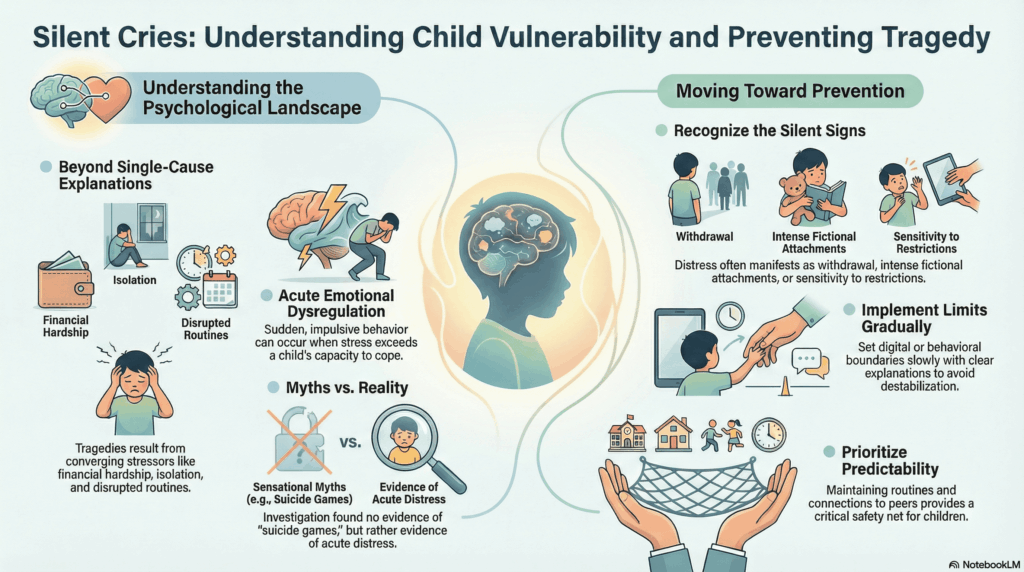
Investigating agencies have clarified that there is no evidence of a “suicide game” or online challenge linked to this incident. Early claims in that direction were later corrected. The sisters were reportedly watching television and online serial content, including Korean dramas, largely on their parents’ phones.
The family was facing severe financial stress, and the children had experienced major disruptions in their daily lives over recent years. Schooling had been interrupted after the pandemic. Access to personal phones had been restricted shortly before the incident. Investigators noted signs of emotional expression—diaries, writing, photographs—but no clear indication of planning or external coercion.
An eyewitness account suggests that events unfolded rapidly, without clear intent or preparation, pointing toward a moment of acute distress rather than a deliberate, planned act.
Beyond these verified facts, any single-cause explanation would be misleading.
Why simple labels can be harmful
In the aftermath of such tragedies, there is often a rush to assign blame—to technology, to parenting, to media, or to culture. While digital habits and screen exposure deserve thoughtful discussion, it is important to state clearly:
This was not a story of gaming alone.
Nor was it a story of “bad children” or “failed parents.”
What emerges instead is a picture of multiple stressors converging—economic hardship, prolonged disruption of routine, emotional isolation, and limited access to supportive outlets. For children and adolescents, such conditions can significantly strain emotional regulation, especially when distress remains unspoken or unnoticed.
Using labels like “addiction” or “influence” without context risks oversimplifying a deeply complex psychological landscape.
Understanding emotional vulnerability in children
Children do not always communicate distress through words. Often, it shows up as withdrawal, intense attachment to stories or fictional characters, changes in sleep, or heightened sensitivity to perceived loss or restriction.
When familiar comforts are suddenly removed—whether they are routines, school, peer contact, or access to media—emotionally vulnerable children may experience overwhelming distress. This does not mean that limits should not be set, but how and when limits are introduced matters greatly, especially in families already under strain.
From a clinical perspective, moments of acute emotional dysregulation can occur when stress exceeds a child’s capacity to cope. In such moments, behaviour may be impulsive and uncharacteristic, without full awareness of consequences.
What this tragedy asks of us
The deaths of these three sisters should prompt reflection rather than fear.
It reminds us that:
-
children absorb family stress even when it is not spoken
-
prolonged disruption of education and routine can quietly erode resilience
-
emotional withdrawal is not the same as emotional safety
-
sudden changes, without emotional support, can be deeply destabilising
Most importantly, it reminds us that mental health crises in children are often silent until they are not.
Moving toward prevention, not blame
Responsible discussion of such events must always turn toward prevention and support.
What helps protect children during times of family stress includes:
-
maintaining predictable routines wherever possible
-
keeping children connected to education and peers
-
setting limits gradually and with explanation
-
checking in emotionally, not just behaviourally
-
seeking professional support early, especially when multiple stressors coexist
This is not about perfect parenting or eliminating all risk. It is about recognising vulnerability early and responding with compassion.
A final word
Three young lives have been lost. Their deaths should not be used to promote fear, sensational narratives, or moral panic. They should be honoured by a commitment to listen more closely to children, support families under strain, and treat mental health as a shared responsibility.
If this story leaves you feeling unsettled, that discomfort can serve a purpose—if it moves us to notice distress sooner, speak more openly, and reach for help without shame.
If you or someone you know is struggling emotionally, support is available.
In India, you can contact local mental health services, hospitals, or helplines for guidance and assistance. Seeking help early can save lives.
About the Author
Dr. Srinivas Rajkumar T, MD (AIIMS), DNB, MBA (BITS Pilani)
Consultant Psychiatrist & Neurofeedback Specialist
Mind & Memory Clinic, Apollo Clinic Velachery (Opp. Phoenix Mall)
✉ srinivasaiims@gmail.com 📞 +91-8595155808