QEEG-Led Clinical Breakthrough: Primary vs Secondary Negative Symptoms in Schizophrenia
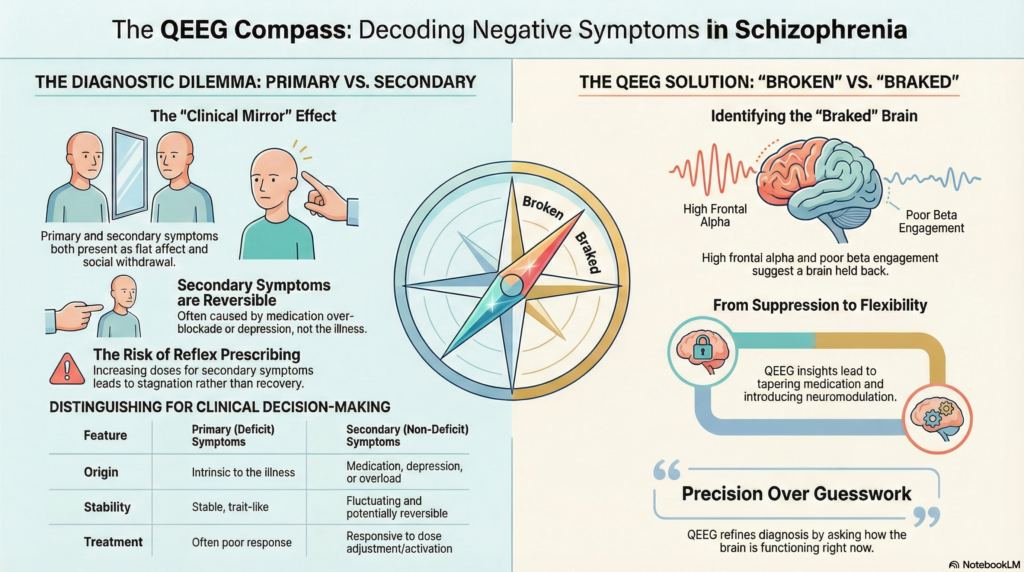 Negative symptoms are the quiet crisis of schizophrenia.
They don’t shout like hallucinations.
They don’t alarm like catatonia.
But they decide whether a person returns to life or remains frozen outside it.
And yet, one of the most damaging mistakes in clinical psychiatry is this:
Assuming all negative symptoms are the same.
They are not.
This is the story of how QEEG changed a clinical dead-end into a treatment breakthrough by helping distinguish primary from secondary negative symptoms in schizophrenia.
The Clinical Problem We All Face
A patient with schizophrenia stabilises:
-
No hallucinations
-
No delusions
-
No agitation
But instead, we see:
-
Flat affect
-
Reduced speech
-
Poor motivation
-
Social withdrawal
-
Cognitive slowing
The reflex diagnosis?
“Residual negative symptoms.”
“Deficit schizophrenia.”
“Poor prognosis.”
And the reflex response?
-
Increase antipsychotic dose
-
Add another drug
-
Accept stagnation
This is where many recoveries quietly die.
Primary vs Secondary Negative Symptoms — The Forgotten Divide
Modern psychiatry clearly distinguishes two entities:
Primary (Deficit) Negative Symptoms
-
Intrinsic to the illness
-
Present early, often premorbid
-
Stable, trait-like
-
Poor response to treatment
Secondary Negative Symptoms
-
Caused by:
-
Medication over-blockade
-
Post-psychotic recovery state
-
Depression or anxiety
-
Cognitive overload
-
-
Potentially reversible
Clinically, they look identical.
Neurobiologically, they are very different.
The challenge has always been:
How do we tell them apart in real patients?
Where QEEG Changed the Game
In a young man with:
-
Acute onset psychosis (ATPD-like)
-
Catatonia with food refusal
-
Short duration of illness (≈1.5 years)
-
Complete remission of positive symptoms
-
Severe PANSS negative score (N = 40)
The question was critical:
Is this deficit schizophrenia
or secondary negative suppression?
Enter Quantitative EEG (QEEG)
Instead of asking what symptoms look like, QEEG asks:
How is the brain functioning right now?
What the QEEG Revealed
Not degeneration.
Not disorganisation.
Not cortical damage.
Instead:
-
Preserved dominant alpha rhythm (~10 Hz)
-
Excess frontal alpha during eyes-open state
-
Poor task-related beta engagement
-
Inadequate theta–beta modulation
-
Failure of cortical “state switching”
In plain terms:
The brain was intact — but under-mobilised.
This is the signature of secondary negative symptoms.
A brain that can engage, but is being held back.
Why This Matters Clinically
If this were primary deficit schizophrenia, QEEG would often show:
-
Generalised slowing
-
Poor rhythmic integrity
-
Reduced reactivity across states
That was not the case.
Instead, the QEEG told us:
“This brain does not need more suppression.
It needs flexibility.”
That single insight changed everything.
The Treatment Breakthrough
Instead of escalating medication:
-
We reframed the diagnosis
-
Recognised dopaminergic over-suppression
-
Identified secondary negative symptoms
What changed in management
-
Cross-tapered high-dose risperidone
-
Introduced a lower-EPS antipsychotic
-
Planned neuromodulation (tDCS, neurofeedback)
-
Shifted focus to cognitive activation and recovery
This was not guesswork.
It was QEEG-guided clinical reasoning.
Why This Is Bigger Than One Case
This is not about EEG gadgets.
It’s about precision psychiatry.
QEEG helps answer questions we’ve struggled with for decades:
-
Is the brain broken or braked?
-
Should we add medication — or remove it?
-
Is stagnation illness-driven or treatment-induced?
Used correctly, QEEG does not replace diagnosis.
It refines it.
A Word of Caution
QEEG is not magic.
-
It does not diagnose schizophrenia
-
It does not replace clinical judgment
-
It must be interpreted in context
But when combined with:
-
Longitudinal history
-
PANSS profiling
-
Cognitive testing
-
Medication review
It becomes a powerful clinical compass.
The Take-Home Message
Not all negative symptoms mean decline.
Not all flatness means deficit.
Not all silence means loss.
Sometimes, it means:
The brain is waiting to be released.
QEEG helps us see that difference — and act on it.
About the Author
Dr. Srinivas Rajkumar T, MD (AIIMS), DNB, MBA (BITS Pilani)
Consultant Psychiatrist & Neurofeedback Specialist
Mind & Memory Clinic, Apollo Clinic Velachery (Opp. Phoenix Mall)
I work at the intersection of clinical psychiatry, neurophysiology, and recovery-oriented care, using tools like QEEG, neurofeedback, and neuromodulation to move beyond symptom control toward functional restoration.
📍 Chennai
📞 +91-8595155808
✉ srinivasaiims@gmail.com
🌐 srinivasaiims.com