SCAN: New Insights on Parkinsonism – Not Just a Movement Disorder
 For decades, Parkinson’s disease has been described mainly as a movement disorder. Tremors, stiffness, slowness of movement, and difficulty walking are usually the first things that come to mind.
But people living with Parkinson’s—and their families—know that the illness goes far beyond movement.
Sleep problems, constipation, dizziness, fatigue, anxiety, low mood, and cognitive slowing are common. These were traditionally labeled as “non-motor symptoms,” almost as if they were secondary or optional.
Modern neuroscience is now challenging that idea.
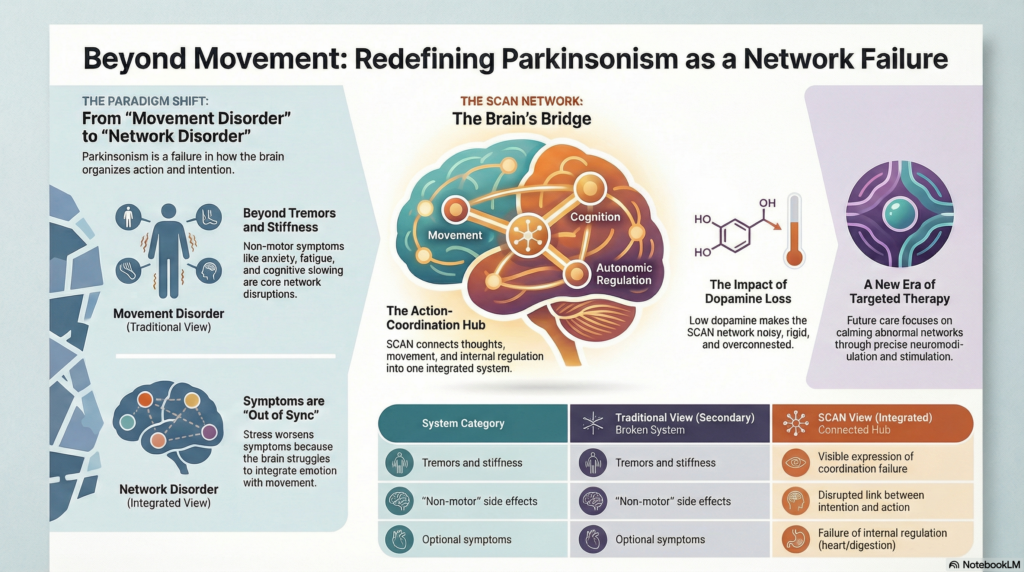
👉 Parkinsonism is not just a disorder of movement. It is a disorder of brain coordination.
The Missing Link: A New Brain Network
Recent research has identified a previously unknown brain network called the
Somato-Cognitive Action Network (SCAN).
In simple terms, SCAN is the brain’s action-coordination system.
Its role is to:
-
turn thoughts into actions
-
coordinate movement with attention
-
adjust the body during stress or emotion
-
integrate thinking, movement, and internal bodily control
SCAN connects brain regions involved in:
-
cognition and planning
-
movement control
-
alertness and arousal
-
regulation of heart rate, digestion, and blood pressure
It acts as a bridge between intention (“I want to move”) and execution (actual movement).
What Goes Wrong in Parkinsonism?
In Parkinsonism, the SCAN network becomes overactive and poorly regulated.
Instead of smooth coordination:
-
brain signals become rigid
-
movements feel slow and effortful
-
actions may feel “blocked” or delayed
This helps explain everyday clinical observations:
-
symptoms worsen under stress
-
movement temporarily improves with music or rhythm
-
symptoms fluctuate across the day
-
both body and mind feel “out of sync”
The problem is not only weak muscles or stiff joints.
It is a network-level disturbance in how the brain organizes action.
Dopamine: Important, but Not the Whole Story
Loss of dopamine-producing cells in the brain is central to Parkinson’s disease. Dopamine normally helps keep action networks like SCAN balanced and flexible.
When dopamine levels fall:
-
SCAN becomes noisy and overconnected
-
the brain struggles to smoothly shift from one action to another
This explains why medications like Levodopa help improve symptoms—but also why they do not completely address fatigue, cognitive slowing, or autonomic symptoms.
Parkinsonism is not just a chemical deficiency.
It is a network disorder.
Why This Changes Treatment Thinking
Understanding SCAN reshapes how we think about therapy.
Research suggests that:
-
deep brain stimulation works by calming abnormal brain networks
-
targeted brain stimulation is more effective than broad stimulation
-
precise neuromodulation can improve both motor and non-motor symptoms
This opens new possibilities for:
-
personalized brain stimulation
-
non-invasive neuromodulation
-
network-guided treatment strategies
Future Parkinson’s care is likely to focus on restoring balance, not just replacing dopamine.
A New Way to Describe Parkinsonism
Instead of saying:
“Parkinson’s is a movement disorder with other symptoms”
We can now say:
Parkinsonism is a brain network disorder that disrupts how the mind turns intention into action.
Movement problems are simply the most visible expression of a deeper coordination failure.
This shift in understanding improves not only treatment strategies, but also empathy and patient education.
Final Thoughts
The discovery of the SCAN network reminds us that the brain works as an integrated whole. When coordination between thinking, movement, and bodily regulation breaks down, symptoms appear across many systems.
Parkinsonism is no longer just about tremor and rigidity.
It is about how the brain organizes action itself.
As neuroscience advances, care is moving toward more precise, humane, and holistic approaches—and that is a hopeful direction for patients and families alike.
About the Author
Dr. Srinivas Rajkumar T, MD (AIIMS, New Delhi), MBA (BITS Pilani)
Consultant Psychiatrist & Neurofeedback Specialist
Mind & Memory Clinic, Apollo Clinic Velachery (Opp. Phoenix Mall)
Dr. Srinivas Rajkumar T specializes in brain-based approaches to psychiatric and neurocognitive disorders, with a strong focus on neurofeedback, neuromodulation, and patient-centered psychoeducation. His work aims to translate cutting-edge neuroscience into practical, compassionate clinical care.
✉ srinivasaiims@gmail.com
📞 +91-8595155808