Healthcare Facilities in South Chennai: A Historical and Market Analysis
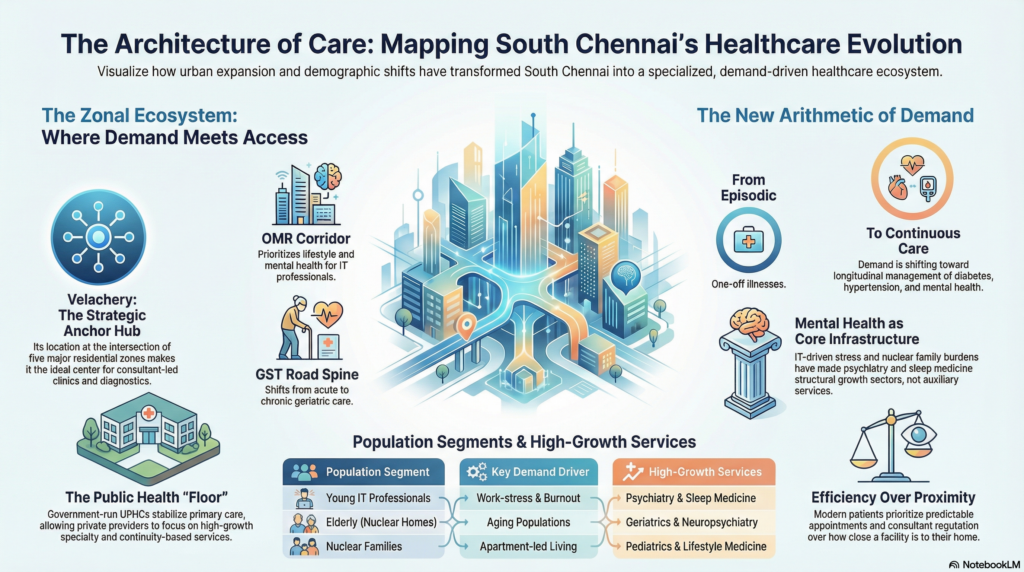 Healthcare systems do not emerge because they are planned; they emerge because they are required. Their shape is determined less by policy documents and more by population movement, work patterns, and the quiet arithmetic of demand. South Chennai—stretching across Velachery, Adambakkam, Nanganallur, Madipakkam, Pallikaranai, Medavakkam, Pallavaram, Chromepet, Tambaram, and the OMR corridor—illustrates this principle with unusual clarity.
To understand healthcare facilities in South Chennai today, one must begin not with hospitals, but with how the city expanded.
From Peripheral Fringe to Healthcare Market
Until the late 1990s, South Chennai functioned largely as a residential periphery. Specialist care remained concentrated in older institutional zones. Patients travelled because there was no alternative.
Two structural changes altered this pattern irreversibly:
- Urban densification beyond the traditional core, particularly after the expansion of the Greater Chennai Corporation.
- Employment-driven migration, especially along GST Road and later the OMR IT corridor.
By the early 2010s, South Chennai had crossed a managerial threshold:
it no longer exported patients—it began to retain them.
This transition created a new healthcare market defined by outpatient intensity rather than inpatient scale.
The Population Arithmetic Behind Demand
The Chennai Metropolitan Area is estimated to house over 14 million residents in the early 2020s, with population growth disproportionately occurring in southern and peripheral zones rather than the historic core. This expansion was apartment-led, workforce-driven, and family-structured.
The healthcare implication was not episodic illness, but continuous demand—for chronic disease management, diagnostics, and mental health care.
The Public Health “Floor” Beneath the Market
Private healthcare expansion does not occur in a vacuum. It rests on a public infrastructure that provides basic access and shapes private incentives.
Greater Chennai Corporation operates:
- Urban Primary Health Centres (UPHCs)
- Urban Health & Wellness Centres (UHWC)
distributed across zones such as Alandur, Adyar, Perungudi, and Sholinganallur.
This public “floor” stabilizes primary care access. What grows above it is specialty and continuity-based private care.
Table 1: South Chennai Zones and Public Health Infrastructure Signals
| South Chennai Cluster | GCC Administrative Zones | Public Health Presence | Market Implication |
| Velachery–Adambakkam–Nanganallur | Alandur / Adyar | Multiple UPHCs & UHWCs | Primary care stable; specialty OPD demand rises |
| Madipakkam–Pallikaranai–Medavakkam | Alandur / Sholinganallur | Developing UHWC coverage | High growth, infrastructure lag |
| Pallavaram–Chromepet–Tambaram (GST Road) | Alandur / Tambaram | Older UPHC network | Shift from acute to chronic care |
| Perungudi–Taramani–Sholinganallur (OMR) | Perungudi / Sholinganallur | UHWC + referral centers | Lifestyle & mental health demand dominant |
Managerial insight:
Where public primary care is adequate, private providers compete on specialization, access, and continuity, not basic availability.
Velachery: The Emergence of an Anchor Hub
Velachery did not become a healthcare hub by policy decree. It became one because it solved a single operational problem: access.
Velachery sits at the intersection of:
- Adambakkam
- Nanganallur
- Madipakkam
- Pallikaranai
- OMR connectors
This makes it ideal for:
- Consultant-led clinics
- Appointment-based OPDs
- Diagnostics and pharmacy clustering
In Drucker’s terms, Velachery aligned structure with task.
It became a hub not by size, but by functional efficiency.
Residential Demand Without Institutional Density: Adambakkam & Nanganallur
Adambakkam and Nanganallur illustrate a recurring healthcare paradox: high demand, low institutional footprint.
Characteristics:
- Stable middle-income populations
- Long residential tenure
- Strong “near me” healthcare search behavior
Land use patterns discourage large hospitals, but demand does not disappear. Instead, it travels—typically within a 3–5 km functional radius.
Velachery and Pallavaram absorb this demand, not by proximity alone, but by consultant reputation and predictable access.
GST Road Belt: From Acute Care to Continuity Care
Pallavaram, Chromepet, and Tambaram historically formed South Chennai’s medical spine. Nursing homes and mid-sized hospitals developed early.
What has changed is the case mix:
- Fewer episodic illnesses
- More diabetes, hypertension, geriatric issues
- Rising demand for mental health and sleep medicine
Institutions designed for episodic care now face the challenge of longitudinal patient management.
OMR Corridor: A Distinct Healthcare Economy
The OMR belt—Perungudi, Taramani, Sholinganallur—does not behave like traditional urban India.
Demographics:
- Younger
- Digitally fluent
- Time-constrained
- Work-stress dominant
Healthcare demand here is functional rather than disease-labelled:
- Sleep disturbances
- Anxiety and burnout
- Cognitive and performance concerns
- Lifestyle disorders
Mental health is not auxiliary in this corridor; it is core infrastructure.
Mental Health as a Structural Growth Sector
National data makes clear that mental healthcare demand is not a passing trend:
- Treatment gaps for mental disorders in India remain extremely high.
- Psychiatrist availability remains well below recommended benchmarks.
- WHO and national surveys consistently identify mental illness as a leading contributor to disability and economic loss.
In South Chennai, these national trends are amplified by:
- IT-driven work stress
- Academic pressure in urban adolescents
- Nuclear family caregiving burdens
Table 2: Demand Drivers and High-Growth Healthcare Services in South Chennai
| Demand Driver | Population Segment | High-Growth Services |
| Apartment-led urban living | Nuclear families | Pediatrics, lifestyle medicine |
| IT & knowledge workforce | Young professionals | Psychiatry, sleep medicine |
| Aging parents in nuclear homes | Elderly | Geriatrics, neuropsychiatry |
| Academic competition | Adolescents | ADHD assessment, counseling |
| Chronic disease prevalence | Middle-aged adults | Endocrinology, diagnostics |
Market reality:
Mental health services increasingly function as continuity care systems, not isolated consultations.
Accessibility Over Distance: How Patients Actually Choose Care
South Chennai patients demonstrate a consistent behavioral pattern:
they are willing to travel farther for:
- Predictable appointments
- Consultant-led care
- Parking and ease of access
- Follow-up continuity
The operative question for patients is not “Who is closest?”
It is “Which system works?”
The Direction of Travel
If current trajectories persist, South Chennai healthcare will increasingly favor:
- Standalone specialty clinics
- Integrated physical–mental health models
- Telemedicine-supported follow-up
- Data-driven OPD systems
- Preventive and lifestyle medicine frameworks
The future will reward fit-for-purpose institutions, not necessarily large ones.
Conclusion
South Chennai’s healthcare ecosystem is no longer emerging—it is maturing under pressure. Its defining feature is not the presence of facilities, but the growing demand for systems that respect time, continuity, and complexity.
As Peter Drucker repeatedly reminded managers:
the most important thing is to understand the reality of the system you are operating in.
South Chennai healthcare is quietly doing just that.
Dr. Srinivas Rajkumar T, MD (AIIMS, New Delhi), MBA (BITS Pilani)
Consultant Psychiatrist & Neurofeedback Specialist
Mind & Memory Clinic, Apollo Clinic Velachery
✉ srinivasaiims@gmail.com 📞 +91-8595155808