Social Media Use and the Adolescent Brain: Why Patterns Matter More Than Screen Time
 For more than a decade, discussions about adolescents and screens have gone in circles. One camp insists social media is damaging a generation; the other argues there’s no solid evidence of harm and that concern is just moral panic dressed up as science.
The truth, as usual, sits somewhere quieter—and more interesting.
A recent study published in JAMA moves the conversation forward by asking a better question. Instead of asking how much social media adolescents use, it asks how their use changes over time. That shift—from hours to trajectories—turns out to matter.
Moving beyond “How many hours?”
Most research on screens has treated all usage as equal. Two hours today is treated the same as two hours tomorrow, and the same as two hours next year. But adolescent development doesn’t work like that.
Brains don’t just respond to exposure; they respond to patterns.
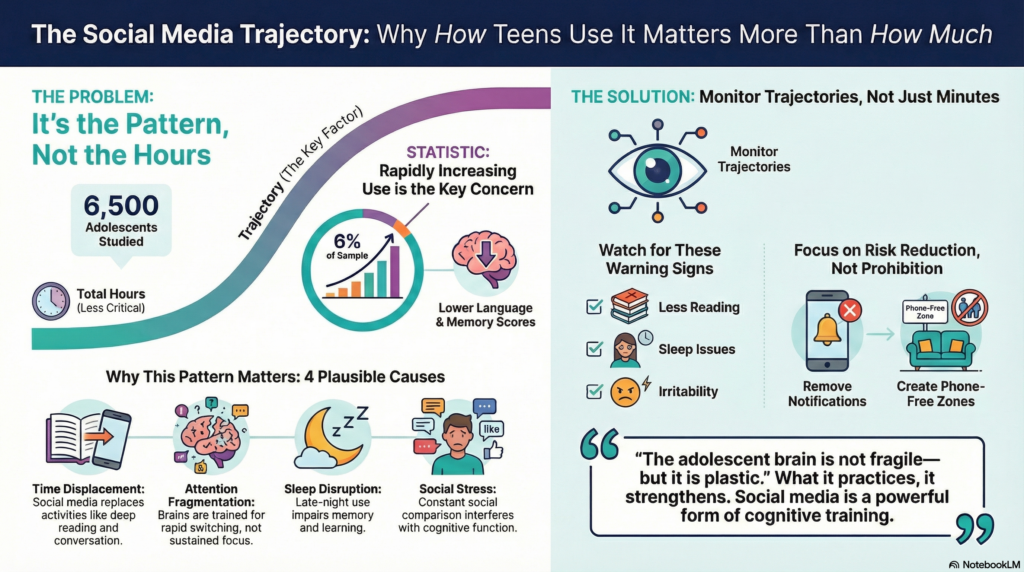
The 2025 JAMA study followed more than 6,500 children from around age 9–10 over two years and identified three distinct social media use trajectories:
-
A majority showed little to no use, remaining stable over time
-
A large group showed gradually increasing use
-
A small but important group showed rapidly increasing use
This last group—about 6% of the sample—became the focal point.
What did the study actually find?
At the two-year follow-up, cognitive performance was assessed using standardized tests that measure language, memory, and processing speed. Adolescents in the rapidly increasing use group scored modestly lower in:
-
Language skills (reading and vocabulary)
-
Sequential memory
The differences were small, not dramatic. No one is losing IQ points overnight. But small differences matter when they appear consistently and affect large populations.
Importantly, processing speed was not affected, suggesting this is not a global cognitive decline. Instead, the signal appears in areas closely tied to reading, memory consolidation, and sustained learning.
This nuance is critical. The study does not say social media “damages the brain.” It says that certain developmental patterns of use are associated with subtle differences in specific cognitive domains.
Why would rising social media use affect language and memory?
The study itself cannot answer this directly—it’s observational, not experimental. But several plausible mechanisms are worth considering.
First, there is time displacement. Language skills develop through reading, conversation, and deep engagement with text. If social media use grows rapidly, something else usually shrinks. Often, that “something” is reading time.
Second, there is attention fragmentation. Social platforms reward rapid switching, novelty, and constant feedback. That kind of attentional training may not translate well to tasks that require sustained focus, narrative comprehension, or memory sequencing.
Third, sleep plays a role. Escalating social media use frequently pushes into late evenings. Even mild, chronic sleep disruption affects memory and learning long before it affects mood.
Finally, there is stress and social comparison. For some adolescents, social media becomes a continuous social evaluation environment. Chronic stress, even at low levels, reliably interferes with learning and memory.
None of these explanations require social media to be inherently harmful. They reflect a mismatch between how platforms are designed and how adolescent brains develop.
Why this matters for policy, not just parenting
A companion JAMA editorial published the same week asks a provocative question: What kind of evidence are we waiting for before we act?
Public health decisions are rarely made on perfect evidence. Seat belts, tobacco warnings, and lead regulations were implemented when evidence was strong enough—not complete.
The problem with social media is not that effects are enormous; it’s that exposure is nearly universal, developmentally timed, and commercially optimized for attention capture rather than child wellbeing.
When small cognitive effects appear repeatedly across studies, even modest risks become meaningful at a population level.
This is why recent policy discussions have shifted away from asking whether social media is “good or bad,” and toward whether current digital environments meet reasonable standards of developmental safety.
What this means in real life
This study does not support bans or panic. It supports monitoring trajectories, especially in early adolescence.
For parents and clinicians, the most important signal is not absolute screen time, but rapid escalation, especially when accompanied by:
-
Reduced reading or academic engagement
-
Sleep disruption
-
Irritability or loss of control around phone use
Interventions don’t need to be extreme. Small design changes—removing notifications, keeping phones out of bedrooms, setting social media windows rather than all-day access—can meaningfully alter trajectories.
For schools and policymakers, the message is similar: focus on risk reduction, not prohibition. Transparency, age-appropriate design standards, and independent safety research matter more than slogans.
The bigger picture
The adolescent brain is not fragile—but it is plastic. What it practices, it strengthens. What it neglects, it gradually loses efficiency in.
Social media is best understood as a powerful, informal form of cognitive training—one that currently runs without developmental oversight.
The question is no longer whether adolescents should use social media. That ship has sailed.
The real question is whether we are willing to shape how they use it—before trajectories harden into habits.
References
-
Nagata JM, Wong JH, Kim KE, et al. Social media use trajectories and cognitive performance in adolescents. JAMA. 2025;334(21):1948-1950.
-
Madigan S, Yeates KO, Fearon P. Developmental costs of youth social media require policy action. JAMA. 2025;334(21):1891-1892.
-
Office of the Surgeon General. Social media and youth mental health: advisory. U.S. Department of Health and Human Services; 2023.
-
Chen Y, Yim H, Lee TH. Negative impact of daily screen use on inhibitory control networks in preadolescence: a 2-year follow-up study. Dev Cogn Neurosci. 2023;60:101218.
-
Boer M, Stevens GWJM, Finkenauer C, van den Eijnden RJJM. The course of problematic social media use in young adolescents. Child Dev. 2022;93(2):e168-e187.
Dr. Srinivas Rajkumar T, MD (AIIMS, New Delhi)
Consultant Psychiatrist
Apollo Clinic Velachery (Opp. Phoenix Mall)
✉ srinivasaiims@gmail.com 📞 +91-8595155808