Methylphenidate FAQ
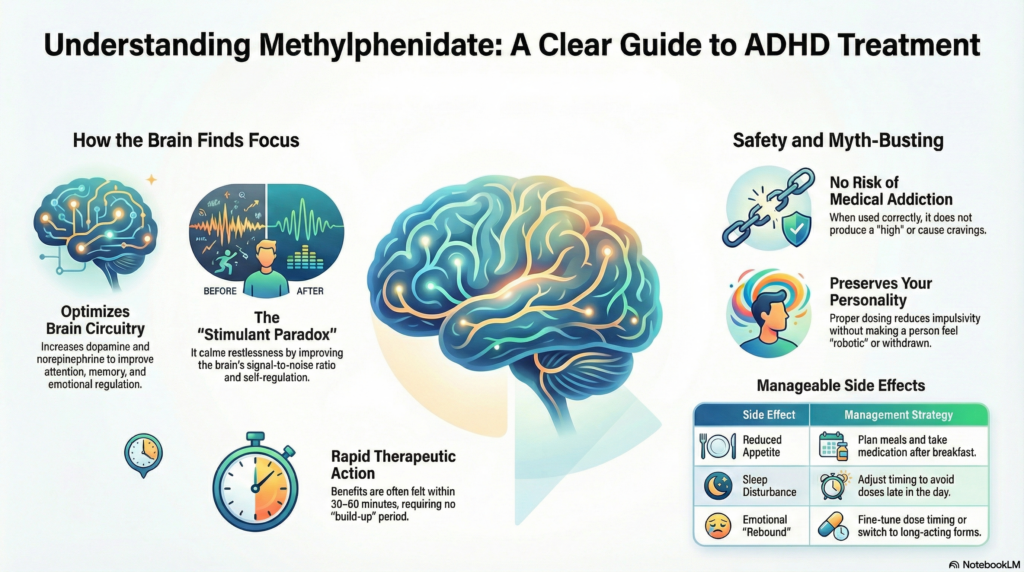 Methylphenidate has been used in clinical practice for over six decades and is one of the most studied medications in psychiatry and child–adolescent mental health. It is best known for its role in the treatment of Attention-Deficit/Hyperactivity Disorder (ADHD), but its use extends beyond stereotypes and misconceptions.
Despite its long history and strong evidence base, methylphenidate often causes anxiety—especially because it is labelled a “stimulant.” Many patients and parents worry: Is this addictive? Will it change personality? Is it safe long term? Why does a stimulant help someone who is already restless?
These are reasonable questions.
This article is written to explain methylphenidate clearly—what it does, how it works, how it is used thoughtfully, what is common, what is rare, and what is often misunderstood.
What does methylphenidate do?
Methylphenidate works by increasing the availability of dopamine and norepinephrine in specific brain circuits—particularly those involved in:
-
Attention
-
Working memory
-
Self-control
-
Task initiation
-
Emotional regulation
In ADHD, these circuits are often underactive, not overactive.
Paradoxically, this is why a stimulant helps:
-
It does not overstimulate the brain
-
It improves signal-to-noise ratio
-
It enhances focus, clarity, and self-regulation
Methylphenidate does not give intelligence, motivation, or discipline.
It creates the neurobiological conditions that make these possible.
Who is methylphenidate commonly prescribed for?
Methylphenidate is most commonly prescribed for:
-
ADHD in children, adolescents, and adults
It may also be used selectively in:
-
ADHD with emotional dysregulation
-
ADHD with learning difficulties
-
Adults with attentional impairment affecting work or academics
-
Certain off-label situations under specialist care
A proper diagnosis and assessment are essential before starting treatment.
What forms of methylphenidate are available?
Methylphenidate comes in immediate-release and long-acting (modified-release) forms.
Common formulations include:
-
Short-acting (lasts 3–4 hours)
-
Long-acting / extended-release (lasts 8–12 hours)
In India, commonly used brands include Inspiral, Inspiral SR, Addwize, Attentrol, and others.
The choice depends on:
-
Age
-
Daily schedule
-
School or work demands
-
Sensitivity to side effects
What is the usual dose range?
Dosing is individualised and usually started low.
Typical approach:
-
Start with a low dose
-
Increase gradually based on response and tolerability
-
Adjust timing rather than simply increasing dose
There is no single “correct” dose.
The right dose is the lowest dose that improves function without causing distressing side effects.
How quickly does methylphenidate work?
Unlike antidepressants, methylphenidate works quickly.
-
Effects are often noticeable within 30–60 minutes
-
Benefits last for the duration of the dose
-
It does not need weeks to build up
This immediate effect also allows careful, stepwise titration.
Should methylphenidate be taken with food?
It can be taken with or without food, but:
-
Taking it after breakfast often reduces stomach discomfort
-
Appetite suppression is less problematic when meals are planned
-
Consistency helps reduce side effects
Long-acting preparations are usually taken in the morning.
Does methylphenidate cause sleep problems?
It can, especially if:
-
Taken too late in the day
-
Dose is higher than needed
-
The formulation lasts longer than required
When used properly:
-
Sleep often improves, because daytime regulation improves
-
Evening rebound symptoms can be managed by dose timing
Sleep issues are usually manageable, not inevitable.
Does methylphenidate change personality or make someone “robotic”?
No.
When properly prescribed:
-
The person feels more themselves, not less
-
Emotional regulation improves
-
Impulsivity reduces
-
Relationships often improve
If someone appears flat, withdrawn, or unlike themselves:
-
The dose may be too high
-
Timing may be incorrect
-
Reassessment is needed
Personality change is not the goal and is not acceptable.
What are the common side effects?
Most side effects are dose-related and reversible.
Common:
-
Reduced appetite
-
Mild stomach discomfort
-
Headache
-
Increased heart rate awareness
-
Initial restlessness
Less common:
-
Irritability as medication wears off
-
Sleep disturbance
-
Anxiety in sensitive individuals
Most side effects improve with:
-
Dose adjustment
-
Timing changes
-
Switching formulation
Is methylphenidate addictive?
This is one of the most common fears.
When prescribed and monitored medically, methylphenidate does NOT cause addiction.
Key points:
-
It does not produce a “high” at therapeutic doses
-
It does not create cravings when used correctly
-
Risk of addiction is lower in treated ADHD than untreated ADHD
-
Misuse risk exists mainly with unsupervised or recreational use
Medical use ≠ substance abuse.
Will my child or I become dependent on it?
No.
Methylphenidate does not:
-
Cause physical dependence
-
Require escalating doses indefinitely
-
Trap someone into lifelong use
Many people:
-
Use it during specific life phases
-
Reduce or stop under guidance
-
Reassess needs periodically
Medication is a tool, not a life sentence.
What happens if I stop methylphenidate suddenly?
Stopping methylphenidate does not cause dangerous withdrawal.
Possible temporary effects:
-
Fatigue
-
Reduced concentration
-
Return of ADHD symptoms
These reflect the absence of medication—not harm.
Unlike antidepressants, tapering is usually not required, though clinical guidance is still recommended.
Does methylphenidate affect growth in children?
This is carefully monitored.
-
Mild appetite suppression can affect weight gain
-
Height effects are generally small and often temporary
-
Regular monitoring of growth is standard practice
-
Dose holidays or adjustments may be used if needed
The benefits of treating ADHD often outweigh these manageable risks.
Are there alternatives to methylphenidate?
Yes.
Alternatives may include:
-
Other stimulant medications
-
Non-stimulant ADHD medications
-
Behavioural therapy
-
Parent training
-
Academic accommodations
-
Combined approaches
Medication works best as part of a broader treatment plan.
Is methylphenidate safe long term?
When properly prescribed and monitored:
-
Yes, it is considered safe and effective
-
Long-term data supports its use
-
Regular follow-up ensures safety
Untreated ADHD itself carries risks:
-
Academic failure
-
Low self-esteem
-
Anxiety and depression
-
Substance misuse
-
Relationship difficulties
Treatment aims to reduce these risks, not add new ones.
Final thoughts
Methylphenidate is not about making someone “normal.”
It is about making life manageable.
When used thoughtfully:
-
Attention improves
-
Effort becomes more effective
-
Emotional regulation strengthens
-
Potential becomes accessible
Good ADHD treatment is not about medication alone.
It is about understanding the brain, respecting individuality, and supporting development.
About the author
Dr. Srinivas Rajkumar T, MD (AIIMS), DNB, MBA (BITS Pilani)
Consultant Psychiatrist & Neurofeedback Specialist
Mind & Memory Clinic – Apollo Clinic Velachery (Opp. Phoenix Mall)
I provide comprehensive ADHD assessment and treatment for children, adolescents, and adults—integrating medication, behavioural strategies, cognitive training, and neuropsychiatric insights.
✉ srinivasaiims@gmail.com
📞 +91-8595155808