How Society Shapes the Presentation of Body Dysmorphic Disorder
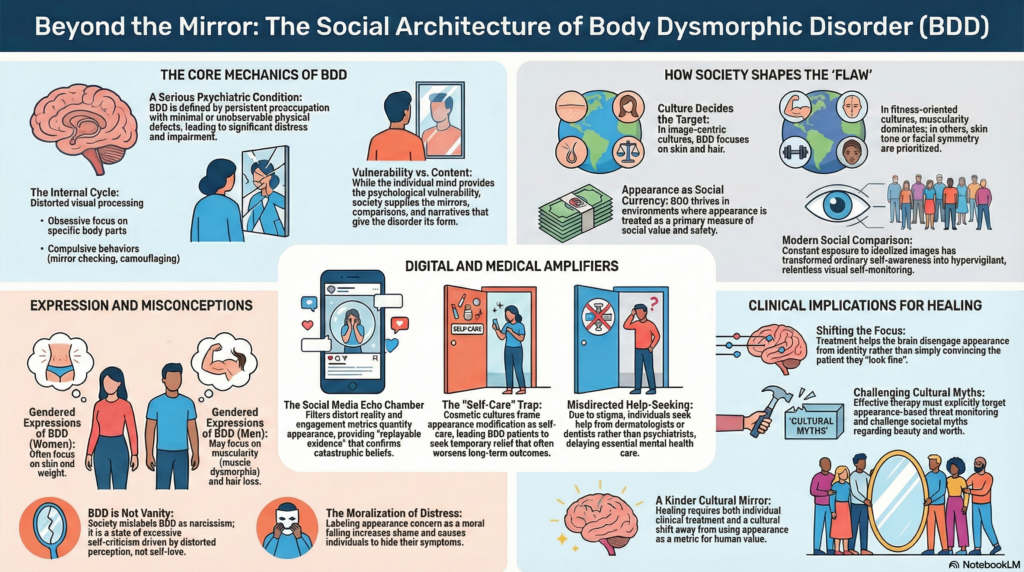 Body Dysmorphic Disorder (BDD) is often misunderstood as a problem of vanity or excessive concern about appearance. In reality, it is a serious psychiatric condition characterised by persistent preoccupation with perceived physical defects that are either minimal or not observable to others. While the core pathology of BDD lies in distorted perception, obsessive thinking, and compulsive behaviours, society plays a powerful role in shaping how the disorder presents, intensifies, and persists.
BDD does not develop in isolation. The individual mind provides the vulnerability, but society supplies the mirrors, comparisons, and narratives through which the disorder takes form.
Understanding Body Dysmorphic Disorder
At its core, BDD involves:
-
Distorted visual and emotional processing of one’s appearance
-
Obsessive focus on specific body parts
-
Compulsive behaviours such as mirror checking, reassurance seeking, camouflaging, or avoidance
-
Significant distress and impairment in social, occupational, or academic functioning
Society does not create these mechanisms—but it shapes their content, intensity, and meaning.
Cultural Ideals Decide What Becomes a “Flaw”
Every society carries implicit rules about beauty, normalcy, and desirability. These cultural ideals strongly influence which body parts become common targets of dysmorphic concern.
In image-centric societies, BDD often centres on skin texture, facial symmetry, weight, or hair. In fitness-oriented cultures, muscularity and body composition dominate. In societies where colourism or marriageability are emphasised, skin tone and facial features become central.
The disorder supplies the obsessive attention; culture decides where that attention is directed.
Social Comparison and the Rise of Self-Surveillance
Modern society has transformed ordinary self-awareness into constant visual self-monitoring. Continuous exposure to idealised images fosters relentless social comparison.
For vulnerable individuals, this leads to:
-
Hypervigilance to perceived flaws
-
Belief that others are constantly judging appearance
-
Heightened shame and avoidance
BDD thrives where appearance becomes a primary measure of social value.
Social Media as an Amplifier of Dysmorphic Thinking
Social media does not cause BDD, but it amplifies its severity and persistence. Filters distort reality, engagement metrics quantify appearance, and images become permanent, replayable evidence.
For individuals with BDD:
-
A single photograph can confirm catastrophic beliefs
-
Neutral feedback feels rejecting
-
Reassurance becomes fleeting and unreliable
The disorder feeds on ambiguity—and digital platforms provide it endlessly.
Beauty, Wellness, and Cosmetic Cultures
Contemporary culture increasingly frames appearance modification as self-care. While this may be adaptive for many, it creates a dangerous overlap for BDD.
-
Pathological concern appears socially sanctioned
-
Reassurance is sought through procedures
-
Temporary relief reinforces obsessive focus
Repeated cosmetic interventions often worsen long-term outcomes in BDD by validating the belief that the problem lies in the body rather than perception.
Stigma Shapes Help-Seeking Pathways
In societies where mental illness is stigmatised, BDD rarely presents directly to psychiatry. Instead, individuals seek help through dermatology, dentistry, or cosmetic services.
Shame, moral judgement, and misunderstanding delay psychiatric care, prolonging suffering. Thus, society influences not only symptoms, but routes to treatment.
Gender Norms Shape Expression, Not Prevalence
BDD affects all genders. Social expectations influence its expression:
-
Women often report concerns about skin, weight, or facial features
-
Men may focus on muscularity, body size, or hair loss
-
Gender-nonconforming individuals experience heightened scrutiny
The disorder adapts to socially permitted anxieties.
Moralisation Increases Shame and Concealment
Society often labels appearance preoccupation as vanity or narcissism. This moral framing deepens shame, leading individuals to hide symptoms and delay help-seeking.
BDD is not excess self-love.
It is excessive self-criticism driven by distorted perception.
Society Reinforces the Core Cognitive Error of BDD
At the heart of BDD lies a belief:
“My worth and safety depend on how I look.”
Modern society repeatedly reinforces this belief through advertising, media, and social hierarchies. For individuals with BDD, this validation makes recovery harder.
Clinical Implications
Understanding the societal influence on BDD reshapes treatment:
-
Cosmetic reassurance is avoided
-
Psychoeducation explicitly challenges cultural myths
-
Therapy targets appearance-based threat monitoring
-
Emphasis is placed on restoring functional self-worth
Treatment focuses not on convincing patients they “look fine”, but on helping the brain disengage appearance from identity and safety.
A Broader Perspective
Society does not cause Body Dysmorphic Disorder—but it decides how loudly it speaks.
BDD flourishes where appearance is currency, comparison is constant, and distress is moralised rather than medicalised. Healing requires not only individual treatment, but a quieter, kinder cultural mirror.
About the Author
Dr. Srinivas Rajkumar T, MD (AIIMS), DNB, MBA (BITS Pilani)
Consultant Psychiatrist & Neurofeedback Specialist
Dr. Srinivas Rajkumar T is a Chennai-based psychiatrist with extensive experience in obsessive–compulsive spectrum disorders, body image disturbances, anxiety disorders, and mood disorders. His clinical approach integrates evidence-based psychiatry, psychological insight, and careful psychoeducation, particularly for conditions shaped by social and cultural forces.
📍 Mind & Memory Clinic, Apollo Clinic Velachery (Opp. Phoenix Mall)
✉ srinivasaiims@gmail.com
📞 +91-8595155808