Healthcare in the Kovilambakkam–Sholinganallur Belt
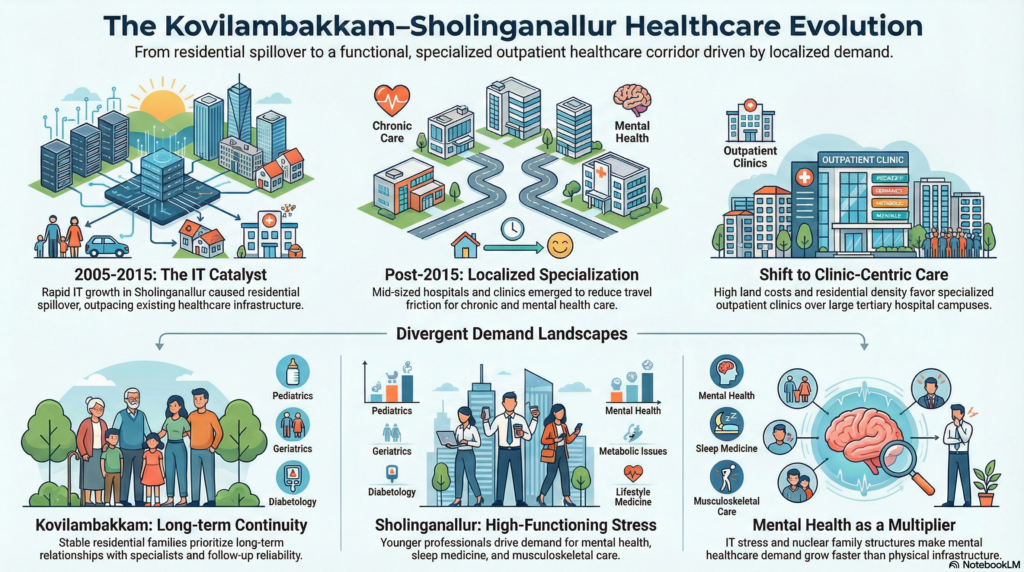 Healthcare in the Kovilambakkam–Sholinganallur Belt:
From Residential Spillover to a Functional Healthcare Corridor
Healthcare rarely announces its arrival. It appears quietly, following people rather than policy. The Kovilambakkam–Sholinganallur belt of South Chennai is a clear example of this phenomenon. What was once a transitional residential stretch between Velachery, Medavakkam, and the Old Mahabalipuram Road (OMR) has, over the last two decades, evolved into a functional healthcare corridor—not by grand hospital projects alone, but through cumulative outpatient demand.
To understand healthcare facilities in Kovilambakkam and Sholinganallur today, one must first understand how this corridor came to exist at all.
The Geography That Created Demand
Kovilambakkam occupies a strategic but often underestimated position:
-
It connects Velachery, Madipakkam, and Pallikaranai to Medavakkam.
-
It lies just west of the OMR corridor without being absorbed by it.
-
It functions as a residential buffer between older Chennai neighborhoods and newer IT-driven developments.
Sholinganallur, by contrast, sits at the economic hinge of OMR—where residential expansion meets large-scale employment concentration.
Together, these areas form a continuous belt of daily mobility, not an administrative boundary. Healthcare demand here is shaped less by pin codes and more by commuting patterns.
A Brief Historical Perspective
Pre-2005
-
Kovilambakkam and surrounding areas were low-density residential zones.
-
Healthcare access depended on Velachery, Adyar, or GST Road hospitals.
-
OMR was still emerging; Sholinganallur was peripheral.
2005–2015
-
Rapid IT corridor growth transformed Sholinganallur.
-
Apartment-led expansion began spilling westward into Kovilambakkam and Pallikaranai.
-
Population density increased faster than healthcare infrastructure.
Post-2015
-
Healthcare facilities began to localize.
-
Clinics, diagnostics, and mid-sized hospitals emerged to reduce travel friction.
-
Mental health, lifestyle medicine, and chronic disease management became visible demand drivers.
The corridor crossed a threshold: it no longer depended entirely on Velachery or Adyar for care.
Public Health Infrastructure as the Base Layer
Like most of Chennai, this belt rests on a public health foundation:
-
Urban Primary Health Centres (UPHCs)
-
Urban Health & Wellness Centres (UHWC)
These provide basic access and preventive care. Their presence stabilizes the system, but they do not absorb the growing demand for:
-
specialist consultations,
-
chronic disease continuity,
-
mental health services.
This creates a predictable market response: private outpatient specialization grows above a stable public base.
The Kovilambakkam Profile: Residential Demand Without Institutional Scale
Kovilambakkam’s healthcare demand has three defining features:
-
Stable, long-term residents
Families here are not transient. This favors continuity-based care rather than episodic hospital visits. -
Mid-distance travel tolerance
Patients are willing to travel 3–6 km for specialist care if access and follow-up are reliable. -
Under-saturation of large hospitals
Land use and economics discourage large hospital campuses, pushing growth toward:
-
clinics,
-
diagnostics,
-
day-care procedures.
Healthcare in Kovilambakkam is therefore clinic-centric, not hospital-centric.
Sholinganallur: Healthcare in an Employment-Dense Zone
Sholinganallur behaves differently.
Its population is:
-
younger,
-
professionally employed,
-
time-constrained,
-
digitally literate.
Healthcare demand here is shaped less by disease labels and more by functional impairment:
-
sleep disruption,
-
anxiety and burnout,
-
metabolic issues,
-
musculoskeletal strain.
This has two consequences:
-
Preference for appointment-based, low-wait-time clinics
-
High acceptance of telemedicine and hybrid follow-up models
Mental health services, sleep medicine, and lifestyle interventions occupy a central role, not a peripheral one.
The Emerging Healthcare Mix
Across the Kovilambakkam–Sholinganallur belt, healthcare facilities now cluster around:
-
Multispecialty outpatient clinics
-
Diagnostic centers (labs, imaging)
-
Diabetology and lifestyle medicine
-
Psychiatry and psychological services
-
Pediatrics and women’s health
-
Orthopedics and pain management
Large tertiary hospitals remain accessible but are no longer the default choice for first contact.
Mental Health as a Demand Multiplier
National data consistently shows:
-
High treatment gaps for mental illness
-
Low psychiatrist-to-population ratios
-
Rising disability burden from anxiety, depression, and substance use
In the Kovilambakkam–Sholinganallur corridor, these national trends are intensified by:
-
IT work stress
-
Nuclear family structures
-
Academic pressure among adolescents
-
Limited informal social support
As a result, mental healthcare demand here grows faster than physical infrastructure.
This explains the steady rise of psychiatry clinics, counseling centers, and integrative mental health practices along this belt.
How Patients Choose Care in This Corridor
Patient behavior in this belt follows a consistent pattern:
-
Accessibility matters more than strict proximity
-
Consultant continuity outweighs brand size
-
Predictable appointments trump walk-in availability
-
Parking and travel ease influence repeat visits
Patients ask not, “Which hospital is nearest?”
They ask, “Which place works with my life?”
The Direction Ahead
From a systems perspective, the Kovilambakkam–Sholinganallur healthcare corridor is moving toward:
-
More standalone specialty clinics
-
Integrated physical and mental health services
-
Telemedicine-supported follow-ups
-
Preventive and lifestyle-oriented care
-
Data-driven outpatient management
Growth here will favor precision and continuity, not sheer scale.
Conclusion
Healthcare in the Kovilambakkam–Sholinganallur belt did not emerge because it was planned. It emerged because people settled, worked, aged, and sought care closer to where life happens.
This corridor now represents a mature outpatient market—still evolving, still uneven, but structurally sound.
As Peter Drucker might have observed:
the purpose of a system is revealed not by its design, but by how people actually use it.
The healthcare system here is revealing its purpose every day.
Dr. Srinivas Rajkumar T, MD (AIIMS), DNB, MBA (BITS Pilani)
Consultant Psychiatrist & Neurofeedback Specialist
Mind & Memory Clinic, Apollo Clinic Velachery
✉ srinivasaiims@gmail.com 📞 +91-8595155808