Fluoxetine FAQ
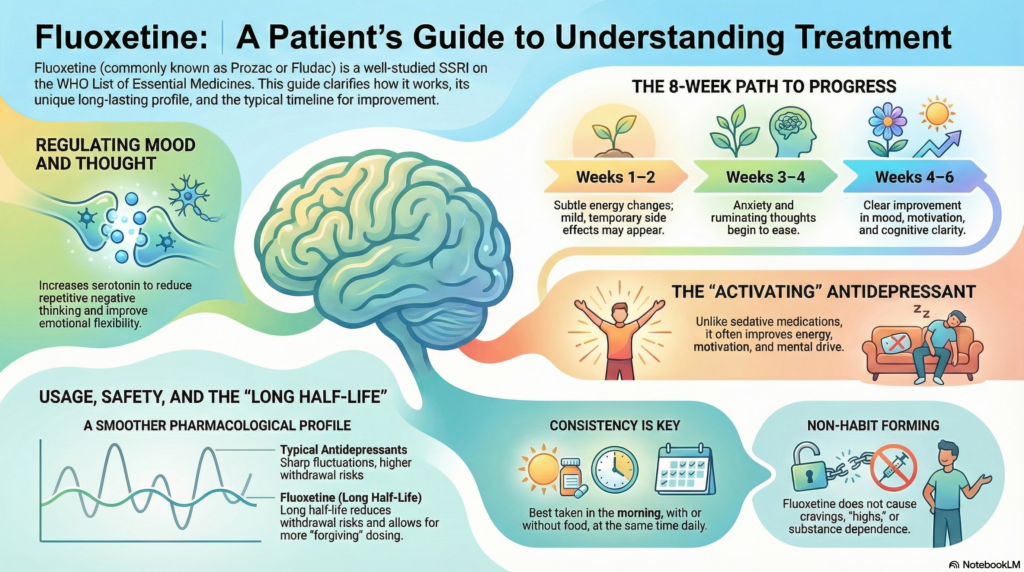 Fluoxetine was approved for medical use in the late 1980s and was one of the first SSRIs to transform the treatment of depression and anxiety worldwide. Its introduction marked a major shift away from older antidepressants that were often poorly tolerated. Over the decades, fluoxetine has been prescribed to millions of people globally, making it one of the most extensively studied psychiatric medications in history.
One of fluoxetine’s defining features is its long half-life—it stays in the body much longer than most other antidepressants. This gives it a smoother pharmacological profile, reduces the risk of abrupt withdrawal symptoms, and allows for more forgiving dosing in certain situations. Its effectiveness, safety profile, and public-health relevance are reflected in its inclusion on the World Health Organization’s List of Essential Medicines.
In India, fluoxetine has been used in routine psychiatric practice for many years and is available under familiar brand names such as Fludac, Prodep, Fluox, Prozac (original brand), and others. As with all antidepressants, while brand names may differ, the active medicine is the same, and outcomes depend far more on appropriate dosing, follow-up, and individual response than on the brand itself.
This long global and Indian experience allows clinicians to understand fluoxetine not just from clinical trials, but from real-world use across diverse populations.
Introduction
Being advised to start fluoxetine can bring mixed emotions.
Some people recognise the name immediately and feel reassured by its long history. Others feel uncertain, especially after reading that it can be “activating” or that it behaves differently from newer antidepressants. Questions arise naturally:
Will this make me anxious? Will it suit my sleep? Is it too strong? Why not a newer medicine?
These concerns are valid.
Fluoxetine is not a “one-size-fits-all” antidepressant—but when chosen thoughtfully, it can be a very effective option. Its long track record means we understand not only how it works, but also who it suits best, who may struggle with it, and how to use it safely.
This article is written to explain fluoxetine clearly and calmly—without exaggeration and without fear. The goal is not to push a medication, but to help you understand it well enough to participate confidently in treatment decisions.
Mental health care works best when uncertainty is replaced with understanding. When expectations are clear, treatment becomes easier to tolerate and more effective.
What does fluoxetine do?
Fluoxetine belongs to a group of medicines called SSRIs (Selective Serotonin Reuptake Inhibitors).
In simple terms, it:
-
Increases the availability of serotonin, a chemical involved in mood, anxiety regulation, and emotional balance
-
Reduces repetitive negative thinking and rumination
-
Improves emotional and cognitive flexibility over time
Compared to some other SSRIs, fluoxetine is generally considered more activating. This means it tends to improve energy, motivation, and mental drive rather than cause sedation.
Fluoxetine is commonly prescribed for:
-
Depression (especially with low energy or apathy)
-
Obsessive–compulsive disorder (often at higher doses)
-
Panic disorder
-
Bulimia nervosa
-
Premenstrual dysphoric disorder (PMDD)
-
Depression with hypersomnia or fatigue
What is the usual dose range of fluoxetine?
Doses are individualised based on symptoms, sensitivity, and diagnosis.
Typical ranges:
-
Starting dose: 10–20 mg once daily
-
Common effective dose: 20–40 mg once daily
-
Higher doses: up to 60 mg (mainly in OCD and selected cases)
Because fluoxetine accumulates slowly in the body, dose increases are made gradually, with adequate time to assess response.
Should fluoxetine be taken with food or after food?
Fluoxetine can be taken with or without food.
However:
-
If nausea occurs, taking it after food helps
-
Food does not reduce effectiveness
-
Taking it at the same time each day improves consistency
Most people are advised to take fluoxetine in the morning.
Does fluoxetine make you drowsy or sleepy?
Usually, no.
Fluoxetine is more likely to:
-
Increase alertness
-
Improve energy
-
Reduce excessive sleepiness
Some people may experience:
-
Mild restlessness
-
Difficulty falling asleep, especially early in treatment
If sleep disturbance occurs:
-
Morning dosing helps
-
Dose adjustment or slower titration may be needed
For individuals with severe anxiety or insomnia, fluoxetine may require careful selection or may not be the first choice.
How long does fluoxetine take to work?
Fluoxetine works gradually.
-
Week 1–2: Mild side effects or subtle energy changes may appear
-
Week 3–4: Anxiety, rumination, and mood symptoms begin to ease
-
Week 4–6: Clear improvement in mood, motivation, and thinking
-
Week 6–8: Full therapeutic benefit usually becomes evident
Because of its long half-life, fluoxetine builds up slowly but steadily.
Does fluoxetine make you emotionally numb?
Most people do not experience emotional numbness.
Common experiences include:
-
Clearer thinking
-
Less emotional overload
-
Improved engagement with daily life
In a small minority, particularly at higher doses:
-
Emotional blunting may occur
Important points:
-
This effect is dose-related
-
It is reversible
-
Dose reduction or switching medication usually resolves it
The goal is emotional balance—not emotional flattening.
What are the common side effects?
Most side effects are mild and temporary, especially in the first few weeks.
Common:
-
Nausea
-
Reduced appetite
-
Headache
-
Mild anxiety or restlessness initially
-
Sleep disturbance
Less common:
-
Tremor
-
Sweating
-
Sexual side effects
Early side effects often settle as the brain adapts.
Does fluoxetine cause dependence or addiction?
No.
Fluoxetine does not:
-
Cause cravings
-
Produce a “high”
-
Lead to substance dependence
-
Require escalating doses to feel normal
It is not habit-forming.
Will I have withdrawal symptoms if I stop fluoxetine?
Fluoxetine is least likely among SSRIs to cause withdrawal symptoms.
This is because:
-
It has a long half-life
-
It leaves the body gradually on its own
Most people tolerate stopping fluoxetine better than other SSRIs, though planned tapering is still recommended.
What is the risk of PSSD (Post-SSRI Sexual Dysfunction)?
PSSD refers to persistent sexual symptoms after stopping SSRIs.
Key points:
-
PSSD appears to be rare
-
Sexual side effects during treatment are more common than persistent symptoms
-
Most patients recover fully
-
Risk may be higher with long-term high-dose use, but remains uncommon
Sexual function is influenced by many factors, including:
-
Depression and anxiety themselves
-
Stress and fatigue
-
Sleep quality
-
Hormonal and relationship factors
Early discussion allows timely management.
Are there alternatives to fluoxetine?
Yes. Fluoxetine is one option among many.
Alternatives may include:
-
Other SSRIs
-
SNRIs
-
Atypical antidepressants
-
Psychological therapies
-
Combined approaches
Fluoxetine is particularly useful where low energy, rumination, or compulsive symptoms are prominent.
Is fluoxetine safe during pregnancy or breastfeeding?
This requires an individualised risk–benefit discussion.
-
Fluoxetine has one of the largest safety datasets among antidepressants
-
It is commonly used when clinically necessary
-
Untreated depression or anxiety also carries risks
Never stop medication suddenly during pregnancy without medical advice.
How long will I need to take fluoxetine?
This varies:
-
First episode: usually 6–12 months after recovery
-
Recurrent depression or OCD: sometimes longer
Stopping medication is always a planned, gradual decision.
Final thoughts
Fluoxetine is not an outdated medicine.
It is a well-studied, reliable option when chosen for the right person.
Good psychiatric care is not about using the newest drug.
It is about using the right drug, at the right dose, for the right duration.
Clarity reduces fear—and fear reduction itself supports recovery.
About the author
Dr. Srinivas Rajkumar T, MD (AIIMS), DNB, MBA (BITS Pilani)
Consultant Psychiatrist & Neurofeedback Specialist
Mind & Memory Clinic – Apollo Clinic Velachery (Opp. Phoenix Mall)
I provide evidence-based psychiatric care integrating medication, psychotherapy, sleep science, and modern neuropsychiatry—tailored to each individual.
✉ srinivasaiims@gmail.com
📞 +91-8595155808