Muse S Athena: Your Handheld Neuroscience Companion
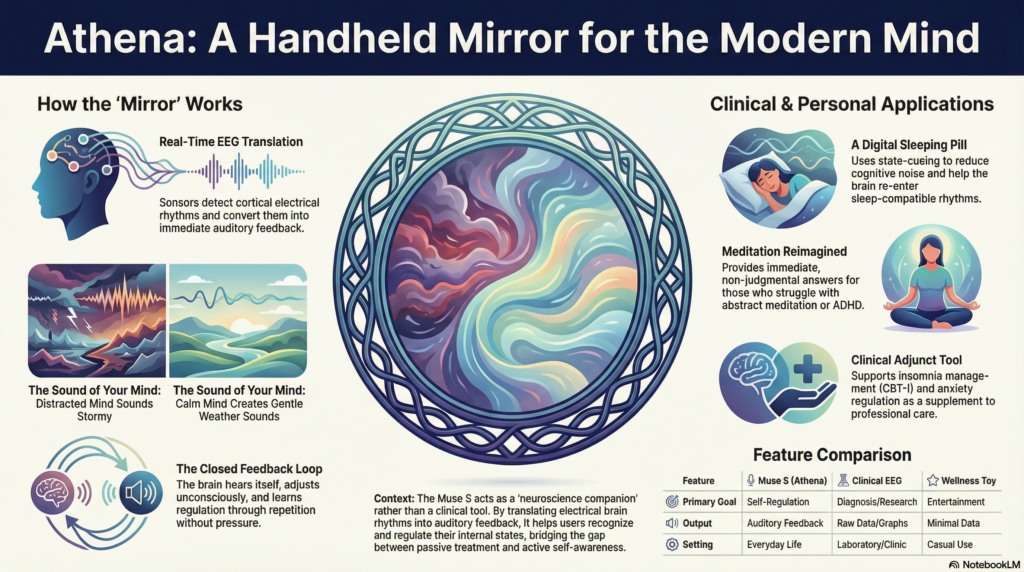 Modern neuroscience has quietly crossed a threshold.
What once required laboratories, technicians, and dense academic language can now sit lightly on the forehead, connect to a smartphone, and translate invisible brain states into experiences we can feel, hear, and act upon.
The Muse S (Athena) represents this shift. Not as a gadget, and certainly not as a miracle cure—but as something more interesting:
a handheld neuroscience companion that brings brain awareness into everyday life.
To understand its significance, we must first understand what it is not.
Not a Toy. Not a Medical Device. Something In Between.
Muse S is not an EEG machine in the clinical sense.
It does not diagnose illness, replace sleep studies, or substitute psychotherapy or medication.
Yet it is also far more than a wellness trinket.
Muse S is a consumer-grade EEG (electroencephalography) device that measures electrical activity from the scalp and converts those signals into real-time neurofeedback. Its power lies not in raw data, but in translation—turning brain signals into experiences that train awareness and regulation.
Think of it less as a scanner and more as a mirror:
not showing the brain’s structure, but reflecting its state.
Why “Athena”? A Useful Metaphor
Athena, in Greek mythology, is not the goddess of emotion or impulse.
She is the goddess of wisdom, strategy, balance, and intelligent restraint.
That symbolism fits Muse S surprisingly well.
This device does not push stimulation.
It does not flood the user with dopamine or excitement.
Instead, it cultivates discernment—helping users notice when the mind is settled, restless, or drifting, and gently guiding it back.
Athena does not shout.
She nudges.
How Muse S Actually Works (Without the Jargon)
Muse S uses sensors placed across the forehead and behind the ears to detect electrical rhythms generated by cortical neurons. These rhythms are grouped into frequency bands—commonly known as delta, theta, alpha, beta, and gamma.
Instead of showing graphs and numbers, Muse converts these signals into auditory feedback:
-
A calm mind sounds like gentle weather
-
A distracted mind sounds stormy
-
As attention stabilizes, the soundscape softens
This creates a closed feedback loop:
the brain hears itself, adjusts unconsciously, and learns regulation through repetition.
No instructions to “relax harder.”
No performance pressure.
Just learning by sensing.
Sleep: Where Muse S Quietly Excels
The “S” in Muse S stands for Sleep, and this is where the device distinguishes itself.
Sleep problems today are rarely just about sleep. They are about:
-
Hyperarousal
-
Cognitive rumination
-
Conditioned insomnia
-
Circadian drift
-
Learned anxiety around bedtime
Muse S addresses this by offering what can be thought of as a digital sleeping pill—not sedating, not pharmacological, but state-dependent.
Using EEG signals, Muse delivers guided auditory experiences that:
-
Help reduce sleep latency
-
Assist in falling back asleep after awakenings
-
Encourage parasympathetic dominance
-
Reduce pre-sleep cognitive noise
Importantly, this is not hypnosis or distraction.
It is state cueing—teaching the brain to recognize and re-enter sleep-compatible rhythms.
Meditation, Reimagined for Modern Minds
Traditional meditation instructions assume patience, introspection, and a tolerance for ambiguity—traits increasingly scarce in a hyperstimulated world.
Muse S meets modern cognition where it is.
Instead of asking, “Am I doing this right?”
The device answers directly.
This is especially valuable for:
-
Beginners who struggle with abstract meditation
-
Individuals with ADHD traits
-
High-functioning professionals with cognitive overdrive
-
Patients who intellectualize but struggle to feel regulation
The feedback is immediate, non-judgmental, and experiential. Over time, users internalize the sensation of a regulated state—and eventually need the device less.
A good mentor works toward redundancy.
Clinical Relevance: Where This Fits (and Where It Doesn’t)
From a clinician’s perspective, Muse S is best understood as an adjunct.
It may support:
-
Insomnia management alongside CBT-I
-
Anxiety regulation practices
-
Stress reduction and burnout prevention
-
Attention training
-
Neurofeedback-informed self-regulation
It does not replace:
-
Psychiatric assessment
-
Medication when indicated
-
Formal neurofeedback protocols
-
Psychotherapy for deep personality or trauma work
Its strength is accessibility.
Its limitation is depth.
And that’s acceptable—because not every tool needs to do everything.
The Deeper Idea: Democratizing Brain Awareness
For decades, patients were told their symptoms were “chemical imbalances” or “stress,” without any way to see or feel what that meant.
Devices like Muse S mark a philosophical shift:
From explanation → to experience
From instruction → to interaction
From passive treatment → to participatory regulation
This matters.
When people learn to recognize internal states early—before distress escalates—they intervene sooner, softer, and more skillfully.
That is not treatment.
That is prevention through insight.
Final Thoughts: A Companion, Not a Crutch
Muse S Athena works best when approached with the right mindset.
Not as a shortcut.
Not as a cure.
Not as a replacement for human care.
But as a companion—a quiet guide that helps users relearn something evolution once made effortless: how to settle, attend, and rest.
Wisdom, after all, is not about control.
It is about alignment.
And sometimes, a small band on the forehead can help us listen again.
About the Author
Dr. Srinivas Rajkumar T, MD (AIIMS), DNB, MBA (BITS Pilani)
Consultant Psychiatrist & Neurofeedback Specialist
Mind & Memory Clinic, Apollo Clinic Velachery (Opp. Phoenix Mall)
📞 +91-8595155808