NICE UK and Digital Technologies for ADHD Diagnosis
When the National Institute for Health and Care Excellence (NICE) released its 2024 HealthTech guidance on digital technologies for ADHD diagnosis, it quietly reshaped an important conversation in psychiatry.
Not with hype.
Not with grand claims about AI replacing doctors.
But with something rarer and more useful: clarity.
This document adds more clarity to how we think, decide, and care in ADHD.
ADHD Diagnosis Has Never Been Just About Symptoms
Anyone who has assessed ADHD knows this truth instinctively.
ADHD is not diagnosed by ticking boxes. It emerges over time—through history, context, contradictions, masking, and missed details. Parents disagree. Teachers give mixed reports. Adults minimise, intellectualise, or overcompensate. Comorbidities blur the picture.
NICE starts here, unapologetically:
ADHD diagnosis is a clinical judgment, made by trained professionals, using multiple sources of information.
No test—digital or otherwise—replaces that.
This is not a step backward. It is the foundation that makes everything else sensible.
Then Why Look at Digital Technologies at All?
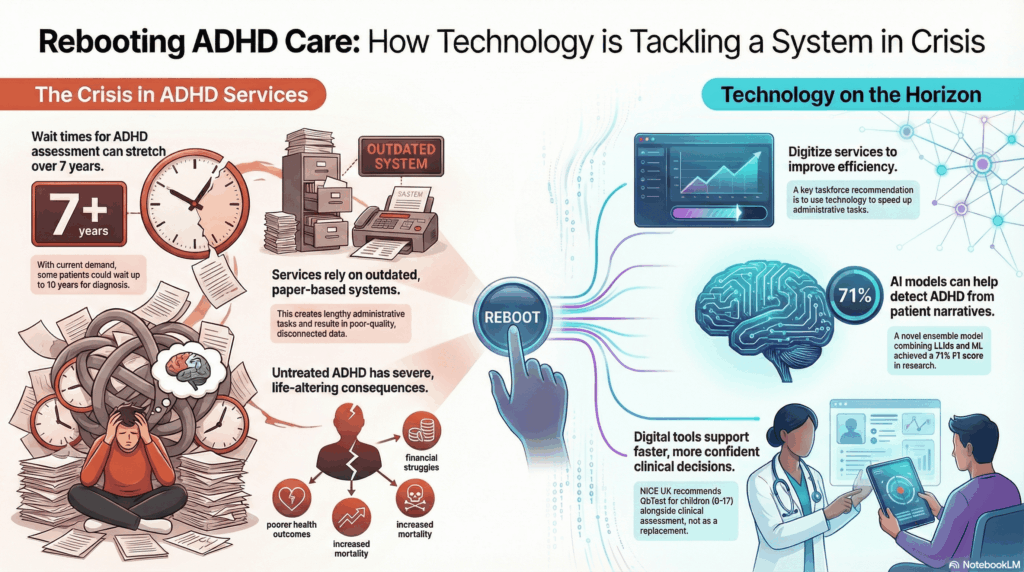
Because the real crisis in ADHD care is not diagnostic theory.
It is time.
Across health systems:
-
Waiting lists stretch into years
-
Families attend multiple appointments without closure
-
Clinicians work with incomplete or conflicting information
-
Subtle presentations (especially in girls and adults) are missed
-
Uncertainty causes distress, frustration, and sometimes despair
NICE was not asking, “Can technology diagnose ADHD?”
It was asking something far more pragmatic:
Can objective data help clinicians reach decisions sooner and with more confidence?
That question changes the entire frame.
What NICE Means by “Effectiveness” (This Is the Key Insight)
Here’s where many readers misunderstand the guidance.
NICE does not define effectiveness as “biological accuracy alone.”
Instead, it cares about:
-
How long it takes to reach a decision
-
How many appointments are needed
-
Whether clinicians feel more confident
-
Whether families understand and accept the outcome
-
Whether services run more efficiently
In other words, NICE evaluates digital tools as decision-support tools, not diagnostic oracles.
This is deeply aligned with real clinical work.
Why QbTest Was Recommended — and Why That Matters
NICE recommends QbTest, but with very clear boundaries:
-
Only for children and adolescents aged 6–17
-
Only alongside standard clinical assessment
Why QbTest?
Because it is the only technology with high-quality trial evidence showing that:
-
Diagnostic decisions were reached faster
-
Fewer clinic visits were needed
-
Clinician confidence improved
-
Costs were justified at a system level
What NICE does not say is just as important:
-
QbTest does not diagnose ADHD
-
It does not replace interviews or judgment
-
It does not provide definitive biological truth
Its value lies in supporting the clinical process, not overriding it.
A Very Clear Line: No Standalone Use
NICE draws a firm boundary here—and rightly so.
Digital technologies should never be used:
-
As screening-only tools
-
As gatekeepers to care
-
As substitutes for specialist assessment
ADHD diagnosis and medication decisions must remain in the hands of trained clinicians.
This protects patients, families, and the integrity of psychiatric practice itself.
What About Webcam-Based and Remote Technologies?
This is where the guidance becomes quietly exciting.
NICE reviews webcam-based and remote attention/motion tracking tools and says, in essence:
“These look promising. But we don’t yet have enough evidence.”
Importantly:
-
They are not rejected
-
They are not dismissed
-
They are placed in the research domain
The problem is not the technology.
The problem is the lack of studies showing how these tools actually help clinicians make better decisions.
This is not a dead end. It is an open door.
Adult ADHD: The Biggest Gap of All
One of the strongest—and most overlooked—statements in the guidance is this:
Evidence from children cannot be applied to adults.
Adults with ADHD:
-
Have more comorbidities
-
Have fewer observer reports
-
Mask symptoms more effectively
-
Present with complex differentials
Because of this, NICE does not currently recommend any digital technology for adult ADHD diagnosis.
But here’s the nuance:
The committee explicitly acknowledges the potential benefit of objective tools in adults and calls for further research.
This is where the future clearly lies.
Complex ADHD: Where Objectivity Helps Most
NICE also recognises something every experienced clinician knows:
ADHD is hardest to diagnose when it is not pure.
Autism. Trauma. Anxiety. Depression. Learning disorders. Conflicting histories. Cultural masking.
In these cases, objective behavioural data can be immensely helpful—not to decide for the clinician, but to support judgment where uncertainty is highest.
Again, evidence is limited. But the logic is sound.
The Deeper Philosophy Behind the Guidance
Taken as a whole, this NICE document is not conservative—it is mature.
Its message is simple and powerful:
-
ADHD diagnosis is human-led
-
Technology should reduce uncertainty, not replace thinking
-
Speed, clarity, and compassion matter
-
Objectivity is useful when it serves understanding
This is not psychiatry resisting technology.
This is psychiatry integrating it responsibly.
What This Means Going Forward
NICE has effectively laid out a roadmap:
-
Where evidence is strong (children, QbTest, decision support)
-
Where evidence is weak (adults, complex cases, treatment monitoring)
-
Where innovation is needed (scalable, clinician-integrated tools)
The future of ADHD assessment is not about machines versus clinicians.
It is about clinicians supported by meaningful, interpretable data.
About the Author
Dr. Srinivas Rajkumar T, MD (AIIMS), DNB, MBA (BITS Pilani)
Consultant Psychiatrist & Neurofeedback Specialist
Mind & Memory Clinic – Apollo Clinic Velachery (Opp. Phoenix Mall), Chennai
Dr. Srinivas works extensively with children, adolescents, and adults with ADHD, integrating traditional psychiatric assessment with objective attention profiling, including eye and motion tracking, QEEG, and neurofeedback-based interventions. His clinical approach focuses on precision psychiatry—using technology to support judgment, not replace it.
📞 +91-8595155808
✉ srinivasaiims@gmail.com