Can a Child’s Brain Predict Future ADHD or Depression?
 What neuroscience tells us about the developing brain, attention, emotions, and the future of mental health.
Why do some children struggle with attention during childhood but improve as they grow older?
Why do others appear emotionally healthy at seven or eight years of age but develop anxiety or depression during adolescence?
For decades, psychiatrists have tried to understand these differences by studying childhood behaviour, family history, school performance, and life experiences.
Now, neuroscience is exploring another possibility.
Could the way a child’s brain is connected tell us something about their future mental health?
A fascinating study published in JAMA Psychiatry in 2020, discussed by neuroscientist Dylan Gee in Science Translational Medicine, suggests that it might.
But the findings come with an important warning: the brain may contain clues about future mental health, but it cannot reliably predict an individual child’s psychiatric future.
The Developing Brain Is a Work in Progress
A child’s brain is not simply a smaller version of an adult brain.
It is constantly changing.
During childhood and adolescence, billions of connections between nerve cells are strengthened, reorganised, or eliminated. Some brain regions mature relatively early, while others continue developing well into adulthood.
The prefrontal cortex, which helps us plan, concentrate, control impulses, and regulate emotions, is among the regions that mature relatively late.
This helps explain why children may struggle with patience, emotional control, or sustained attention even when they understand what is expected of them.
However, children do not develop at identical speeds.
One child may become better at concentrating by age ten. Another may continue struggling with attention into adulthood.
Similarly, some children develop emotional difficulties during adolescence despite showing few problems earlier.
Understanding why these developmental paths differ is an important goal of modern psychiatry.
The Brain Works Through Networks
We often hear that one part of the brain controls memory, another controls attention, and another controls emotions.
In reality, brain functions are rarely confined to a single region.
Different parts of the brain must communicate and coordinate with one another.
Think of the brain as a large organisation.
Some departments handle routine activities. Others manage planning and decision-making. Still others monitor important events and emotional signals.
For the organisation to function efficiently, these departments must communicate when necessary and work independently when appropriate.
The brain operates in a somewhat similar way.
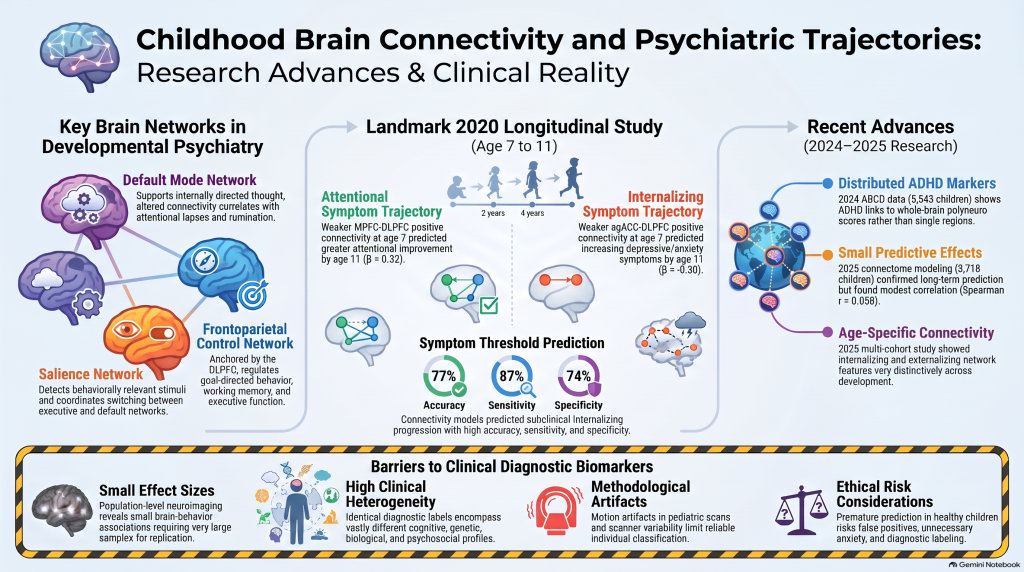
Three networks are particularly interesting when studying ADHD and depression.
1. The Default Mode Network: The Mind’s Internal World
This network is involved when we think about ourselves, remember past experiences, imagine the future, or allow our thoughts to wander.
For example, a student sitting in a classroom may suddenly start thinking about an upcoming cricket match instead of listening to the teacher.
Mind-wandering is normal and can even be useful for creativity.
However, difficulty coordinating internally directed thinking with task-focused attention may contribute to concentration problems.
2. The Executive Control Network: The Brain’s Manager
This network helps us:
- Maintain attention.
- Plan and organise activities.
- Remember instructions.
- Control impulses.
- Adjust behaviour when situations change.
It involves areas such as the dorsolateral prefrontal cortex (DLPFC).
Differences in executive control are relevant to ADHD, although ADHD involves many other brain systems as well.
3. The Salience Network: Deciding What Matters
This network helps the brain recognise important information and direct attention toward it.
For instance, you may be deeply involved in reading a book but immediately notice someone calling your name.
Efficient attention and emotional regulation depend partly on how these and other networks work together.
What Did the 2020 Study Discover?
Researchers led by Susan Whitfield-Gabrieli studied the brain connectivity of 94 children at approximately seven years of age.
They used a technique called resting-state functional MRI.
Unlike ordinary MRI, which mainly shows brain structures, functional MRI examines patterns of brain activity. Researchers can study whether activity in different brain regions fluctuates together.
Four years later, when the children were approximately eleven, follow-up information was available for 54 of them.
The researchers wanted to know whether brain connectivity at age seven was associated with changes in attention and emotional symptoms over the following years.
They identified two particularly interesting patterns.
Finding 1: Brain Connectivity Was Associated With Future Attention Problems
Children with relatively weaker positive connectivity between certain medial prefrontal and executive control regions at age seven tended to show greater improvement in attentional symptoms by age eleven.
Why might this happen?
One possible explanation involves the developing brain learning to separate different types of activity more efficiently.
When a child is studying, networks involved in focused attention need to operate without excessive interference from unrelated internal thoughts.
As the brain matures, some networks become more clearly differentiated.
The findings suggest that the way these systems are organised during childhood may be associated with how attention develops over time.
However, the researchers were studying changes in attention-related symptoms, not predicting whether individual children would eventually receive or lose an ADHD diagnosis.
Finding 2: Another Brain Connection Was Associated With Emotional Difficulties
The researchers also examined connectivity between the DLPFC and the subgenual anterior cingulate cortex (sgACC).
The sgACC is involved in brain circuits associated with mood and emotional processing.
They found that certain connectivity patterns at age seven were associated with increasing anxiety and depressive symptoms by age eleven.
This was particularly interesting because the brain differences were observed several years before the later symptoms were measured.
In other words, some aspects of emotional vulnerability may be reflected in brain organisation before they become clinically obvious.
But these findings concerned internalising symptoms, such as sadness, anxiety, and withdrawal. They did not establish that a brain scan could predict major depressive disorder.
Can We Really Predict Depression Four Years in Advance?
One analysis in the study reported approximately 77% accuracy in identifying children who later crossed a particular threshold for emotional symptoms.
At first glance, this sounds impressive.
Imagine being able to identify vulnerable children years before they develop significant emotional difficulties.
Parents, teachers, and doctors could potentially intervene earlier.
However, there are important limitations.
The number of children followed was relatively small. The outcome was a symptom threshold rather than a confirmed diagnosis of depression. The prediction model was not established as a reliable clinical screening test.
Furthermore, an accuracy figure from one research sample does not guarantee similar performance in another population.
A model that works reasonably well in a small study may perform much less effectively in everyday clinical practice.
Therefore, 77% research accuracy does not mean that a brain scan can predict an individual child’s depression with 77% certainty.
This distinction is essential.
What Have Larger Studies Found Since Then?
Research has continued, with scientists increasingly studying thousands rather than dozens of children.
A 2024 study involving more than 5,500 participants from the Adolescent Brain Cognitive Development (ABCD) Study examined connectivity patterns associated with ADHD symptoms.
It suggested that ADHD-related differences are distributed across multiple brain networks rather than being confined to one specific region.
Similarly, a 2025 study involving more than 3,700 children examined whether functional brain connectivity could predict future anxiety and depression symptoms.
The researchers found measurable relationships, but the predictive effects were generally small.
These larger studies support an important conclusion.
Brain networks contain information related to future mental health, but that information is not yet strong enough to support reliable individual predictions.
What Does This Mean for Children With ADHD?
ADHD is a neurodevelopmental condition, meaning that differences in brain development contribute to its symptoms.
However, ADHD does not have one universal brain pattern.
Two children with ADHD can have very different difficulties.
One child may be predominantly inattentive. Another may struggle with impulsivity and hyperactivity. A third may have significant problems with emotional regulation.
Their symptoms may also change as they grow older.
Some children improve substantially during adolescence. Others continue experiencing difficulties with organisation, motivation, attention, and emotional control into adulthood.
The emerging science of brain connectivity may eventually help explain why these developmental differences occur.
It may also help researchers understand why ADHD frequently coexists with anxiety and depression.
Nevertheless, ADHD remains a clinical diagnosis based on developmental history, symptoms, impairment, and assessment across relevant settings.
Could EEG or qEEG Provide Similar Information?
MRI is expensive and is not always practical for routine psychiatric assessment.
This has encouraged interest in more accessible techniques such as EEG, quantitative EEG (qEEG), and computerised attention testing.
These techniques can provide additional information about aspects of brain functioning.
For example, qEEG can examine patterns of electrical activity, while continuous performance tests can measure certain features of attention and response control.
However, these measurements are fundamentally different from functional MRI connectivity.
Research findings from MRI cannot automatically be applied to EEG or qEEG.
Importantly, no single EEG or qEEG finding can independently diagnose ADHD, exclude depression, or reliably predict a child’s future psychiatric illness.
These tests may contribute useful information in appropriate circumstances, but they do not replace careful clinical assessment.
Can Early Intervention Change a Child’s Future?
Perhaps the most encouraging message from this research is that the developing brain is adaptable.
A child’s future is not permanently determined by their brain connectivity at seven years of age.
Genetics and neurodevelopment matter, but so do sleep, family relationships, education, emotional experiences, physical health, and access to appropriate care.
Children with attention difficulties may benefit from behavioural interventions, educational support, parent training, and medication when indicated.
Children developing anxiety or depressive symptoms may benefit from early psychological support and timely treatment.
These approaches can improve functioning and quality of life.
We cannot yet say that they prevent later psychiatric illness by changing the specific brain connections identified in this study.
Nevertheless, early identification of meaningful difficulties and appropriate intervention remain important.
The Future of Psychiatry: From Diagnosis to Prediction?
Traditionally, psychiatry has focused on identifying the condition a person currently has.
Does this child have ADHD?
Does this adolescent have depression?
Does this adult have an anxiety disorder?
Future psychiatry may increasingly ask an additional question:
How is this individual’s mental health likely to change over the next five or ten years?
Perhaps future assessment will combine developmental history, clinical interviews, psychological testing, brain measurements, genetic information, and environmental factors.
Artificial intelligence may help identify patterns across these different sources of information.
Such approaches could eventually improve our understanding of who is likely to experience persistent symptoms, who may improve, and who might benefit most from particular interventions.
However, these possibilities still require substantial research and careful validation.
The goal should not be to label healthy children as future psychiatric patients.
It should be to understand vulnerability, recognise resilience, and provide support when it is genuinely needed.
Final Thoughts
The 2020 research offers a fascinating glimpse into the relationship between childhood brain development and future psychiatric symptoms.
It suggests that the organisation of brain networks during early childhood may be associated with later changes in attention and emotional well-being.
But it also reminds us that psychiatric disorders cannot be reduced to one abnormal brain region or a single measurable connection.
Mental health emerges from complex interactions between biology, development, and life experiences.
The most important lesson is simple:
A child’s brain may offer clues about future mental health, but it does not determine the child’s destiny.
The real promise of developmental neuroscience is not predicting who will become mentally ill.
It is understanding how mental health develops, why some children become vulnerable, why others remain resilient, and how we can improve their developmental journey.
Selected References
- Gee DG. Neurodevelopment and risk for ADHD and depression. Science Translational Medicine. 2020;12(527). DOI: 10.1126/scitranslmed.aba2913.
- Whitfield-Gabrieli S, et al. Association of Intrinsic Brain Architecture With Changes in Attentional and Mood Symptoms During Development. JAMA Psychiatry. 2020;77(4):378–386.
- Cumulative Effects of Resting-State Connectivity Across All Brain Networks Significantly Correlate with Attention-Deficit Hyperactivity Disorder Symptoms. Journal of Neuroscience. 2024.
- Brain Functional Connectivity Predicts Depression and Anxiety During Childhood and Adolescence. Imaging Neuroscience. 2025.
- Qu YL, et al. Distinct Brain Network Features Predict Internalizing and Externalizing Traits in Children, Adolescents and Adults. Nature Mental Health. 2025.