Writer’s Cramp: Accelerated 10 Hz rTMS and Emerging Neuromodulation Protocols for Focal Hand Dystonia
 Introduction: When Writing Becomes a Struggle
Writing is one of the most sophisticated motor skills acquired by the human brain. What appears to be a simple act of moving a pen across paper requires precise coordination between the fingers, wrist, forearm, sensory feedback systems and motor networks of the brain.
For most people, this complex process becomes automatic through years of practice. We rarely think about the individual movements required to form a letter or sign our name.
For someone with writer’s cramp, however, this familiar activity can become unexpectedly difficult.
A person may begin writing normally, only to notice that the fingers gradually tighten around the pen. The wrist may bend involuntarily, the hand may assume an uncomfortable posture, or the movements may become increasingly jerky and effortful. Some patients experience excessive pressure on the pen, pain, or an inability to continue writing despite having otherwise normal hand strength.
Interestingly, the same person may be able to use a spoon, operate a mobile phone or perform other activities without significant difficulty.
This peculiar loss of control during a highly specific movement is characteristic of task-specific focal hand dystonia.
Historically, treatment has focused on relieving excessive muscle contractions through botulinum toxin injections, medications and rehabilitation. Although these approaches benefit some patients, results remain variable and complete restoration of normal handwriting is uncommon.
Recent advances in non-invasive brain stimulation are opening another possibility: rather than treating only the muscles that become overactive, can we modify the abnormal brain networks responsible for their activation?
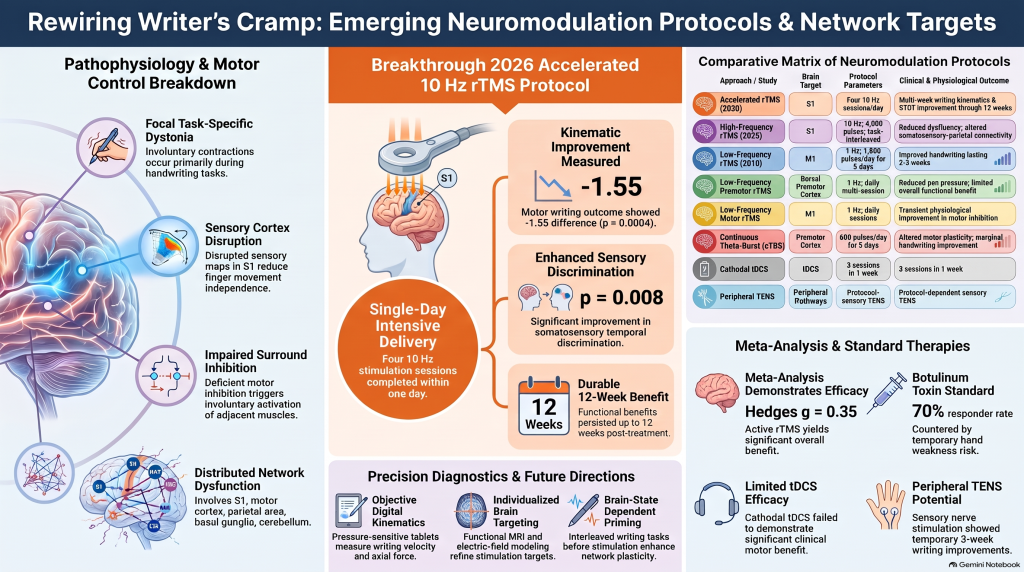
A Phase II clinical trial presented at the 2026 International Congress of Parkinson’s Disease and Movement Disorders provides encouraging preliminary evidence. Researchers reported that a single day of accelerated repetitive transcranial magnetic stimulation (rTMS), targeting the primary somatosensory cortex, improved writing-related motor performance and sensory discrimination, with benefits observed for up to 12 weeks.
This finding deserves attention, not because it establishes a cure, but because it potentially changes how we approach the treatment of writer’s cramp.
1. What Exactly Is Writer’s Cramp?
Writer’s cramp is a neurological movement disorder classified under focal task-specific dystonia.
Dystonia refers to involuntary muscle contractions that produce abnormal movements, sustained postures or both. In writer’s cramp, these abnormalities predominantly emerge during handwriting.
Two broad clinical patterns are recognized.
Simple writer’s cramp occurs primarily during writing. Other hand movements may remain relatively unaffected.
Complex or dystonic writer’s cramp involves additional skilled activities, such as using utensils, handling tools, typing or performing other fine motor tasks.
The distinction is important because it helps characterize the extent of the movement disorder and the functional difficulties experienced by the patient.
Common clinical features include excessive pen pressure, involuntary finger flexion or extension, wrist deviation, abnormal forearm rotation, tremulous handwriting, deterioration in writing fluency and progressive difficulty sustaining the task.
Some patients describe an unusual loss of automaticity. They know perfectly well what they want to write, but their hand no longer seems to obey the intended movement.
The disorder can be particularly disabling for teachers, students, doctors, accountants, artists and other professionals whose work involves repeated handwriting.
Writer’s cramp is not simply a consequence of poor handwriting technique, muscular weakness, anxiety or excessive writing. It is fundamentally a disorder of motor control. Nevertheless, emotional distress, fatigue, performance pressure and anticipatory anxiety may aggravate symptoms or increase the disability associated with the condition.
2. The Neurobiology: Why Does the Brain Lose Control of a Familiar Skill?
Normal handwriting requires the integration of several neural systems.
The primary motor cortex generates and coordinates voluntary muscle activation. Premotor and supplementary motor regions contribute to planning and sequencing movement. The basal ganglia participate in selecting and regulating motor programmes. The cerebellum helps refine timing and movement accuracy.
Equally important is the primary somatosensory cortex (S1).
Located in the postcentral gyrus, S1 receives and processes sensory information from the hand, including touch, pressure and proprioceptive feedback.
During writing, the brain must continually estimate where the fingers are positioned, how much pressure they are applying and whether the pen is moving as intended.
This sensory information helps the motor system adjust its commands almost continuously.
Abnormal sensory representation
Research in focal hand dystonia has demonstrated disturbances in sensory discrimination and cortical representations of the fingers.
Normally, representations of neighbouring fingers are sufficiently distinct to support independent control. In dystonia, altered sensory maps may contribute to reduced differentiation between finger movements.
The brain may therefore have difficulty distinguishing the sensory consequences of individual movements.
Reduced motor inhibition
Another important abnormality involves cortical inhibition.
Healthy motor control requires the activation of appropriate muscles while suppressing unnecessary or competing movements.
This selective inhibition is sometimes described as surround inhibition.
In writer’s cramp, inhibition may be insufficient. When a person attempts to move one finger, additional muscles may become involuntarily activated.
The result is excessive muscular cocontraction, abnormal posturing and loss of fine motor precision.
Maladaptive neuroplasticity
Repeated practice normally strengthens useful motor representations.
In task-specific dystonia, however, the mechanisms regulating plasticity may become maladaptive. Extensive repetition of a highly skilled movement, combined with individual susceptibility, may contribute to abnormal sensorimotor learning.
The key concept is that the brain may have learned an inefficient or unstable motor programme that becomes activated during a specific task.
This does not mean that patients have consciously learned to move incorrectly. The changes occur within automatic neural mechanisms.
A disorder of networks, not one brain region
Modern functional imaging studies indicate that writer’s cramp involves interactions between the somatosensory cortex, motor cortex, premotor regions, superior parietal cortex, basal ganglia and cerebellum.
Accordingly, contemporary neuromodulation research increasingly focuses on modifying network activity rather than stimulating a single cortical area in isolation.
3. Why rTMS May Help Writer’s Cramp
Repetitive transcranial magnetic stimulation is a non-invasive technique that uses rapidly changing magnetic fields to induce electrical currents in cortical tissue.
When delivered repeatedly, TMS can modify cortical excitability and influence activity in interconnected brain networks.
Traditional neuromodulation models generally associated low-frequency rTMS, particularly around 1 Hz, with reduced cortical excitability and higher-frequency stimulation with increased excitability.
However, this distinction is an oversimplification.
The physiological effects of rTMS depend on the stimulated region, intensity, number of pulses, intertrain intervals, prior brain activity, individual anatomy and network state.
Consequently, stimulation protocols cannot be understood solely by describing them as excitatory or inhibitory.
Earlier research in focal hand dystonia concentrated primarily on suppressing excessive motor cortical activity or improving impaired cortical inhibition.
The newer approach involves stimulating the somatosensory cortex and attempting to reorganize the neural interactions that support normal handwriting.
This is an important conceptual shift.
Instead of merely reducing excessive motor output, treatment may help improve the sensory information and network processing required for accurate motor control.
4. The 2026 Phase II Trial: One-Day Accelerated 10 Hz rTMS
At the 2026 International Congress of Parkinson’s Disease and Movement Disorders, Xu and colleagues from Duke University presented preliminary findings from a Phase II clinical trial investigating accelerated high-frequency rTMS for focal hand dystonia.
The study evaluated whether multiple sessions of stimulation, delivered during a single day, could produce meaningful and sustained improvements in hand function.
Study design
Nineteen participants with focal hand dystonia were enrolled in a randomized, double-blind crossover trial.
Each participant received both active and sham stimulation, with the order randomized and a 20-week washout period separating the intervention days.
Unlike conventional protocols that deliver treatment over several days or weeks, the accelerated intervention concentrated four sessions into one day.
The investigators individualized the stimulation target using functional MRI and electric-field modelling.
Stimulation parameters
| Parameter | Protocol |
|---|---|
| Target | Primary somatosensory cortex (S1/PSC) |
| Frequency | 10 Hz |
| Stimulation intensity | 90% resting motor threshold |
| Total pulses | 16,000 |
| Treatment schedule | Four sessions in one day |
| Trial design | Randomized, double-blind crossover |
| Participants | 19 enrolled |
| Washout | 20 weeks |
| Reported follow-up | Up to 12 weeks |
The total stimulation dose corresponds to an average of 4,000 pulses per session, although the conference abstract does not fully specify the train structure, individual session allocation or intersession intervals.
These missing technical details are important. The protocol should not be reproduced in routine practice solely from the published abstract.
Outcome measurements
The researchers assessed changes in writing-related motor behaviour using quantitative movement measurements.
They also examined the somatosensory temporal discrimination threshold (STDT), a neurophysiological measure of how effectively a person can distinguish successive sensory stimuli occurring close together in time.
STDT is particularly relevant because abnormal temporal sensory discrimination has been observed in dystonia.
Results
The study reported statistically significant improvements compared with sham stimulation.
The composite kinematic writing outcome showed a reported difference of −1.55 arbitrary units (p = 0.0004).
An improvement in somatosensory temporal discrimination was also reported (p = 0.008).
The abstract lists an STDT value of 160 seconds. Because STDT is ordinarily expressed in milliseconds, this appears to be a possible reporting or unit discrepancy that requires clarification in the full publication.
Importantly, the authors reported improvements extending up to 12 weeks following stimulation.
This is notable because many earlier rTMS investigations in focal hand dystonia assessed only immediate or short-term outcomes.
How should these results be interpreted?
The study provides a promising efficacy signal, particularly because it incorporated a sham condition and objective movement assessments.
However, the findings remain preliminary.
The full peer-reviewed clinical trial report is needed to establish the magnitude of improvement, responder proportions, confidence intervals, adverse effects, durability across individual participants and effects on everyday disability.
The composite writing score is reported in arbitrary units, making it difficult to translate directly into changes in handwriting legibility or occupational functioning.
A significant result on an objective motor measure does not automatically mean that every patient can return to normal handwriting.
The most important conclusion is that intensive, individually targeted somatosensory stimulation warrants further clinical investigation.
It is not yet an established treatment for writer’s cramp.
5. The 2025 Study That Helped Establish the Somatosensory Target
The scientific rationale for the accelerated protocol was strengthened by an earlier study published in Brain Stimulation in 2025.
Bukhari-Parlakturk and colleagues investigated how rTMS affects writing performance and motor-network connectivity in individuals with writer’s cramp.
Twelve participants underwent three stimulation conditions in a double-blind crossover design: active 10 Hz stimulation over the primary somatosensory cortex, active 10 Hz stimulation over premotor/motor regions, and sham stimulation.
The active protocol delivered 4,000 pulses at 90% resting motor threshold.
Importantly, the stimulation was combined with an interleaved writing-task paradigm intended to engage the affected motor network.
The researchers found that stimulation over the primary somatosensory cortex significantly reduced writing dysfluency, whereas premotor stimulation did not demonstrate the same benefit.
Functional imaging showed changes in interactions involving the somatosensory cortex, superior parietal cortex, basal ganglia and cerebellum.
Improved handwriting was associated with changes in somatosensory-parietal activity.
These findings suggest that the benefits of stimulation may arise from functional reorganization of distributed motor networks.
The study also raises a clinically interesting possibility: the state of the brain during stimulation may influence the response to treatment.
Activating relevant motor networks through carefully designed writing tasks could potentially influence subsequent plasticity. Whether this approach improves long-term clinical outcomes remains to be established.
6. Earlier Low-Frequency rTMS Protocols
Before the recent emphasis on accelerated 10 Hz stimulation, most investigations used lower-frequency protocols.
A. Primary somatosensory cortex: 1 Hz stimulation
Havrankova and colleagues investigated stimulation of the somatosensory cortex in patients with writer’s cramp.
Their protocol involved 1 Hz stimulation for approximately 30 minutes daily over five consecutive days.
The research protocol used 1,800 pulses per day, for a cumulative total of 9,000 pulses, with stimulation intensity reported as 90% of the active motor threshold.
The researchers observed improvements in handwriting and associated changes in cortical activation patterns.
The reported clinical benefit generally persisted for approximately two to three weeks.
This study was important because it established that targeting the sensory cortex could influence a movement disorder traditionally considered primarily motor.
Interestingly, both low-frequency and high-frequency stimulation of S1 have subsequently demonstrated benefits in different studies.
This illustrates why frequency alone cannot reliably predict clinical response. Stimulation may influence different network mechanisms depending on the protocol and physiological state.
B. Dorsal premotor cortex: 1 Hz stimulation
Another line of investigation targeted the dorsal premotor cortex, which contributes to movement planning and regulation.
Kimberley and colleagues investigated repeated low-frequency stimulation over this region in patients with focal hand dystonia.
A five-day protocol delivered 1 Hz stimulation to the premotor cortex contralateral to the affected hand.
The investigators assessed measures such as handwriting pressure, movement velocity, motor-evoked potentials and cortical silent period.
Although improvements in certain physiological measures and reductions in pen pressure were observed, the overall functional benefits were limited.
The findings suggested that increasing cortical inhibition does not necessarily produce equivalent improvement in complex skilled movements.
This remains an important lesson for neuromodulation research: correcting a neurophysiological abnormality is not always sufficient to restore functional performance.
C. Primary motor cortex: low-frequency stimulation
Early investigations of writer’s cramp also examined 1 Hz stimulation over the primary motor cortex.
Siebner and colleagues demonstrated that low-frequency stimulation could modify deficient intracortical inhibition and reduce excessive handwriting pressure in some patients.
However, the improvements were largely transient.
These experiments provided early evidence that the abnormal physiology of writer’s cramp could be influenced through non-invasive cortical stimulation, even though a durable therapeutic protocol had not yet emerged.
7. Theta-Burst Stimulation for Writer’s Cramp
Theta-burst stimulation (TBS) represents another approach to modifying cortical plasticity.
Unlike conventional rTMS, which uses trains of equally spaced pulses, TBS delivers patterned bursts of stimulation.
A commonly investigated continuous theta-burst stimulation protocol uses triplets of pulses delivered at 50 Hz, repeated at 5 Hz.
In one study, Huang and colleagues delivered continuous theta-burst stimulation over the premotor cortex for five consecutive days.
Each treatment consisted of 600 pulses, giving a total of 3,000 pulses across the intervention.
The study demonstrated changes in abnormal motor-network physiology, including measures of inhibition and plasticity.
However, improvement in handwriting was only marginal.
This distinction between physiological and clinical outcomes is particularly important.
Brain stimulation may produce measurable changes in cortical function without generating a proportionate improvement in the activities that matter most to patients.
For writer’s cramp, the ultimate objective is not simply normalization of a TMS parameter but the restoration of useful, comfortable and sustainable handwriting.
8. Other Neuromodulation Approaches
Transcranial direct current stimulation (tDCS)
Transcranial direct current stimulation delivers a weak electrical current through scalp electrodes to influence cortical excitability.
Its practical advantages include relatively simple equipment and lower procedural complexity compared with conventional rTMS.
However, evidence in writer’s cramp is inconsistent.
A randomized, sham-controlled study involving 12 patients investigated cathodal tDCS over the motor cortex across three sessions.
The intervention did not improve clinical ratings, handwriting kinematics or cortical inhibition. The study was terminated early following reports of unexplained subjective worsening.
Other small investigations have explored tDCS combined with action observation, EMG biofeedback and motor retraining.
Some encouraging individual responses have been reported, but the available evidence does not support tDCS as an established treatment for writer’s cramp.
Transcutaneous electrical nerve stimulation (TENS)
TENS provides peripheral sensory stimulation rather than directly stimulating the cerebral cortex.
Its potential role in dystonia is based on the idea that modifying sensory input may influence abnormal sensorimotor processing.
A small randomized crossover study involving 10 patients reported improvement in several measures of writer’s cramp, with benefits lasting approximately three weeks.
These findings are intriguing but require confirmation in larger trials.
Sensorimotor retraining
Sensorimotor retraining attempts to improve the accuracy and independence of skilled finger movements.
It may involve structured finger exercises, graded handwriting tasks, modification of movement patterns and sensory discrimination training.
Such approaches can be useful components of rehabilitation.
However, evidence remains heterogeneous, and studies combining retraining with rTMS have not consistently demonstrated superior outcomes.
The most promising future direction may involve identifying which rehabilitation exercises can reinforce beneficial network changes produced by stimulation.
9. Comparing the Major Neuromodulation Protocols
| Approach | Target | Research protocol | Main finding |
|---|---|---|---|
| Accelerated rTMS, 2026 | S1 | 10 Hz; 16,000 pulses; four sessions in one day | Preliminary benefit reported through 12 weeks |
| High-frequency rTMS, 2025 | S1 | 10 Hz; 4,000 pulses | Improved writing dysfluency and altered network connectivity |
| Low-frequency rTMS, 2010 | S1 | 1 Hz; 1,800 pulses/day for five days | Handwriting improvement lasting approximately 2–3 weeks |
| Low-frequency premotor rTMS | Dorsal premotor cortex | 1 Hz; repeated daily sessions | Physiological improvement with modest functional benefit |
| Low-frequency motor rTMS | M1 | 1 Hz | Transient improvement in some patients |
| Continuous theta-burst stimulation | Premotor cortex | 600 pulses/day for five days | Neurophysiological changes; marginal writing benefit |
| Cathodal tDCS | Motor cortex | Three sessions in one week | No significant benefit in a small controlled trial |
| Peripheral TENS | Peripheral sensory pathways | Protocol-dependent | Preliminary short-term benefit in a small study |
These protocols are provided to explain the research literature. They should not be interpreted as standardized treatment prescriptions.
10. What Does the Overall Evidence Tell Us?
A systematic review and meta-analysis published in Dystonia in August 2026 offers a useful perspective.
Simsek and colleagues examined nine studies involving 111 individuals with focal hand dystonia.
The pooled analysis demonstrated a statistically significant improvement following TMS compared with pretreatment assessment.
The standardized effect size was Hedges’ g = 0.36.
When analysis was restricted to studies comparing active stimulation with sham stimulation, eight studies involving 102 participants produced a pooled effect size of Hedges’ g = 0.35, with a 95% confidence interval of 0.12–0.57.
The active-versus-sham comparison was statistically significant (p = 0.002).
These results suggest a small-to-moderate therapeutic benefit.
However, several limitations remain.
The studies included relatively small samples, varied stimulation targets, different pulse schedules, different outcome measures and generally short follow-up periods.
Consequently, the meta-analysis could not establish an optimal stimulation site or protocol.
The literature search was conducted through January 2026, so the subsequently presented accelerated Phase II trial was not included in that pooled analysis.
The overall evidence therefore supports continued investigation of rTMS, but not its adoption as a routine first-line intervention.
11. What About Conventional Treatment?
While newer neuromodulation techniques are being investigated, established treatments remain important.
Botulinum toxin injections
Botulinum toxin is one of the principal symptomatic treatments for writer’s cramp.
The injection is directed toward muscles contributing to the abnormal dystonic posture.
By reducing excessive muscular activation, treatment may improve movement control and reduce cramping.
In a randomized placebo-controlled trial, 70% of participants receiving botulinum toxin reported benefit and chose to continue treatment, compared with approximately 32% receiving placebo.
However, temporary hand weakness remains an important limitation.
The muscles involved in writing are small and highly specialized. Excessive weakening may impair precisely the fine motor skills the treatment is intended to improve.
Careful muscle selection, often assisted by EMG or ultrasound, is therefore essential.
Treatment effects are temporary, and repeated injections may be required.
Occupational therapy and handwriting rehabilitation
Rehabilitation may include graded task practice, relaxation of excessive grip, ergonomic modifications, alternative writing instruments and structured sensory-motor training.
Patients may benefit from temporarily reducing prolonged, highly effortful handwriting and avoiding repeated attempts to force normal movement through severe dystonic contractions.
Adaptive writing devices and electronic alternatives can help maintain occupational functioning.
The goal is not simply to strengthen the hand. In most patients, the primary problem is not weakness but abnormal control of muscular activation.
Medications
Oral medications such as anticholinergic agents, benzodiazepines or other agents are occasionally considered in selected cases.
However, their benefits may be limited by adverse effects, including sedation, cognitive impairment and reduced coordination.
They are generally not sufficient as stand-alone treatment for significant task-specific dystonia.
Psychological interventions
Writer’s cramp is a neurological disorder, not a psychological habit.
Nevertheless, patients may develop substantial anticipatory anxiety, frustration, self-consciousness and avoidance.
For example, someone who repeatedly experiences hand spasms while signing documents may begin to anticipate failure whenever asked to sign in front of others.
This anticipatory anxiety can increase muscular tension and further interfere with performance.
Psychological interventions, including cognitive behavioural techniques, graded exposure and strategies for managing performance-related distress, may help reduce the secondary burden of the disorder.
Such treatment should complement neurological management rather than replace it.
12. How Should Writer’s Cramp Be Evaluated Clinically?
A careful clinical assessment remains the foundation of treatment.
The clinician must first establish whether the symptoms represent true task-specific dystonia or another condition that interferes with writing.
Differential diagnoses include dystonic tremor, primary writing tremor, essential tremor, peripheral nerve disorders, musculoskeletal conditions, medication-induced movement disorders and functional movement disorders.
The examination should assess the patient’s actual handwriting rather than relying exclusively on symptoms described during ordinary conversation.
Useful observations include finger positioning, grip pressure, wrist deviation, forearm movement, writing speed, legibility and the degree of deterioration during continued writing.
It is also valuable to compare handwriting with other activities, such as drawing, typing, holding utensils or performing simple finger movements.
Some patients demonstrate overflow activation or abnormal posturing in the opposite hand.
Others report that changing the pen grip, altering finger contact or modifying the writing position temporarily improves movement. Such sensory tricks can provide useful diagnostic information.
Objective assessment of writing
Research increasingly uses pressure-sensitive digital pens and tablets to quantify writing characteristics.
Measurements may include writing velocity, axial pen force, movement smoothness, acceleration peaks, irregularities in stroke trajectory and the frequency of abnormal movement interruptions.
Clinical rating instruments such as the Writer’s Cramp Rating Scale can complement these measurements.
A combination of clinician-rated severity, patient-reported disability and objective writing kinematics would provide a particularly useful approach for monitoring treatment.
Neurophysiological measures such as cortical silent period, motor-evoked potentials and somatosensory temporal discrimination may offer additional research information.
However, these tests are not diagnostic substitutes for clinical examination, and qEEG currently has no validated role as a stand-alone diagnostic test for writer’s cramp.
13. Could Writer’s Cramp Associated With Typing or Computer Use Respond Similarly?
Task-specific dystonia is not restricted to handwriting.
Similar phenomena can occur during activities requiring highly repetitive and skilled movements, including instrument playing, typing and specialized occupational tasks.
A patient may experience involuntary finger movements, abnormal wrist posturing or loss of keyboard accuracy exclusively while typing.
In such cases, focal task-specific hand dystonia should be considered.
However, computer-related hand discomfort is considerably more common than true dystonia.
Conditions such as repetitive strain disorders, tendinopathies, peripheral neuropathies and ergonomic problems must be excluded.
It is tempting to assume that because typing dystonia and writer’s cramp involve overlapping networks, they will respond identically to somatosensory stimulation.
This assumption is not yet supported by sufficient clinical evidence.
The latest accelerated rTMS findings cannot automatically be generalized to every form of occupational hand dystonia.
Individualized diagnosis and task-specific outcome measurements remain essential.
14. Safety: Can Accelerated rTMS Be Used Routinely?
One of the major attractions of accelerated rTMS is its potential convenience.
A protocol delivered in a single day could theoretically reduce repeated hospital visits and improve access to treatment.
However, accelerated stimulation is not simply conventional rTMS delivered more quickly.
Increasing the cumulative number of pulses and reducing the interval between sessions may alter the physiological effects and safety considerations.
TMS can produce headache, scalp discomfort and transient auditory symptoms. Seizures are rare but potentially serious adverse events.
Proper screening should consider seizure history, relevant medications, implanted devices, neurological conditions and other factors affecting risk.
High-frequency and accelerated protocols require particular attention to motor-threshold determination, train duration, intertrain intervals, cumulative dose and intersession spacing.
The 2026 writer’s cramp study used individualized fMRI targeting and electric-field modelling. These methodological features should not be treated as optional details when considering the reproducibility of the intervention.
Furthermore, rTMS protocols used for depression cannot be automatically transferred to writer’s cramp.
The target, underlying disease mechanism, intended network effects and stimulation schedule differ.
Until larger controlled trials and adequate safety data become available, accelerated 10 Hz S1-rTMS should be regarded as an investigational intervention, preferably undertaken within an appropriately supervised research setting.
15. The Future: Toward Personalized Neuromodulation
The most interesting implication of recent research is that writer’s cramp may become a model for increasingly individualized treatment of motor-network disorders.
Several developments deserve attention.
First, individualized cortical targeting. Functional MRI and electric-field modelling may help identify stimulation sites relevant to each person’s abnormal network activity.
Second, objective digital biomarkers. Pressure-sensitive writing tablets and quantitative movement analysis could provide more sensitive indicators of treatment response than subjective reporting alone.
Third, sensory biomarkers. Somatosensory temporal discrimination and related physiological measures may help researchers understand how stimulation changes sensory processing.
Fourth, brain-state-dependent stimulation. Carefully designed writing or movement tasks performed before stimulation could potentially influence how the brain responds to neuromodulation.
Fifth, combined rehabilitation. A future treatment programme might integrate targeted stimulation with carefully timed sensory-motor retraining, allowing functional improvements to be reinforced through practice.
Finally, individualized treatment selection. Patients with predominant sensory-processing abnormalities may eventually prove more responsive to somatosensory stimulation, while those with different network disturbances might benefit from alternative targets.
These remain research possibilities rather than validated clinical algorithms.
16. A Practical Clinical Perspective
Writer’s cramp illustrates a fascinating aspect of human motor control: a person may retain normal strength, sensation and knowledge of a movement yet lose the ability to perform that movement automatically.
For the patient, the consequences extend far beyond handwriting.
The disorder may affect professional confidence, independence, productivity and personal identity.
Repeated failed attempts to write can produce embarrassment and apprehension, particularly when the activity must be performed in public.
Effective care must therefore address both the abnormal movement and the lived experience of having that movement disorder.
The recent accelerated rTMS study provides an encouraging direction by demonstrating that targeted modulation of sensory networks may influence writing performance for longer than previously observed in many small trials.
Yet scientific enthusiasm must be balanced with clinical caution.
At present, no single rTMS protocol has sufficient evidence to replace established multidisciplinary treatment.
What the new research offers is a rationale for further trials of individualized, network-based neuromodulation.
The ultimate goal is not simply to change cortical excitability or improve a laboratory measurement.
It is to help patients regain the ability to perform the ordinary, meaningful activities that their nervous system has made unexpectedly difficult.
For someone with writer’s cramp, even the ability to sign a document, complete a handwritten note or write without fear can represent a substantial improvement in quality of life.
About the Author and Clinical Services
Dr. Srinivas Rajkumar T
Consultant Psychiatrist | MD Psychiatry – AIIMS New Delhi | DNB Psychiatry
Chennai, Tamil Nadu
Dr. Srinivas Rajkumar T is a consultant psychiatrist with a clinical and academic interest in neuropsychiatry, brain stimulation, cognitive neuroscience and the application of emerging technologies to psychiatric and neurological disorders.
His approach emphasizes the integration of careful clinical assessment, contemporary neuroscience, evidence-based treatment and an understanding of the psychological difficulties associated with chronic illnesses.
Movement disorders such as writer’s cramp demonstrate why neurological and psychological perspectives often need to work together. Although writer’s cramp is a neurological dystonia, patients may also experience anticipatory anxiety, reduced confidence, occupational difficulties and significant emotional distress.
A comprehensive approach therefore involves identifying the underlying movement disorder, recognizing associated psychological factors and developing an individualized management plan.
Dr. Srinivas has experience and academic interest in non-invasive brain stimulation techniques, including repetitive transcranial magnetic stimulation (rTMS), transcranial direct current stimulation (tDCS), and neurophysiological approaches to assessing brain function.
His broader clinical interests include neuropsychiatric disorders, ADHD, OCD, mood disorders, cognitive disorders and brain-based therapeutic interventions.
Seeking Help for Writer’s Cramp or Similar Movement Difficulties?
Individuals experiencing involuntary hand contractions, difficulty writing, task-specific tremors, abnormal hand postures or anxiety associated with performing skilled movements may benefit from a comprehensive clinical evaluation.
Assessment can help distinguish neurological movement disorders from other causes of impaired hand function and identify when specialized movement-disorder evaluation, rehabilitation, psychological interventions or additional investigations may be appropriate.
Where necessary, coordinated care with movement-disorder neurologists, rehabilitation specialists and other healthcare professionals is essential.
Emerging treatments such as accelerated rTMS for writer’s cramp remain experimental and should not be regarded as established or routinely available interventions.
For professional enquiries and psychiatric or neuropsychiatric consultations:
Dr. Srinivas Rajkumar T
Consultant Psychiatrist
Chennai – Velachery
Website: https://srinivasaiims.com
Advancing mental healthcare through clinical neuroscience, compassionate care and evidence-based innovation.
Selected Scientific References
- Xu I, Simsek Z, Mulcahey P, et al. One day accelerated 10 Hz rTMS for focal hand dystonia: A Phase II clinical trial. Movement Disorders. 2026;41(Suppl 1). Conference abstract.
- Bukhari-Parlakturk N, et al. Motor network reorganization associated with rTMS-induced writing improvement in writer’s cramp dystonia. Brain Stimulation. 2025;18(2):198–210. DOI.
- Simsek ZB, Mulcahey PJ, Lutz MW, Peterchev AV, Bukhari-Parlakturk N. Effect of transcranial magnetic stimulation on focal hand dystonia: A systematic review and meta-analysis. Dystonia. 2026;5:16666. DOI.
- Havrankova P, et al. Repetitive TMS of the somatosensory cortex improves writer’s cramp and enhances cortical activity. Neuro Endocrinology Letters. 2010;31(1):73–86. PubMed.
- Kimberley TJ, et al. Multiple sessions of low-frequency repetitive transcranial magnetic stimulation in focal hand dystonia: Clinical and physiological effects. Restorative Neurology and Neuroscience. 2013;31(5):533–542. PubMed.
- Huang YZ, et al. Modulation of the disturbed motor network in dystonia by multisession suppression of premotor cortex. PLoS ONE. 2012;7(10). DOI.
- Kruisdijk JJM, et al. Botulinum toxin for writer’s cramp: A randomised, placebo-controlled trial and 1-year follow-up. Journal of Neurology, Neurosurgery & Psychiatry. 2007;78(3):264–270. DOI.
- Rossi S, et al. Safety and recommendations for TMS use in healthy subjects and patient populations. Clinical Neurophysiology. 2021;132(1):269–306. PubMed.
- Tinazzi M, et al. TENS for the treatment of writer’s cramp dystonia: A randomized, placebo-controlled study. Neurology. 2005. PubMed.
- Transcranial direct current stimulation for the treatment of focal hand dystonia. Full text.
This article is intended for professional education and public awareness. Individual diagnosis and treatment require clinical evaluation. The findings of the accelerated rTMS trial are preliminary and do not constitute an established treatment recommendation.