Coder’s Cramp: When the Brain Struggles to Control the Fingers on a Keyboard
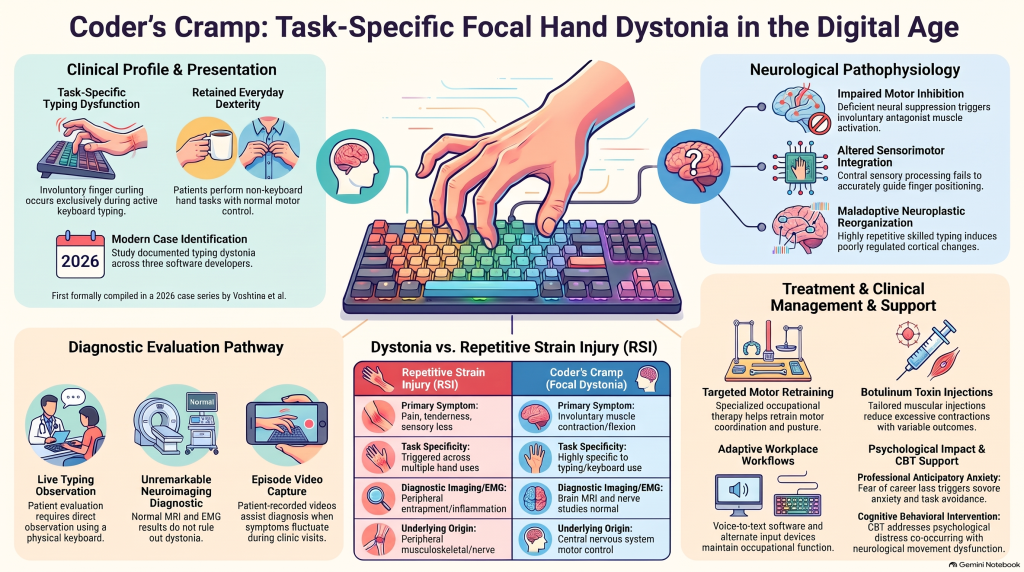 Task-Specific Focal Hand Dystonia in the Digital Age
We often associate occupational movement disorders with activities requiring extraordinary precision: the violinist who loses control of a finger, the pianist whose hand begins to assume an unnatural posture, or the writer who discovers that holding a pen has become unexpectedly difficult.
But what happens when the affected person is a software engineer whose livelihood depends on a keyboard?
Imagine a programmer who has spent years typing effortlessly. One day, the ring and little fingers begin to curl involuntarily while entering code. The person attempts to straighten them, but the abnormal movement returns almost immediately. Typing becomes slower, frustrating, and increasingly unpredictable.
Yet away from the keyboard, the same individual may be able to button a shirt, hold a cup, use a smartphone, and perform other everyday activities without difficulty.
This unusual phenomenon has a neurological explanation: task-specific focal hand dystonia associated with typing, recently described under the memorable name Coder’s Cramp.
A New Name for an Established Neurological Phenomenon
At the 2026 International Congress of Parkinson’s Disease and Movement Disorders, researchers R. Voshtina, S. Barton, and J. Ng from Palo Alto presented a case series titled “Coder’s Cramp”: A Case Series of Task-Specific Typing Dystonia.
They described three software engineers who developed involuntary hand movements specifically while typing.
The first was a 28-year-old left-handed man whose third, fourth, and fifth fingers began flexing involuntarily within 30 seconds of typing.
The second was a 26-year-old right-handed man who experienced abnormal movements of his left wrist and little finger, including irregular oscillations at approximately 5–7 Hz.
The third was a man who had experienced essential tremor since adolescence and subsequently developed involuntary flexion of three fingers and pronation of his left wrist while typing at the age of 52.
Remarkably, all three patients had otherwise normal neurological examinations. Their brain MRI and conventional electromyography/nerve conduction investigations revealed no abnormalities.
The dystonic movements became evident only when they performed the triggering activity.
The authors proposed the term Coder’s Cramp to describe this occupational presentation.
However, it is important to recognise that this was a small conference case series involving only three patients, rather than definitive evidence of a distinct neurological disease.
The underlying phenomenon is not entirely new. Typist’s cramp has been described in neurological literature for decades. In 1988, Cohen and Hallett investigated the electromyographic features of several occupational hand cramps, including those experienced by typists, musicians, and writers.
What the 2026 report illustrates is how an established neurological disorder continues to appear in contemporary occupations that depend heavily on repetitive, highly skilled hand movements.
What Exactly Happens in Coder’s Cramp?
Under ordinary circumstances, typing is a remarkably sophisticated motor activity.
The brain must coordinate numerous muscles of the fingers, wrist, and forearm with extraordinary speed and accuracy. Each finger must move when required, while neighbouring fingers remain sufficiently relaxed to permit smooth, independent movements.
With years of practice, typing becomes largely automatic.
We no longer consciously decide how to position every finger. We think of a word, and our hands produce it.
In task-specific focal dystonia, this efficient coordination is disrupted.
Muscles that should remain relatively quiet may become involuntarily activated. Opposing muscles may contract simultaneously, and the usual independence of finger movements becomes impaired.
The result may be abnormal flexion, extension, twisting, tremulous movements, or a sensation that the fingers are no longer responding normally.
The individual knows what they want to type. The difficulty lies in executing the familiar movement.
This distinction is important: the problem is not a loss of knowledge or skill, but an abnormality in motor control.
Why Does the Brain Develop This Problem?
The precise cause of task-specific focal dystonia remains incompletely understood.
Current neurological models implicate disturbances in sensorimotor integration, inhibitory motor control, and plasticity within interconnected cortical, basal ganglia, thalamic, and cerebellar networks.
Three mechanisms are particularly relevant.
1. Reduced motor inhibition
Normal movement requires not only activation of the correct muscles but also suppression of unwanted movements. In focal dystonia, these inhibitory mechanisms may become less effective, allowing inappropriate muscle activation.
2. Altered sensorimotor integration
The brain continuously integrates information about finger position, pressure, touch, and movement. Disruption of this integration may interfere with the precise control required for typing.
3. Maladaptive neuroplasticity
Repeated skilled activity produces changes in the nervous system that normally improve performance.
In susceptible individuals, some of these adaptations may become poorly regulated, contributing to abnormal motor patterns.
However, it would be incorrect to conclude that excessive typing alone causes dystonia. Genetic susceptibility and other individual factors appear relevant, and the interaction between occupational demands and vulnerability remains incompletely understood.
Millions of people type for extended periods without developing the condition.
Coder’s Cramp Is Not the Same as Repetitive Strain Injury
This distinction is clinically important.
A software professional presenting with hand discomfort is often assumed to have repetitive strain injury, carpal tunnel syndrome, or another musculoskeletal problem.
Although these are common explanations for computer-related hand symptoms, task-specific dystonia has a different clinical pattern.
Repetitive strain disorders frequently involve pain, tenderness, fatigue, or discomfort associated with repeated activity. Peripheral nerve entrapment may cause tingling, numbness, altered sensation, or weakness.
In coder’s cramp, the dominant difficulty may instead be an involuntary abnormal movement occurring during typing, sometimes with little or no pain.
A patient may report:
- Fingers curling or extending involuntarily over the keyboard.
- Loss of precise finger control despite apparently normal strength.
- Abnormal wrist positioning when typing.
- Increasing difficulty pressing particular keys.
- Involuntary movements that disappear when typing stops.
- Normal performance during many unrelated hand activities.
Some patients also experience dystonic tremor.
The most revealing feature is often task specificity.
The same hand that becomes dysfunctional during typing may perform other demanding movements normally.
Importantly, pain or tingling does not exclude dystonia, and more than one condition can coexist. Clinical evaluation is essential.
How Is It Diagnosed?
Diagnosis is primarily clinical.
A detailed neurological examination should be followed by observation of the exact activity that produces the difficulty.
For example, a patient reporting typing-related dystonia should ideally be observed using an actual computer keyboard.
The clinician may assess finger positioning, involuntary muscle contractions, abnormal wrist movements, changes in typing speed, and whether symptoms occur with other tasks such as handwriting or mouse use.
A video recorded during a typical episode can be especially valuable when symptoms are difficult to reproduce during consultation.
MRI and nerve conduction studies may be appropriate when another neurological disorder is suspected, but these investigations can be normal in task-specific dystonia.
A normal scan does not mean the symptoms are imaginary or psychologically generated.
The differential diagnosis includes peripheral neuropathies, nerve entrapment, tendon disorders, tremor syndromes, medication-related movement disorders, and functional neurological movement disorders.
Although task-specific dystonia may sometimes appear unusual, task specificity alone is not evidence of a functional or psychogenic disorder.
Can Coder’s Cramp Be Treated?
Treatment requires individualisation, and the evidence specifically addressing typing-induced dystonia remains limited.
Most available treatment approaches have been developed through research on writer’s cramp, musician’s dystonia, and other forms of focal hand dystonia.
1. Occupational therapy and motor retraining
Specialised occupational therapy may help patients explore more efficient movements, reduce unnecessary muscle activation, modify hand positioning, and gradually practise affected tasks.
The objective is not simply to strengthen the fingers. It is to improve movement coordination and functional performance.
Certain patients may benefit from altered keyboard arrangements, assistive devices, or adjustments in typing technique.
These interventions must be tailored to the actual dystonic movement pattern.
2. Botulinum toxin injections
Botulinum toxin can reduce excessive muscle activity when injected into carefully selected muscles.
Evidence from controlled trials supports its use in writer’s cramp, although treatment may cause unwanted finger or hand weakness.
In the 2026 coder’s cramp case series, the outcomes varied considerably.
One patient did not improve with botulinum toxin or several other interventions. Another experienced better dexterity with a weighted glove. The third achieved an excellent response after the injection pattern was adjusted to reduce treatment-related weakness.
These differing outcomes highlight why precise muscle selection and individualised treatment are important.
3. Medication
Oral medications such as anticholinergic agents or muscle relaxants are occasionally considered in focal dystonia, but their benefits are inconsistent and adverse effects may limit use.
The published coder’s cramp cases did not demonstrate reliable benefit from oral medication.
4. Practical workplace adaptations
For someone whose livelihood depends on typing, rehabilitation should address real occupational demands.
Temporary accommodations may include shorter typing sessions, planned breaks, voice-to-text software, alternative input devices, or a modified workflow.
These measures do not correct the underlying neurological disorder but may help maintain professional functioning during treatment.
The Psychological Burden: When Typing Becomes a Source of Fear
There is another dimension to these conditions that deserves attention.
For a software engineer, typing is not merely a physical activity. It is often central to professional identity, independence, and confidence.
An individual who previously typed without thinking may suddenly become intensely conscious of every finger movement.
What was automatic becomes deliberate. What was effortless becomes uncertain.
The patient may begin anticipating failure even before approaching the keyboard.
What if my fingers curl again?
What if the condition becomes permanent?
Will I still be able to work?
What if this happens during an important assignment?
Such concerns can produce substantial anticipatory anxiety.
It is essential, however, not to confuse the emotional consequences of dystonia with its neurological cause.
Coder’s cramp is not simply performance anxiety. Psychological distress can coexist with, and sometimes aggravate, the movement difficulty without being responsible for the underlying disorder.
Psychological care may become particularly valuable when the patient begins avoiding typing, repeatedly testing hand movements, catastrophising occasional symptoms, or losing confidence despite improvement in motor function.
Cognitive behavioural interventions may help the patient challenge catastrophic expectations, manage anticipatory anxiety, and gradually return to avoided activities.
This psychological approach should complement neurological treatment and motor rehabilitation, rather than replace them.
There is not yet strong direct clinical-trial evidence supporting CBT specifically for coder’s cramp, although research in other forms of dystonia provides a rationale for addressing associated anxiety and functional avoidance.
Why This Matters in Modern Clinical Practice
The emergence of coder’s cramp as a contemporary clinical description raises an important question.
As our occupations increasingly depend on keyboards, touchscreens, digital interfaces, and other highly repetitive skilled movements, will clinicians encounter more unusual forms of task-specific dystonia?
At present, there is insufficient epidemiological evidence to conclude that coder’s cramp is becoming more common.
Nevertheless, the recognition of typing-induced and mouse-related dystonia reminds us that the expression of neurological disorders may reflect the skilled activities that occupy our daily lives.
A violinist may develop dystonia while playing an instrument. A writer may experience involuntary finger contractions while holding a pen. A software engineer may develop the same class of neurological dysfunction while typing.
The underlying clinical principle remains the same: a disturbance in the neural control of a highly practised motor task.
The practical message is equally important.
When a patient reports involuntary finger posturing, abnormal hand movements, or a peculiar loss of typing control—particularly when routine examinations and investigations appear normal—task-specific focal dystonia deserves consideration.
Early recognition may help avoid inappropriate reassurance, unnecessary investigations, and delays in access to specialist neurological rehabilitation.
Conclusion
Coder’s cramp is a modern occupational description of task-specific focal hand dystonia associated with keyboard use.
It is not simply ordinary muscle fatigue, repetitive strain injury, or anxiety about work.
It represents an impairment in the neurological control of a highly skilled movement, often occurring in an individual whose hand functions normally during most other activities.
The 2026 case series offers an important reminder that occupational dystonias are not restricted to traditional activities such as handwriting or musical performance.
They can also affect the skills on which modern digital professions depend.
And behind every disrupted movement is a person whose confidence, professional identity, and daily functioning may be affected.
Recognising both the neurological disorder and its psychological consequences is essential to providing meaningful care.
About the Author
Dr. Srinivas Rajkumar T MD(AIIMS, New Delhi)
Consultant Psychiatrist, Chennai
Dr. Srinivas Rajkumar T has clinical interests in the interaction between brain function, behaviour, cognition, and psychological well-being.
His approach emphasises comprehensive psychiatric assessment, evidence-informed treatment, and an understanding of how neurological and psychiatric conditions affect everyday functioning, confidence, and quality of life.
Patients experiencing anxiety, psychological distress, fear of symptom recurrence, or difficulties adjusting to neurological conditions may benefit from psychiatric evaluation and coordinated care alongside neurological specialists.
Consultations: Apollo Clinic, Velachery, Chennai
Website: https://srinivasaiims.com