How Can Methylphenidate Work for 12 Hours When Its Half-Life Is Only 3.5 Hours? The Science of Extended-Release ADHD Medication
 Understanding osmotic drug delivery, dopamine, pharmacokinetics, and why different methylphenidate formulations can produce very different experiences.
Methylphenidate is among the most extensively studied medications for Attention-Deficit/Hyperactivity Disorder (ADHD). Yet one of the most frequent questions patients ask is surprisingly simple:
“Why does my ADHD medication work well for a few hours and then suddenly wear off?”
Some patients describe a noticeable improvement in concentration within an hour, followed by a return of distractibility, restlessness, or irritability later in the day. Others experience smoother benefits lasting through work or school.
Interestingly, two medications containing exactly the same active ingredient—methylphenidate—can produce distinctly different experiences.
The explanation lies not only in the drug itself but also in how the medication is delivered into the bloodstream over time.
A detailed product monograph for Taro-Methylphenidate ER, an extended-release methylphenidate formulation authorized in Canada, offers an excellent opportunity to understand this science.
1. Methylphenidate: A Familiar Drug With Complex Pharmacology
Methylphenidate is a central nervous system stimulant used in the treatment of ADHD.
Its primary pharmacological action involves blocking the reuptake of two important neurotransmitters:
- Dopamine, involved in motivation, reward processing, reinforcement learning, and aspects of cognitive control.
- Noradrenaline, involved in alertness, attention regulation, and the maintenance of goal-directed behaviour.
Methylphenidate primarily inhibits dopamine transporters (DAT) and norepinephrine transporters (NET), increasing extracellular catecholamine availability.
These neurotransmitter systems are particularly relevant to circuits connecting the prefrontal cortex with other cortical and subcortical brain regions.
The prefrontal cortex plays an important role in executive functions such as working memory, response inhibition, planning, prioritisation, and regulating attention.
In individuals with ADHD, methylphenidate can improve the efficiency of these functions.
However, the response is not simply a matter of increasing dopamine as much as possible.
Both insufficient and excessive catecholaminergic stimulation can impair prefrontal functioning. Consequently, more medication does not necessarily mean better attention.
The clinical goal is to achieve an optimal and sustained therapeutic response, not maximal stimulation.
2. The Pharmacokinetic Paradox: A 3.5-Hour Half-Life but 12-Hour Coverage
Methylphenidate has a relatively short elimination half-life.
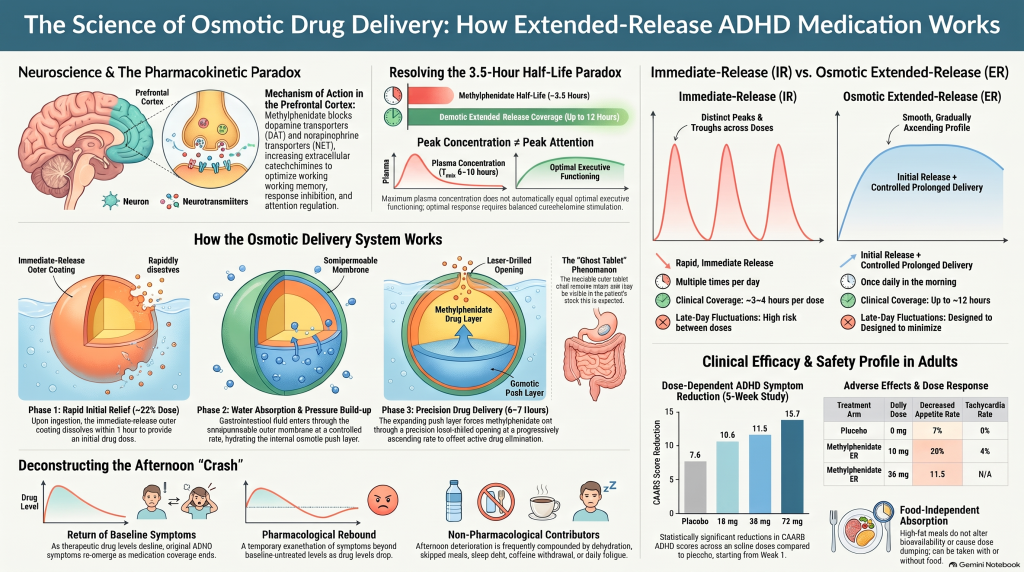
According to the Taro-Methylphenidate ER product monograph, the elimination half-life in adults is approximately 3.5 hours.
The elimination half-life describes how long it takes for the plasma concentration of a drug to decrease by approximately 50% once elimination is occurring without sufficient additional drug input.
At first glance, this raises an obvious question.
If methylphenidate has such a short half-life, how can a once-daily formulation provide ADHD symptom control for much of the day?
The answer is that the duration of drug delivery is different from the duration of drug elimination.
With immediate-release methylphenidate, much of the dose becomes available relatively quickly. Plasma concentrations rise, reach a peak, and subsequently decline.
With extended-release formulations, additional methylphenidate continues entering the bloodstream over several hours.
Thus, even while the body is metabolising and eliminating the drug, the formulation continues supplying new methylphenidate.
This prolonged input can sustain clinically useful drug concentrations despite the short elimination half-life.
It is a useful example of how pharmaceutical engineering can substantially change the clinical behaviour of an established medication.
3. The Osmotic Pump: A Tiny Drug-Delivery System Inside a Tablet
Taro-Methylphenidate ER uses an osmotic-controlled delivery mechanism similar in design to that used in Concerta.
Rather than simply dissolving immediately after ingestion, the tablet contains a carefully engineered multilayer structure.
Its principal components include:
- An immediate-release outer coating containing approximately 22% of the total methylphenidate dose.
- Two internal drug-containing layers.
- An osmotically active push layer.
- A semipermeable membrane surrounding the tablet core.
- A precision laser-drilled opening through which the drug is released.
Step 1: Immediate release
Following ingestion, the outer drug coating begins dissolving.
Approximately 22% of the total methylphenidate dose is contained in this coating, which dissolves within about one hour in an aqueous environment.
This provides an initial supply of medication while the internal delivery system begins operating.
For example, an 18 mg tablet contains approximately 4 mg of methylphenidate in its immediate-release coating.
Step 2: Water enters the tablet
Gastrointestinal fluid passes through the tablet’s semipermeable membrane.
The membrane allows water to enter while controlling its rate of entry.
Step 3: Osmotic pressure develops
Water entering the tablet causes the osmotically active push layer to expand.
This expansion creates mechanical pressure inside the tablet.
Step 4: Methylphenidate is released gradually
The increasing pressure forces methylphenidate from the drug-containing layers through the laser-drilled opening.
Importantly, the drug-delivery rate is designed to increase over approximately six to seven hours.
This compensates, in part, for the methylphenidate that is being continuously removed from circulation through metabolism and elimination.
The result is a progressively rising plasma concentration profile rather than repeated sharp peaks and troughs.
One interesting feature is that the tablet’s outer shell is not completely absorbed or digested. Some patients may notice a tablet-like structure in their stool.
This is expected and does not necessarily indicate that the medication has failed to release.
4. What Happens to Methylphenidate Concentrations After Taking the Tablet?
The product monograph provides detailed pharmacokinetic data.
Following administration of osmotic-release methylphenidate, plasma concentrations initially rise, reaching an early local maximum at approximately one hour.
Thereafter, concentrations generally increase over the next several hours.
The mean time to maximum plasma concentration, or Tmax, occurs approximately 6–10 hours after administration across the studied doses.
This is quite different from the concentration profile of immediate-release methylphenidate.
| Feature | Immediate-release methylphenidate | Osmotic extended-release methylphenidate |
|---|---|---|
| Drug delivery | Relatively rapid | Initial release followed by prolonged delivery |
| Plasma concentration pattern | Distinct peaks and troughs with repeated doses | Gradually ascending profile |
| Dosing | Often requires multiple daily doses | Once daily |
| Typical clinical coverage | Often around 3–4 hours per dose | May extend to approximately 12 hours |
| Late-day fluctuations | May occur between doses | Designed to reduce fluctuations |
These are general formulation characteristics. Actual clinical duration varies considerably between patients.
Does maximum plasma concentration mean maximum attention?
Not necessarily.
A common misunderstanding is that the medication must be working best when its plasma concentration is highest.
In reality, the relationship between plasma concentration and cognitive performance is more complicated.
Improvement in attention may occur considerably earlier than Tmax.
Likewise, the highest plasma concentration does not necessarily produce the best executive functioning.
Factors influencing the clinical response include baseline symptom severity, individual drug sensitivity, sleep quality, anxiety, task demands, and the patient’s therapeutic concentration range.
An individual may experience good attention at a moderate plasma concentration but increased restlessness, anxiety, or physical discomfort at higher concentrations.
This is why medication optimization requires attention to both the timing and quality of the clinical response.
5. Why Do Some Patients Experience a Methylphenidate Crash?
Patients frequently use the term crash to describe the unpleasant experience of medication wearing off.
However, at least three different clinical phenomena may be involved.
A. Return of baseline ADHD symptoms
As medication concentrations decline, the original symptoms of ADHD may become noticeable again.
Distractibility, impulsivity, difficulty initiating tasks, or restlessness can return.
This does not necessarily indicate an adverse drug reaction.
It may simply mean that the therapeutic effect is ending.
B. Rebound symptoms
Rebound refers to a temporary worsening of symptoms that may exceed the patient’s usual untreated baseline.
For example, someone may become unusually irritable or restless during the period when medication effects are declining.
This phenomenon is clinically distinct from merely returning to the original ADHD symptom state.
C. Adverse effects or other conditions
Not every unpleasant afternoon experience represents pharmacological rebound.
Anxiety, reduced food intake, dehydration, inadequate sleep, caffeine consumption, and underlying mood symptoms can contribute to late-day deterioration.
For this reason, it is useful to document exactly when symptoms emerge relative to medication administration.
A medication wearing-off diary can be more informative than a single statement that the medication lasts only three hours.
6. Not All Sustained-Release Methylphenidate Formulations Are the Same
One of the most important lessons from the Taro-Methylphenidate ER monograph is that extended-release formulations cannot automatically be considered interchangeable.
Different products may use different drug-delivery technologies.
These include matrix-based sustained-release tablets, multiparticulate bead systems, and osmotic-controlled formulations.
Each technology can produce a different concentration–time profile.
Consequently, two products containing the same total amount of methylphenidate may differ in:
- How quickly the first clinically meaningful effect emerges.
- How much drug is released early in the day.
- Whether concentrations rise, remain relatively stable, or produce separate peaks.
- How much symptom coverage remains later in the day.
- The timing of possible adverse effects.
This distinction is particularly relevant when patients switch between immediate-release, sustained-release, and osmotic-release methylphenidate formulations.
A milligram-for-milligram substitution should not be assumed to provide the same clinical response.
What about Concerta?
The Taro-Methylphenidate ER product monograph includes direct comparative bioavailability studies against Concerta.
These studies examined 18 mg and 54 mg formulations under fasting and fed conditions.
The reported geometric mean ratios for overall exposure and peak concentration were close to those of the reference formulation, with confidence intervals consistent with conventional bioequivalence criteria.
Partial-area-under-the-curve analyses further supported similarities between the concentration–time profiles.
This provides a substantial pharmacokinetic basis for comparing the two products.
Nevertheless, bioequivalence at the population level does not mean that every individual will experience identical symptom control after changing products.
7. Does Food Affect Extended-Release Methylphenidate?
The monograph reports that administration after a high-fat breakfast did not produce meaningful differences in the pharmacokinetic or pharmacodynamic performance of the studied formulation.
It also reports no evidence of dose dumping in the presence or absence of food.
Dose dumping refers to the unintended rapid release of a large amount of medication from a modified-release formulation.
Thus, Taro-Methylphenidate ER can be administered with or without food.
However, taking the medication with breakfast may still be practically useful for patients who experience nausea or appetite suppression.
It is important to distinguish the specific food-effect evidence for this formulation from the properties of other methylphenidate products.
8. How Effective Is Osmotic-Release Methylphenidate in Adults?
The monograph describes a five-week randomized, double-blind, placebo-controlled study involving 401 adults with ADHD.
Participants received methylphenidate ER at fixed daily doses of 18 mg, 36 mg or 72 mg, or placebo.
Improvement was assessed using the Conners’ Adult ADHD Rating Scale (CAARS).
Mean reductions in total scores were:
| Treatment | Mean reduction in CAARS total score |
|---|---|
| Placebo | 7.6 points |
| Methylphenidate ER 18 mg | 10.6 points |
| Methylphenidate ER 36 mg | 11.5 points |
| Methylphenidate ER 72 mg | 13.7 points |
All three active treatment groups demonstrated statistically significant improvement compared with placebo.
Differences were detectable from the first week of treatment.
The study is notable because it demonstrates efficacy across different dose levels.
However, the results also illustrate why dose optimization should be individualized.
The highest dose produced the largest average symptom reduction, but it was also associated with greater adverse-event-related discontinuation.
Therefore, treatment decisions should balance symptom improvement against tolerability rather than pursuing the highest permissible dose.
The Canadian label recommends a maximum of 72 mg/day for adults and 54 mg/day for children and adolescents aged 6–18 years. These are formulation- and jurisdiction-specific recommendations, not universal prescribing limits.
9. What Are the Common Side Effects?
Like other methylphenidate preparations, osmotic-release methylphenidate may produce adverse effects related to central catecholaminergic stimulation and peripheral sympathomimetic activity.
Commonly reported effects include decreased appetite, insomnia, dry mouth, nausea, headache, increased pulse rate, and irritability.
The adult clinical trial demonstrated that some adverse effects became more frequent at higher doses.
For example, decreased appetite was reported by approximately 20% of patients receiving 18 mg and 34% of those receiving 72 mg, compared with 7% receiving placebo.
Tachycardia was reported by 4% of patients receiving 18 mg and 8% receiving 72 mg, compared with none in the placebo group.
The findings reinforce the need to monitor appetite, sleep, weight, heart rate, blood pressure, mood, and overall functioning.
Patients also require appropriate screening for cardiovascular disorders and important psychiatric comorbidities before stimulant treatment.
Rare but clinically significant adverse reactions include treatment-emergent psychotic or manic symptoms, peripheral vasculopathy, priapism, and serious cardiovascular events in susceptible individuals.
Methylphenidate should therefore be prescribed following an appropriate clinical assessment, with ongoing monitoring.
10. How Should We Measure Whether ADHD Medication Is Working?
Traditionally, patients are asked questions such as:
“Are you able to concentrate better?”
“Do you feel calmer?”
“How long does the medication last?”
These questions remain clinically useful, but they capture only part of the treatment response.
ADHD treatment can affect multiple domains, including sustained attention, response inhibition, task initiation, restlessness, emotional regulation, and functional performance.
These domains may not improve equally or at the same time.
For example, a patient may report feeling mentally calmer while continuing to struggle with procrastination.
Another patient may show better task completion but experience problematic appetite suppression or insomnia.
A more comprehensive approach involves combining clinical interviews, standardized symptom scales, functional assessment, and, when appropriate, objective attention testing.
Continuous Performance Tests (CPTs) can provide additional information about aspects of attention and response inhibition.
However, CPT performance is influenced by factors beyond ADHD and cannot independently establish the diagnosis or determine an individual’s ideal medication dose.
Similarly, quantitative EEG (qEEG) remains an investigational or adjunctive approach in this context rather than a validated standalone diagnostic test or reliable predictor of methylphenidate response.
The primary outcome should remain meaningful improvement in daily functioning.
11. Why the Future of ADHD Treatment May Depend on Better Measurement
An important direction in ADHD care is the systematic measurement of treatment response over time.
Rather than depending solely on retrospective impressions during a follow-up consultation, clinicians can examine how symptoms and functional performance change across the dosing day.
For example, structured measurements before medication and at selected post-dose intervals may help characterize the onset of benefit, periods of optimal functioning, and the return of symptoms.
Such assessments must be interpreted carefully because improvements on repeated cognitive tasks can also reflect practice effects, motivation, sleep, and ordinary day-to-day variability.
Nevertheless, combining detailed clinical observation with standardized outcome measures offers an opportunity to make treatment decisions more transparent and individualized.
The development of improved drug-delivery technologies is only one part of this process.
The other is developing more reliable ways to identify whether the chosen treatment is improving the patient’s real-world functioning.
Conclusion: The Same Molecule, a Different Clinical Experience
The pharmacology of methylphenidate has remained broadly familiar for decades.
Yet the evolution of drug-delivery technology has changed how the medication can be used.
Osmotic-release formulations demonstrate how a drug with an elimination half-life of approximately 3.5 hours can provide sustained clinical benefits extending across much of the day.
The initial drug coating provides early exposure, while the internal osmotic mechanism supplies additional methylphenidate over several hours.
The result is a concentration–time profile designed to reduce the fluctuations associated with repeated immediate-release dosing.
However, no formulation can guarantee the same duration, benefit, or tolerability for every patient.
The most important question in ADHD pharmacotherapy is not simply how long a medication lasts, but how effectively and consistently it improves the patient’s functioning during the hours that matter.
Understanding the relationship between drug delivery, brain pharmacology, and clinical response is central to making ADHD treatment more precise.
About the Author
Dr. Srinivas Rajkumar T, MD (Psychiatry), DNB, MBA
Senior Consultant Psychiatrist | Chennai
Dr. Srinivas has a special interest in adult ADHD, executive functioning, neurophysiology, and evidence-based approaches to psychiatric assessment and treatment.
His ADHD-focused clinical practice in Chennai integrates comprehensive psychiatric assessment, standardized rating scales, Continuous Performance Testing (CPT), and individualized treatment planning. He also explores emerging applications of quantitative EEG (qEEG) and neurofeedback, while recognizing their current evidentiary limitations.
Reference
Sun Pharma Canada Inc. Taro-Methylphenidate ER (Methylphenidate Hydrochloride Extended-Release Tablets): Product Monograph Including Patient Medication Information. Initially authorized June 20, 2023.
Disclaimer: This article is intended for medical education and general awareness. Medication selection, dosing, and changes between formulations require individual clinical assessment and supervision.