The Kafka Trap: When Denial Becomes Evidence of Guilt
 Introduction
A Kafka trap is a communication trap in which a person is accused of something, and any attempt to deny the accusation is treated as proof that the accusation is true.
It is called “Kafka” because it resembles the atmosphere of Franz Kafka’s fiction, especially The Trial, where a person is trapped in a confusing system of accusation, guilt, and helplessness. Kafka’s work is widely associated with situations where isolated individuals face surreal, incomprehensible powers; the term “Kafkaesque” has entered language for such experiences.
In simple language:
A Kafka trap is a situation where you cannot defend yourself because your defense is used against you.
Example:
“You are selfish.”
“I don’t think I am being selfish.”
“See? A selfish person would never admit it.”
The accusation becomes unfalsifiable.
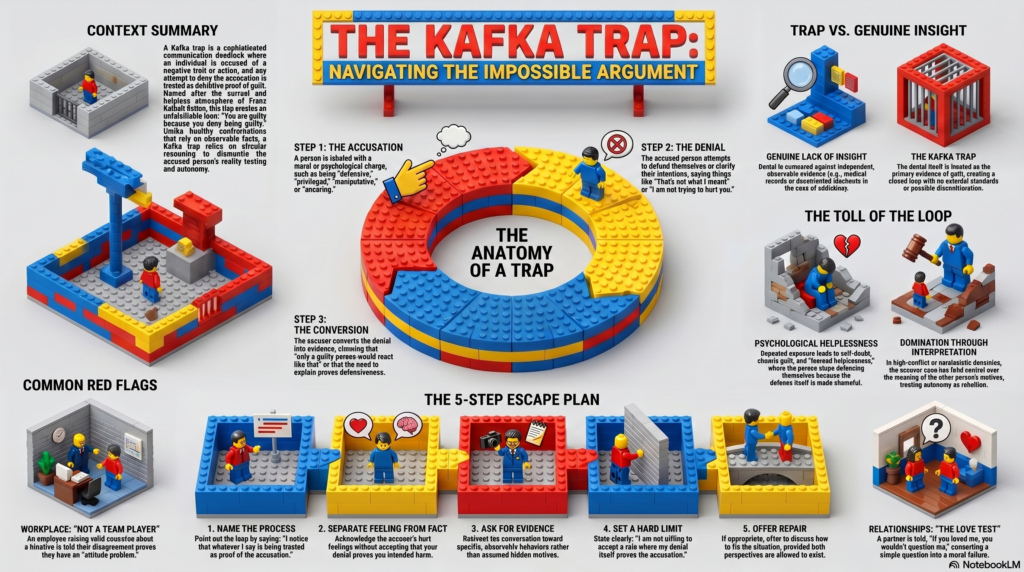
1. What is the structure of a Kafka trap?
A Kafka trap usually has three parts.
1. An accusation
Someone says:
“You are insensitive.”
“You are manipulative.”
“You are privileged.”
“You are gaslighting me.”
“You are defensive.”
“You don’t care.”
2. A denial or clarification
The accused person says:
“That is not what I meant.”
“I don’t think that is fair.”
“Can I explain?”
“I am not trying to hurt you.”
3. The denial is converted into evidence
The accuser says:
“Your denial proves my point.”
“Only a guilty person would react like that.”
“Your need to explain shows you are defensive.”
“If you were truly innocent, you would not be upset.”
The result is a closed loop.
There is no possible response that proves innocence.
2. Why is it psychologically powerful?
The Kafka trap is powerful because it attacks the person’s ability to defend reality.
Usually, in healthy communication, there are three possibilities:
- The accusation may be true.
- The accusation may be partly true.
- The accusation may be false.
But in a Kafka trap, only one option is allowed:
“The accusation is true.”
Everything else becomes resistance, denial, defensiveness, fragility, narcissism, manipulation, or lack of insight.
This produces helplessness.
The person feels:
“Whatever I say will be used against me.”
This is why Kafka traps are emotionally exhausting.
3. Everyday examples
Example 1: Relationship
Partner A:
“You don’t care about me.”
Partner B:
“I do care. I was just busy at work.”
Partner A:
“Exactly. You always have excuses. You care more about work.”
Here, explanation is treated as proof of emotional neglect.
Example 2: Family
Parent:
“You are ungrateful.”
Child:
“I am not ungrateful. I just felt hurt.”
Parent:
“See? You cannot even accept correction. That proves how ungrateful you are.”
The child cannot express hurt because hurt itself becomes evidence of badness.
Example 3: Workplace
Manager:
“You are not a team player.”
Employee:
“I have been contributing, but I had concerns about the timeline.”
Manager:
“That is exactly the attitude problem I am talking about.”
The employee’s attempt to clarify becomes evidence of non-cooperation.
Example 4: Therapy or interpersonal conflict
Person A:
“You are gaslighting me.”
Person B:
“I am not gaslighting you. I remember the event differently.”
Person A:
“That is gaslighting. You are denying my reality.”
This is especially difficult because real gaslighting exists. But not every disagreement about reality is gaslighting.
4. Kafka trap vs genuine lack of insight
This distinction is very important.
Sometimes a person denies something because they genuinely lack insight.
For example:
A person with alcohol dependence may say:
“I don’t have a drinking problem.”
But the evidence may show repeated blackouts, withdrawal, family conflict, and occupational impairment.
That is not automatically a Kafka trap.
A Kafka trap occurs when denial is treated as proof without independent evidence.
Difference
| Situation | What happens |
|---|---|
| Genuine lack of insight | Denial is compared with observable evidence |
| Kafka trap | Denial itself is treated as evidence |
| Healthy confrontation | “Let us look at facts.” |
| Kafka trap | “Your disagreement proves guilt.” |
So the problem is not that someone is challenged. The problem is that the accusation becomes immune to examination.
5. Kafka trap vs circular reasoning
The Kafka trap is a form of circular reasoning.
The logic is:
“You are guilty because you deny being guilty.
Your denial proves you are guilty.”
This is like saying:
“You are lying because you say you are telling the truth.”
It creates a sealed argument.
There is no external standard.
No evidence can disconfirm it.
That is why it becomes psychologically coercive.
6. Kafka trap and shame
Kafka traps are especially powerful when they attach to shame.
The accused person may begin to think:
“Maybe I really am bad.”
“Maybe my attempt to defend myself proves I am defective.”
“Maybe I cannot trust my own intentions.”
This is why repeated Kafka-trap communication can be emotionally damaging.
It can produce:
self-doubt,
confusion,
excessive apologizing,
fear of speaking,
chronic guilt,
emotional shutdown,
anger outbursts,
or learned helplessness.
The person may stop defending themselves because defense itself has been made shameful.
7. Kafka trap in high-conflict relationships
In high-conflict relationships, Kafka traps often appear as moral accusations.
Examples:
“If you loved me, you would not question me.”
“If you were honest, you would admit you are wrong.”
“If you were a good husband/wife/child/friend, you would not defend yourself.”
“If you need boundaries, it means you do not care.”
“If you feel hurt by what I said, it means you are too fragile.”
This converts disagreement into moral failure.
The relationship becomes unsafe because one person controls the meaning of the other person’s motives.
8. Kafka trap and borderline communication
In borderline personality organization, Kafka-trap-like communication may appear during intense attachment threat.
For example:
“You don’t care about me.”
“I do care.”
“No, if you cared, I would not feel this way.”
Here, the patient’s emotional reality becomes the only evidence.
The feeling is real, but the conclusion may not be fully accurate.
Clinically, we must validate the feeling without accepting the trap.
Helpful response:
“It really feels like I don’t care right now. I want to take that feeling seriously. At the same time, I don’t want us to conclude that the feeling alone proves I don’t care. Let us look at what happened.”
This preserves both:
emotional validation
and
reality testing.
9. Kafka trap and narcissistic communication
In narcissistic or controlling dynamics, Kafka traps may be used to preserve superiority.
Example:
“You are disrespectful.”
“I was just asking a question.”
“Your questioning proves your disrespect.”
Here, the other person’s autonomy is treated as rebellion.
The trap protects the accuser from accountability.
Any challenge becomes:
disrespect,
betrayal,
disloyalty,
jealousy,
ignorance,
or weakness.
This is not dialogue. It is domination through interpretation.
10. Kafka trap in institutions
Kafka traps are not limited to families or relationships. They can occur in institutions.
Examples:
“You are not committed to the organization.”
“I am committed, but I disagree with this policy.”
“Your disagreement proves lack of commitment.”
Or:
“You are resistant to change.”
“I support change, but I have concerns about implementation.”
“That resistance is exactly the problem.”
This creates a culture where feedback is impossible.
People learn to remain silent.
Innovation dies because disagreement is pathologized.
11. Kafka trap in therapy: a caution for clinicians
Clinicians must be careful not to create Kafka traps unintentionally.
For example:
Therapist:
“You are avoiding your feelings.”
Patient:
“I don’t think I am avoiding. I’m trying to explain.”
Therapist:
“That explanation is another avoidance.”
This may be true sometimes. But if used too quickly, it becomes a trap.
A better stance:
“It may be avoidance, or it may be your attempt to clarify. Let us slow down and examine what is happening.”
Good therapy should increase freedom of thought, not reduce all disagreement to resistance.
12. Psychoanalytic version: “resistance” as Kafka trap
In older psychoanalytic practice, there was sometimes a danger of overusing the concept of resistance.
If the patient agrees, the interpretation is confirmed.
If the patient disagrees, the disagreement is called resistance.
This can become a Kafka trap.
Healthy psychoanalytic work requires humility:
“My interpretation is a hypothesis, not a verdict.”
A good clinician allows the patient to say:
“No, that does not fit.”
And the therapist remains curious.
13. How to recognize a Kafka trap
You may be in a Kafka trap if:
Your denial is treated as proof.
Your explanation is called manipulation.
Your boundaries are called cruelty.
Your distress is called guilt.
Your silence is called admission.
Your emotion is called instability.
Your calmness is called coldness.
Your request for evidence is called defensiveness.
Your attempt to clarify is called avoidance.
Your disagreement is called lack of insight.
The key sign:
There is no acceptable response except confession.
14. What not to do
When caught in a Kafka trap, avoid over-explaining.
Why?
Because the trap feeds on explanation.
The more you explain, the more the other person may say:
“See how defensive you are?”
Avoid:
long justifications,
repeated apologies for things you did not do,
angry counterattacks,
trying to prove your entire character,
arguing about your intentions endlessly.
The goal is not to win inside the trap.
The goal is to step outside it.
15. How to respond to a Kafka trap
Use a calm structure:
1. Name the process
“I notice that whatever I say is being treated as proof of the accusation.”
2. Separate feeling from fact
“I accept that you feel hurt. I do not accept that my denial itself proves I intended harm.”
3. Ask for evidence
“Can we look at the specific behavior rather than assume motive?”
4. Set a limit
“I am willing to discuss what happened. I am not willing to accept a conclusion that cannot be questioned.”
5. Offer repair if appropriate
“If I hurt you, I want to understand it and repair it. But I need us to discuss it in a way where both perspectives can exist.”
16. Useful phrases
In relationships
“I hear that you felt abandoned. I want to understand that. But my explaining myself should not be taken as proof that I abandoned you.”
In family conflict
“I am willing to reflect on whether I was wrong. But I cannot participate in a conversation where disagreement itself is treated as disrespect.”
In workplace conflict
“I am open to feedback. Could we identify the specific behavior and expected alternative?”
In therapy
“That interpretation may be worth exploring. At the moment, it does not feel accurate to me. Can we hold it as a possibility rather than a certainty?”
With a highly dysregulated person
“I don’t want to argue about labels right now. I want to understand what hurt you and what we can do next.”
17. How to avoid creating Kafka traps as a clinician
Clinicians should be careful with labels such as:
defensive,
avoidant,
manipulative,
narcissistic,
attention-seeking,
resistant,
borderline,
dependent,
passive-aggressive.
These terms may be clinically useful, but they can become oppressive if used as closed interpretations.
Better language:
Instead of:
“You are being defensive.”
Say:
“Something in this conversation may be feeling threatening. I wonder what feels at stake.”
Instead of:
“You are avoiding.”
Say:
“I notice we moved away from the feeling. Was that protective, or am I misunderstanding?”
Instead of:
“You are manipulating.”
Say:
“There seems to be a strong need here, but it is coming out indirectly. Can we make the need more direct?”
This keeps the patient’s mind alive in the conversation.
18. Kafka trap and gaslighting: important difference
A Kafka trap and gaslighting can overlap, but they are not the same.
Gaslighting involves making someone doubt their perception of reality.
Kafka trap involves making someone’s denial into proof of guilt.
Example of gaslighting:
“That never happened. You are imagining things.”
Example of Kafka trap:
“Your denial proves you are guilty.”
Both can damage reality testing. But Kafka traps specifically close off the possibility of self-defense.
19. The ethical problem
The Kafka trap is ethically dangerous because it destroys fair dialogue.
A healthy conversation allows:
clarification,
evidence,
context,
mistake,
repair,
difference of perspective,
and uncertainty.
A Kafka trap allows only:
accusation,
confession,
submission,
or punishment.
That is why clinicians, teachers, leaders, parents, and partners must avoid it.
The ability to say, “I may be wrong,” is essential to humane communication.
20. Clinical takeaway
The Kafka trap is not merely a debating trick. It is a relational pattern where one person controls the meaning of another person’s response.
It becomes especially harmful in intimate relationships, families, institutions, and therapy because it attacks the person’s right to clarify their own mind.
A psychologically mature conversation should allow both truths:
“Your feelings matter.”
“My perspective also matters.”
When only one side is allowed to define reality, communication becomes coercive.
Summary
A Kafka trap happens when denial is treated as proof of guilt. It creates a no-win situation where explanation becomes defensiveness, silence becomes admission, and disagreement becomes evidence of pathology. In clinical practice, the antidote is to validate emotion while preserving reality testing, evidence, and mutual subjectivity.
The healthiest response to a Kafka trap is not endless defense, but calm boundary-setting:
“I am willing to examine my behavior. I am not willing to accept a rule where my denial itself proves the accusation.”