Pregabalin Withdrawal After Schedule H1 Regulation: How to Taper Safely and What Alternatives Can Help
 Why this article matters now
India has now moved Pregabalin from Schedule H to Schedule H1, meaning it can be sold only with a valid prescription, pharmacies must maintain sale records, and packaging must carry Schedule H1 warnings. The government cited misuse, especially among youth, and reports of illegal stocking and unauthorised sale.
This is a good public-health step. But there is one important clinical risk:
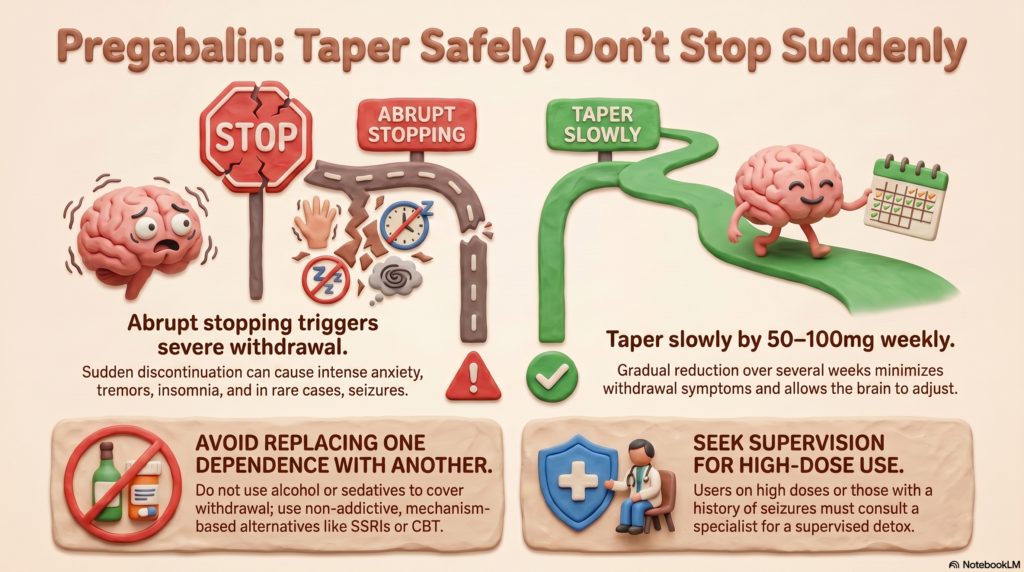
When access suddenly becomes difficult, patients who are dependent on Pregabalin may stop abruptly — and that can trigger withdrawal.
The goal should not be panic, punishment, or sudden stoppage. The goal should be safe tapering, treatment of the original condition, and withdrawal-free or low-withdrawal transition wherever possible.
What Pregabalin does in the brain
Pregabalin is a gabapentinoid. Despite the name, it does not directly act like GABA. It binds mainly to the alpha-2-delta subunit of voltage-gated calcium channels in the nervous system. This reduces the release of excitatory neurotransmitters such as glutamate, noradrenaline, and substance P.
That is why it can help in:
- Neuropathic pain
- Fibromyalgia
- Certain seizure disorders
- Anxiety symptoms in selected patients
- Sleep disturbance related to pain or anxiety
But the same calming, sedating, and anxiolytic effects can also produce misuse, dose escalation, craving, and withdrawal in vulnerable individuals.
What Pregabalin withdrawal looks like
Withdrawal may include:
- Anxiety, panic, irritability
- Insomnia
- Sweating
- Tremors
- Palpitations
- Nausea, loose stools
- Body pain or rebound nerve pain
- Restlessness
- Low mood
- Craving
- Rarely: confusion, hallucinations, seizures
The FDA prescribing information advises that Pregabalin should be tapered gradually over at least one week rather than stopped abruptly, and warns about risks such as withdrawal symptoms and seizure worsening in vulnerable patients.
The key principle: do not replace one dependence with another
A common mistake is to stop Pregabalin suddenly and cover withdrawal with benzodiazepines, alcohol, sleeping tablets, or opioids.
That is risky.
Pregabalin itself can increase sedation and respiratory risk when combined with other central nervous system depressants, including opioids and sedatives.
So withdrawal management should be:
Structured taper + mechanism-based alternatives + monitoring + treatment of the original problem.
Dose-specific Pregabalin tapering principles
There is no single taper for everyone. The taper depends on current dose, duration, kidney function, seizure history, psychiatric comorbidity, and substance-use history.
A practical deprescribing guide from Hull University Teaching Hospitals suggests reducing Pregabalin by a maximum of 50–100 mg per week. Other deprescribing guidance also supports gradual weekly reductions in this range.
Example taper: Pregabalin 300 mg/day
For someone taking 150 mg morning + 150 mg night:
Week 1: 150 mg morning + 75 mg night = 225 mg/day
Week 2: 75 mg morning + 75 mg night = 150 mg/day
Week 3: 50 mg morning + 50 mg night = 100 mg/day
Week 4: 25 mg morning + 25 mg night = 50 mg/day
Week 5: Stop or continue 25 mg night for a few more days, depending on symptoms
This is close to published example schedules for 150 mg twice daily.
Example taper: Pregabalin 600 mg/day
For someone taking 300 mg twice daily, especially long-term:
Week 1: 300 mg morning + 225 mg night = 525 mg/day
Week 2: 225 mg morning + 225 mg night = 450 mg/day
Week 3: 225 mg morning + 150 mg night = 375 mg/day
Week 4: 150 mg morning + 150 mg night = 300 mg/day
Then taper more slowly by 50–75 mg/week.
High-dose users should generally not attempt unsupervised tapering.
Mechanism-based alternatives during taper
1. For neuropathic pain
Alternatives may include:
Duloxetine
Mechanism: serotonin-noradrenaline reuptake inhibition.
Useful when nerve pain coexists with depression, anxiety, fatigue, or fibromyalgia-like symptoms.
Common clinical dose range: 30–60 mg/day, sometimes increased depending on indication and tolerance.
Amitriptyline or Nortriptyline
Mechanism: serotonin-noradrenaline reuptake inhibition, sodium-channel effects, sleep benefit.
Useful when pain is worse at night and sleep is poor.
Common clinical starting dose: 10–25 mg at night, titrated gradually.
Gabapentin
Mechanism: similar alpha-2-delta calcium-channel modulation.
May help some patients, but it is also a gabapentinoid and can also cause dependence/withdrawal. It should not be treated as a harmless substitute. Switching guidance notes that evidence is limited and conversion must be individualised.
2. For anxiety during taper
SSRIs/SNRIs
Mechanism: longer-term regulation of serotonergic and noradrenergic circuits.
Examples: sertraline, escitalopram, duloxetine, venlafaxine.
These do not give immediate sedation like Pregabalin, but they treat the underlying anxiety disorder more sustainably.
Buspirone
Mechanism: 5-HT1A partial agonism.
May help generalised anxiety without typical sedative dependence risk.
Psychological approaches
CBT, relaxation training, worry scheduling, breathing retraining, and sleep-focused behavioural work are essential because withdrawal often amplifies body sensations and catastrophic thinking.
3. For insomnia
Avoid reflexively replacing Pregabalin with benzodiazepines or Z-drugs.
Safer options may include:
- Sleep hygiene and stimulus control
- Melatonin in selected cases
- Treating pain at night
- Low-dose sedating antidepressants when clinically appropriate
- Short-term symptomatic treatment only under supervision
4. For body pain and autonomic symptoms
Supportive treatment may include:
- Hydration
- Regular meals
- Magnesium only if deficient or clinically appropriate
- Paracetamol/NSAIDs where safe
- Physiotherapy
- Graded activity
- Heat therapy
- Relaxation breathing
When inpatient or supervised detox is safer
Consider specialist or inpatient management if there is:
- Very high-dose Pregabalin use
- Polysubstance use
- Alcohol, opioid, or benzodiazepine dependence
- Seizure history
- Severe psychiatric symptoms
- Suicidal thoughts
- Confusion or hallucinations
- Failed repeated outpatient tapers
- Poor family supervision
Pregabalin withdrawal has been reported even after therapeutic doses and relatively short durations, so risk should not be dismissed just because the medicine was initially prescribed.
Patient-friendly message
Pregabalin is not banned. It is now more strictly regulated.
Patients who genuinely need it can still receive it with a valid prescription. The danger is not medical use. The danger is casual use, self-medication, dose escalation, mixing with alcohol/sedatives, and sudden stopping.
Final clinical takeaway
A sudden regulatory change should not become a sudden medical discontinuation.
The safest path is:
Assess → stabilise → taper slowly → treat the original condition → use non-addictive alternatives → monitor relapse and withdrawal.
Pregabalin withdrawal can be managed safely, but it should be done thoughtfully and medically — not through panic stopping.
Dr. Srinivas Rajkumar T, MD (AIIMS), DNB, MBA (BITS Pilani)
Consultant Psychiatrist & Neurofeedback Specialist
Mind & Memory Clinic, Apollo Clinic Velachery (Opp. Phoenix Mall)
✉ srinivasaiims@gmail.com 📞 +91-8595155808
Related posts:
- Pregabalin Now Under Schedule H1 in India: What Patients, Families, and Doctors Need to Know
- How to Safely Taper Sleep Medicines in the Elderly
- Moving From Schedule X to Safer Alternatives in Psychiatry: A Practical Guide for Indian Patients & Caregivers
- Withdrawal or Relapse – Drug Withdrawal or Relapse of Illness : A Critical Clinical Distinction