The Consistency Gap: Why Bright Minds Struggle with ADHD
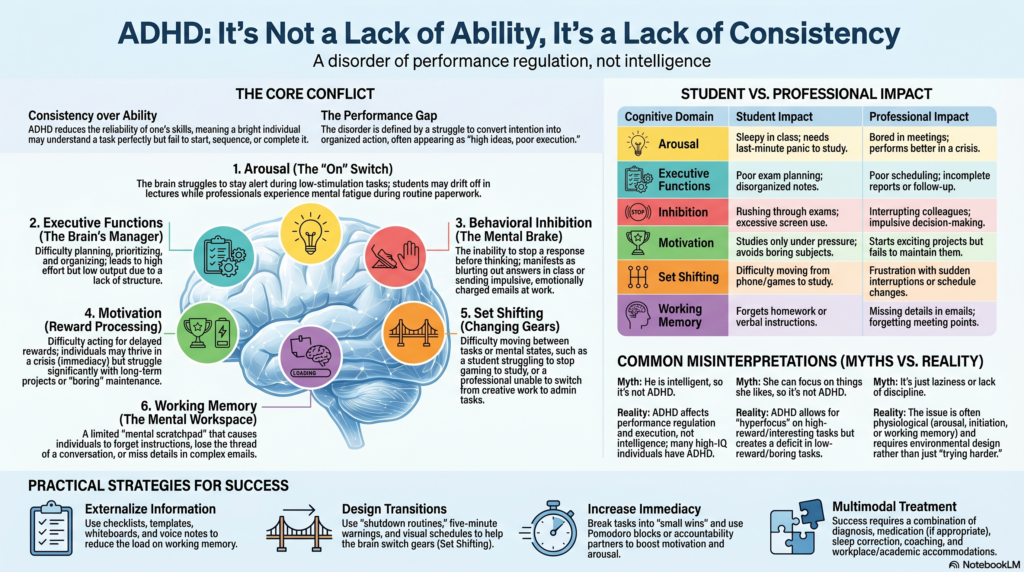 Have you ever wondered why a brilliant student fails to submit assignments on time? Or why a talented professional produces excellent ideas but repeatedly misses deadlines? Or why someone can focus for hours on something exciting, yet feel completely stuck when it comes to routine work?
This is one of the most misunderstood aspects of Attention-Deficit/Hyperactivity Disorder, or ADHD.
ADHD is often described casually as a problem of “poor concentration.” But clinically, that is too simplistic. Many individuals with ADHD can concentrate very well—sometimes intensely—when the task is interesting, urgent, novel, or emotionally rewarding.
The real difficulty is not always ability.
It is consistency.
ADHD does not necessarily reduce intelligence, creativity, or potential. Instead, it affects the brain’s ability to regulate performance reliably across situations. A person may know exactly what needs to be done, may genuinely want to do it, and may even have the talent to do it well—but still struggle to start, organise, persist, shift, or finish.
This creates what I call the consistency gap: the painful distance between a person’s actual potential and their day-to-day execution.
ADHD Is Not Just a Focus Problem
ADHD is better understood as a disorder of self-regulation, executive control, reward processing, and performance regulation.
For students, it may look like:
- Studying only at the last minute
- Forgetting assignments despite good understanding
- Making careless mistakes in exams
- Losing interest once the novelty of a subject fades
- Spending hours on planning but very little on actual execution
For professionals, it may look like:
- Starting many projects but completing few
- Being excellent in crisis situations but poor with routine paperwork
- Missing deadlines despite strong capability
- Struggling with meetings, documentation, or follow-through
- Feeling chronically overwhelmed despite working hard
This is why ADHD is often missed in intelligent people. Their abilities may compensate for years. But as life becomes more complex, the hidden executive difficulties become more visible.
1. Arousal: The Struggle to Stay “Switched On”
Arousal refers to the brain’s readiness for action.
In ADHD, the brain often struggles to maintain alertness during boring, repetitive, or low-stimulation tasks. This is why a student may feel sleepy during a lecture but become fully alert while playing a game. A professional may feel mentally absent during routine meetings but perform brilliantly during emergencies.
This is not simple laziness. It reflects difficulty in regulating brain activation.
How it appears in real life
A student may postpone studying until exam pressure creates enough stimulation. A professional may delay reports until the deadline becomes frighteningly close. The person may appear “careless,” but internally they may be waiting for the brain to finally switch on.
What helps
Tasks need to be made shorter, more active, and more rewarding. Pomodoro blocks, movement breaks, active recall, visual timers, body doubling, and gamified progress tracking often work better than simply saying, “I must focus harder.”
2. Executive Functions: The Brain’s Mental Office
Executive functions are the brain’s management system. They help us plan, prioritise, organise, sequence, estimate time, and monitor progress.
In ADHD, this “mental office” becomes disorganised. The person may have ideas, intentions, and motivation—but may struggle to convert them into structured action.
How it appears in students
A student may buy notebooks, make timetables, download apps, and plan extensively, but still fail to sit and study consistently. They may underestimate how long a task will take and overestimate how much can be done in one evening.
How it appears in professionals
A professional may be creative and insightful but struggle with emails, documentation, billing, deadlines, or administrative follow-up. This creates a pattern of high effort but inconsistent output.
What helps
Structure must be externalised. The ADHD brain should not be expected to hold everything internally. Calendars, checklists, templates, written workflows, reminders, visual boards, and fixed routines reduce the burden on executive functioning.
The goal is not to become more “disciplined” through guilt. The goal is to design systems that reduce friction.
3. Behavioural Inhibition: Difficulty Applying the Brakes
Behavioural inhibition is the ability to pause before acting.
It allows a person to stop an automatic response and choose a better one. In ADHD, this braking system may be weaker or slower. The person may act before fully thinking through the consequences.
How it appears in students
Students may rush through exams, skip instructions, interrupt others, make careless mistakes, or struggle to stop using the phone even when they know they should study.
How it appears in professionals
Professionals may interrupt in meetings, send emotionally charged messages, make impulsive decisions, or jump into new projects without completing older ones.
What helps
The key is to create a pause between impulse and action.
Simple rules can help: wait before sending important messages, write down decisions before acting on them, keep the phone away during deep work, and use checklists for repetitive tasks where mistakes commonly occur.
In ADHD, the environment must support inhibition. Willpower alone is often unreliable.
4. Motivation: The Delayed Reward Problem
One of the most confusing features of ADHD is the motivation gap.
A person may focus intensely on something exciting but feel almost paralysed when facing a boring but important task. This is why ADHD is often mistaken for laziness or lack of seriousness.
But ADHD motivation is not absent. It is often interest-based, urgency-based, or reward-based.
Tasks with immediate reward are easier. Tasks with delayed reward are harder.
How it appears in students
A student may study well the night before an exam but struggle to study two months in advance. They may know that early preparation is better, but the reward feels too distant to activate effort.
How it appears in professionals
A professional may enjoy brainstorming, problem-solving, or crisis work, but struggle with documentation, routine follow-up, tax work, or long-term planning.
What helps
Rewards must be made immediate and visible.
Break work into smaller milestones. Use progress trackers. Create accountability. Pair boring tasks with mildly rewarding conditions. Use short deadlines instead of distant deadlines. Make the first step so small that starting becomes easier.
For ADHD, motivation often follows action. Waiting to “feel motivated” may not work.
5. Set Shifting: Difficulty Changing Mental Gears
Set shifting is the ability to move from one task, rule, or mental state to another.
In ADHD, transitions can be difficult. The person may get stuck in one activity even when they know they need to move on.
How it appears in students
A student may plan to watch one video and then study, but two hours later they are still scrolling. The difficulty is not always enjoyment—it may be difficulty disengaging.
How it appears in professionals
A professional may find it hard to switch from creative work to administrative work, from clinic mode to family mode, or from one unfinished task to another.
What helps
Transitions need design.
Five-minute warnings, shutdown rituals, separate workspaces, visual schedules, transition alarms, and “bridge routines” can help the brain shift gears.
For example, after work, a fixed routine such as closing the laptop, writing tomorrow’s first task, taking a short walk, and then entering home mode can reduce cognitive spillover.
6. Working Memory: The Easily Overloaded Mental Workspace
Working memory is the brain’s short-term workspace. It allows us to hold information in mind and use it.
In ADHD, this workspace can become overloaded quickly.
How it appears in students
A student may forget instructions, lose track while reading, make calculation errors, or forget what they were about to write.
How it appears in professionals
A professional may forget why they entered a room, miss details in meetings, lose track of tasks, or remember something important only after the deadline has passed.
What helps
Important information should not remain only in the head.
Use notes, whiteboards, voice memos, checklists, calendars, sticky notes, and task management apps. The ADHD brain performs better when memory is externalised and visible.
A simple principle is: If it matters, write it down immediately.
Why ADHD Becomes More Visible with Age
Many people are diagnosed with ADHD only in college, during professional training, after marriage, after becoming parents, or after taking on leadership roles.
This happens because earlier life often provides external structure.
In school, parents and teachers may monitor assignments, routines, food, sleep, and deadlines. But in adulthood, the person must manage everything independently: work, finances, relationships, health, time, emotions, and long-term goals.
When external structure reduces and self-management demands increase, ADHD becomes more obvious.
This is why bright students may suddenly struggle in college. It is why talented professionals may feel overwhelmed after promotion. It is why adults may say, “I was managing somehow earlier, but now everything is falling apart.”
The problem was not absent earlier. It was compensated.
ADHD and Emotional Burden
The consistency gap is not merely practical. It becomes emotional.
Repeated underperformance despite ability can lead to shame, anxiety, low self-esteem, irritability, and burnout. Many individuals with ADHD grow up hearing:
“You are careless.”
“You are wasting your potential.”
“You can do it when you want to.”
“You are intelligent, but not disciplined.”
Over time, these comments become internal beliefs. The person may begin to think they are lazy, irresponsible, or defective.
A more accurate understanding is essential.
ADHD is not a moral failure. It is a neurodevelopmental condition that affects self-regulation. With the right treatment and systems, functioning can improve significantly.
Treatment Is Not Just About Medication
Medication can be very helpful in ADHD, but treatment should not stop there.
A comprehensive ADHD plan may include:
- Accurate clinical diagnosis
- Screening for anxiety, depression, sleep problems, substance use, and learning difficulties
- Medication when appropriate
- Sleep correction
- Executive-function coaching
- Environmental redesign
- Digital hygiene
- Family psychoeducation
- Academic or workplace accommodations
- Emotional regulation strategies
The goal is not just to “increase focus.”
The goal is to help the person convert ability into consistent functioning.
Practical Daily Strategies for ADHD
Here are some simple but powerful strategies:
1. Make tasks visible
Do not keep tasks only in memory. Use a board, notebook, calendar, or app.
2. Reduce task size
“Study chemistry” is too vague. “Read two pages and answer five questions” is better.
3. Start with the smallest possible step
Opening the document, writing the title, or arranging the desk may be enough to create momentum.
4. Use timers
Time blindness is common in ADHD. Timers make time external and visible.
5. Use body doubling
Working in the presence of another person, even silently, can improve task initiation.
6. Create friction for distractions
Keep the phone away. Block apps. Log out of distracting websites. Make distraction slightly harder.
7. Create routines for repeated tasks
The more decisions you remove, the easier execution becomes.
8. Reward progress, not perfection
ADHD improvement is built through repeated small wins.
The Bottom Line
ADHD is not simply a disorder of concentration. It is a disorder of consistency, regulation, execution, and self-management.
Many individuals with ADHD are intelligent, creative, emotionally intense, and capable. Their struggle is not lack of potential. Their struggle is converting potential into predictable performance.
When we understand ADHD properly, we stop asking, “Why are you not trying harder?”
We start asking, “What system will help your brain perform more consistently?”
That shift changes everything.
About the Author
Dr. Srinivas Rajkumar T, MD (AIIMS, New Delhi), DNB, MBA (BITS Pilani)
Consultant Psychiatrist & Neurofeedback Specialist
Mind & Memory Clinic, Apollo Clinic Velachery (Opp. Phoenix Mall)
✉ srinivasaiims@gmail.com 📞 +91-8595155808