How to Recognize Early Dementia in a Loved One: A Practical Guide for Family Caregivers
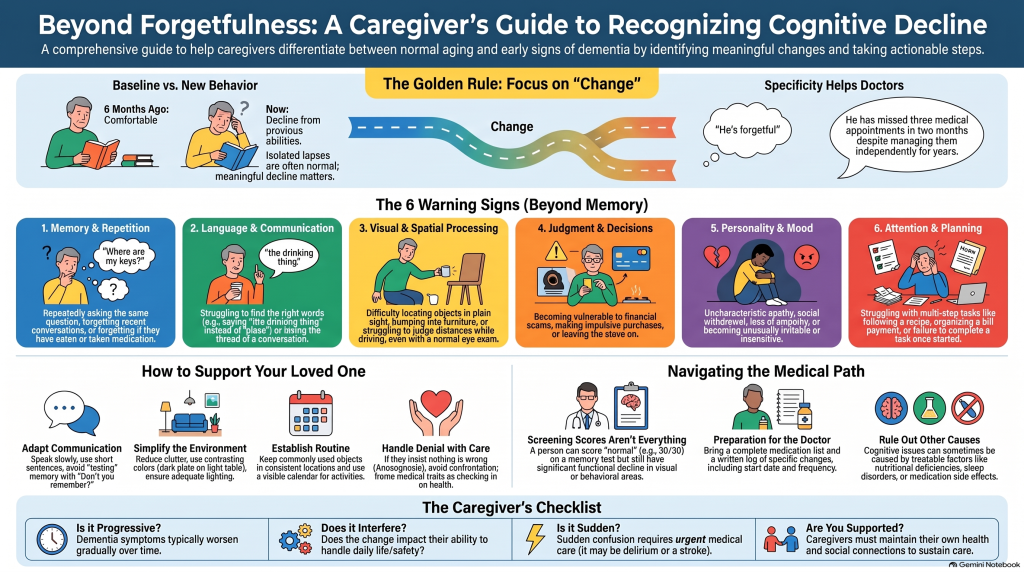 Is your parent becoming forgetful, behaving differently, or struggling with familiar activities? Learn how to recognize meaningful cognitive changes, understand what they may indicate, and support your loved one with patience and confidence.
When an aging parent forgets an appointment, repeats a question, or misplaces their glasses, it is natural to wonder whether these are ordinary age-related changes or early signs of dementia.
For many families, the first signs are subtle. A mother who previously managed the household effortlessly starts making mistakes while cooking. A father who handled the family’s finances for decades suddenly struggles with banking. A spouse who was always considerate becomes unusually irritable or withdrawn.
These changes can be confusing and emotionally difficult, particularly when the person experiencing them insists that nothing is wrong.
Dementia does not always begin with memory loss. It can initially affect language, attention, judgment, visual perception, or behavior.
For caregivers, recognizing these changes early is important. It can help families seek appropriate medical evaluation, identify potentially treatable conditions, improve safety, and plan for the future.
This guide explains what to observe, what questions to ask, and how to support a loved one who may be experiencing cognitive decline.
1. Start by Asking: What Has Changed?
Everyone occasionally forgets a name, misplaces an object, or struggles to concentrate.
An isolated memory lapse does not necessarily indicate dementia.
What matters more is whether there has been a noticeable change from the person’s previous abilities.
Consider two examples.
Your father has always been somewhat forgetful about where he keeps his keys. This has been a longstanding habit and has not become significantly worse.
Your mother, who previously remembered every family appointment, has recently started missing important meetings and repeatedly asking about events that have already taken place.
The second situation deserves closer attention because it represents a change from previous functioning.
As a caregiver, ask yourself:
-
What could my loved one do comfortably six months or a year ago that they now find difficult?
-
When did I first notice the change?
-
Is the problem gradually becoming more frequent?
-
Does it interfere with everyday activities?
-
Have other family members noticed similar changes?
Try to identify specific examples rather than relying on general impressions.
Instead of saying, “My father is becoming forgetful,” it may be more helpful to tell the doctor:
“My father has missed three medical appointments in the past two months, even though he previously managed his appointments independently.”
Specific examples help doctors understand the nature and severity of the problem.
2. Memory Changes: Is Your Loved One Repeatedly Forgetting Recent Events?
Memory loss is one of the most recognized symptoms of dementia, particularly Alzheimer’s disease.
However, the pattern of forgetting is often more informative than the occasional memory lapse.
What caregivers may notice
Your loved one may repeatedly ask the same question within a short period.
They may forget conversations that happened earlier in the day.
They may forget important appointments, family visits, or recent events.
They may repeat the same story without realizing they have already told it.
They may forget whether they have eaten or taken their medication.
They may struggle to remember something that happened the previous week.
Questions to consider
Does your loved one repeatedly ask a question even after receiving an answer?
Do they forget important events that they would previously have remembered?
Do they remember information when you provide a reminder?
Do they frequently forget recent conversations but remember events from many years ago?
Have they started relying more heavily on family members for appointments and medications?
How caregivers can help
Use a visible calendar for appointments and important activities.
Keep commonly used objects in consistent locations.
Establish regular routines for meals, medications, and sleep.
Provide gentle reminders without repeatedly testing the person’s memory.
Avoid asking questions such as, “Don’t you remember what I told you five minutes ago?”
Such questions may increase frustration or embarrassment without improving memory.
Instead, calmly provide the information again.
If medication errors are occurring, arrange a supervised medication routine rather than relying exclusively on reminders.
3. Language Changes: When Your Loved One Struggles to Find Words
Not every complaint of forgetting indicates a memory problem.
Some people develop difficulty finding the correct words during conversation.
Others may struggle to understand familiar words or follow conversations despite having adequate hearing.
These changes may reflect impairment in language rather than memory.
What caregivers may notice
Your loved one may pause frequently while speaking.
They may describe an object instead of naming it.
For example, they may say, “Give me that thing used for drinking water,” instead of asking for a glass.
They may use an incorrect word or pronounce familiar words incorrectly.
They may have difficulty understanding instructions.
Their conversations may become shorter or less informative.
They may gradually speak less because communication has become difficult.
How caregivers can help
Speak slowly and clearly without speaking to the person as though they are a child.
Use short, straightforward sentences.
Allow enough time for the person to respond.
Avoid interrupting or completing every sentence for them.
If they cannot find a word, gently offer a suggestion when appropriate.
Reduce background noise from televisions or other conversations.
Use gestures, pictures, or written information if these make communication easier.
Most importantly, continue including your loved one in conversations and family decisions whenever possible.
Difficulty expressing words does not automatically mean that a person cannot understand what others are saying.
4. Visual and Spatial Changes: When the Person Cannot Find Things That Are Clearly Visible
Some people with cognitive impairment develop difficulty interpreting visual information.
Their eyesight may be relatively normal, but the brain may struggle to process what they see.
This can be particularly confusing for families.
A person may repeatedly complain that they cannot see objects, even after an eye examination finds no significant problem.
What caregivers may notice
Your loved one may struggle to locate an object on a crowded table.
They may reach inaccurately for a cup or plate.
They may frequently bump into furniture.
They may struggle to find clothes inside a cupboard.
They may become confused in familiar surroundings.
They may develop difficulty judging distances or navigating stairs.
They may have increasing difficulty driving.
Why this matters
Some dementia syndromes predominantly affect visual and spatial processing.
One example is posterior cortical atrophy, which is commonly associated with Alzheimer’s disease pathology.
People with this condition may initially seek ophthalmological consultations because the symptoms appear to involve vision.
A normal eye examination does not necessarily exclude a problem with the brain’s visual processing.
How caregivers can help
Keep frequently used objects in consistent locations.
Reduce unnecessary clutter.
Ensure adequate lighting throughout the home.
Remove obstacles from walking areas.
Use contrasting colors to make important objects easier to identify.
For example, a dark plate on a light-colored table may be easier to locate than a white plate on a white table.
Consider an occupational therapy assessment when visual difficulties affect everyday safety.
If your loved one has developed significant difficulties judging distances, locating objects, or navigating roads, driving safety should be professionally assessed.
Do not assume that better spectacles alone will solve the problem.
5. Changes in Judgment: When Previously Sensible Decisions Become Unusual
Some of the earliest changes in cognitive impairment may involve judgment and decision-making.
A person who previously managed finances responsibly may suddenly become vulnerable to scams.
Someone who was always cautious may begin making impulsive or unsafe decisions.
These changes can have serious consequences for the individual and family.
What caregivers may notice
Your loved one may make unusual financial transactions.
They may give money to strangers or respond to suspicious calls.
They may purchase unnecessary items.
They may struggle to understand the consequences of their decisions.
They may leave the stove switched on.
They may make unsafe decisions while driving.
They may behave inappropriately in social situations.
How caregivers can help
Review financial arrangements when there is evidence of increasing difficulty.
Consider transaction alerts and appropriate safeguards against scams.
Discuss important financial decisions together while respecting the person’s preferences.
Ensure that emergency contact information is easily accessible.
Assess safety risks involving cooking, driving, medications, and household appliances.
If significant decision-making difficulties are present, seek a professional assessment of the person’s ability to make the specific decisions in question.
Remember that having dementia does not automatically mean someone lacks the capacity to make all decisions.
Decision-making ability can vary depending on the complexity of the decision and the person’s cognitive abilities.
The goal should be to preserve independence wherever possible while providing appropriate protection.
6. Personality Changes: When Your Loved One No Longer Behaves Like Themselves
For some families, changes in personality are more noticeable than memory difficulties.
A previously affectionate spouse may become emotionally distant.
A responsible parent may begin behaving impulsively.
An active individual may lose interest in hobbies, social gatherings, or family activities.
These changes can be particularly painful because family members may interpret them as intentional behavior.
What caregivers may notice
Your loved one may become unusually apathetic or withdrawn.
They may show reduced interest in activities they previously enjoyed.
They may become impulsive or socially inappropriate.
They may make comments that seem insensitive.
They may show less empathy toward others.
They may develop repetitive behaviors or rigid routines.
Their eating habits may change.
They may become less attentive to personal hygiene.
What these changes may indicate
Progressive behavioral and personality changes can occur in several conditions.
Behavioral variant frontotemporal dementia is one possible cause when changes in behavior, judgment, empathy, and inhibition are prominent.
However, depression, medication effects, sleep disorders, and other medical or neurological conditions may also produce behavioral changes.
A proper clinical evaluation is necessary to understand the cause.
How caregivers can help
Try to understand the behavior in the context of the person’s cognitive difficulties.
Avoid prolonged arguments about whether their behavior is appropriate.
Use simple explanations and consistent routines.
Identify environmental situations that trigger agitation or distress.
Provide structured activities that match the person’s abilities.
If behavioral changes are severe, distressing, or create safety concerns, seek professional guidance.
Caregivers should also recognize that sudden behavioral changes may indicate an acute medical problem, particularly when accompanied by confusion or altered alertness.
7. Attention and Planning: When Everyday Tasks Become Difficult
Some individuals remember what they need to do but struggle to organize or complete the activity.
For example, your mother may remember that she needs to prepare lunch but become confused about the sequence of steps.
Your father may remember that he needs to pay a bill but struggle to organize the required information.
These difficulties may involve attention and executive functioning.
What caregivers may notice
The person may struggle to follow multistep instructions.
They may lose track of activities.
They may begin tasks but fail to complete them.
They may become slower at performing familiar activities.
They may struggle to organize medications or appointments.
They may find it difficult to switch between tasks.
How caregivers can help
Break complicated activities into smaller steps.
Provide one instruction at a time.
Use written checklists when helpful.
Maintain predictable routines.
Allow additional time for completing activities.
Avoid rushing the person or correcting every minor mistake.
Offer assistance with the difficult parts of a task while allowing them to complete the remaining steps independently.
Preserving involvement in familiar activities can support confidence, autonomy, and quality of life.
8. What if Your Loved One Says Nothing Is Wrong?
One of the most challenging situations for caregivers occurs when the family notices clear difficulties but the person insists that everything is normal.
They may deny forgetting appointments, reject assistance, or become upset when family members raise concerns.
Sometimes this reflects reduced awareness of cognitive impairment, known as anosognosia.
Anosognosia is not necessarily deliberate denial.
A person may genuinely be unable to recognize the extent of their difficulties.
However, disagreement between a patient and family member does not automatically indicate anosognosia.
There may also be differences in perception, emotional responses, or concerns about independence.
How caregivers can respond
Avoid repeatedly confronting the person with evidence of their mistakes.
Do not turn everyday conversations into memory tests.
Use supportive language when suggesting a medical consultation.
For example:
“I have noticed that a few things have become more difficult recently. It might be helpful to speak with a doctor and understand whether anything needs attention.”
Frame the consultation around understanding health and maintaining independence rather than proving that the person has dementia.
With the patient’s permission where appropriate, provide the doctor with specific examples of the changes you have observed.
A separate caregiver discussion can sometimes help communicate concerns that are difficult to discuss openly in front of the patient.
9. When Should Families Seek a Medical Evaluation?
Not every memory complaint is caused by dementia.
Cognitive difficulties can also occur with depression, anxiety, sleep disorders, medication effects, nutritional deficiencies, metabolic disturbances, and other medical conditions.
Some of these contributors may be treatable.
A medical evaluation is particularly important when cognitive or behavioral changes are progressive, interfere with everyday activities, or raise concerns about safety.
Seek professional assessment if your loved one is experiencing repeated memory lapses, progressive language difficulties, unusual behavioral changes, increasing dependence on family members, or problems with navigation and judgment.
Sudden confusion, new neurological symptoms, or rapid changes in alertness require urgent medical evaluation.
These symptoms may indicate delirium, stroke, or another acute medical condition rather than a slowly progressive dementia.
10. Why a Normal Memory Test Does Not Always Mean Everything Is Fine
Many families feel reassured when their loved one receives a normal score on a brief memory screening test.
However, screening instruments such as the MMSE and MoCA do not comprehensively evaluate every aspect of cognitive functioning.
Some individuals with early dementia may perform relatively well on screening tests, particularly if they previously had high cognitive abilities.
Others may have prominent language, visual processing, or behavioral difficulties that are not adequately captured by a brief screening score.
In one published clinical case, a man with progressive visuospatial impairment scored 30 out of 30 on the MMSE despite significant difficulties with everyday activities.
Detailed neuropsychological testing helped identify the nature of his impairment.
This illustrates why persistent concerns should not be dismissed solely because a screening score is normal.
A comprehensive assessment may be helpful when symptoms continue despite apparently reassuring screening results.
11. How to Prepare for Your Loved One’s Dementia Consultation
A little preparation can make a medical consultation considerably more informative.
Before the appointment, write down the specific changes you have observed.
Try to establish when each symptom began and whether it has become more frequent or severe.
Document changes in memory, language, behavior, judgment, daily activities, and independence.
Bring a complete list of medications, including over-the-counter products and supplements.
Carry relevant medical records, previous cognitive assessments, and available brain imaging reports.
It is also helpful to describe the person’s educational background, occupation, and previous level of functioning.
For example, a retired accountant struggling with familiar calculations may have experienced a meaningful decline even if their performance remains within the average range for someone of the same age.
If possible, a family member who knows the person well should accompany them to the consultation.
The objective is to provide the clinician with a clear picture of what has changed and how those changes affect everyday life.
12. Caring for Yourself Is Also Part of Dementia Care
Supporting someone with cognitive impairment can be emotionally and physically demanding.
Caregivers may experience frustration when questions are repeated, sadness when personality changes occur, or anxiety about the person’s future.
As the condition progresses, responsibilities involving medications, finances, appointments, and personal care may increase.
It is important to recognize that caregivers also need support.
Share responsibilities with other family members whenever possible.
Maintain your own medical appointments, sleep, physical activity, and social connections.
Consider caregiver support groups or professional counseling when the emotional burden becomes difficult to manage.
Arrange respite care when available and appropriate.
You do not have to manage every aspect of care independently.
Seeking support can help sustain your ability to care for your loved one over time.
13. A Practical Checklist for Family Caregivers
If you are concerned about a loved one’s cognitive health, consider the following questions.
Memory: Are they repeatedly forgetting recent conversations, appointments, or important events?
Language: Are they struggling to find words or understand conversations?
Visual processing: Are they having difficulty locating objects, judging distances, or navigating familiar surroundings?
Judgment: Have they started making unusual financial or safety-related decisions?
Behavior: Have there been noticeable changes in personality, empathy, motivation, or social conduct?
Attention and planning: Are familiar activities becoming difficult to organize or complete?
Independence: Do they now require assistance with tasks they previously managed independently?
Progression: Have these changes gradually worsened over time?
If you identify persistent or progressive changes, particularly when they affect everyday functioning, arrange a professional cognitive evaluation.
These questions are intended to guide observation. They are not a diagnostic test, and the presence of one or more symptoms does not establish dementia.
Conclusion: Look Beyond Forgetfulness
Dementia is more than memory loss.
It can affect language, attention, judgment, visual perception, personality, and everyday functioning.
For caregivers, the most important observation is often a change from the person’s previous abilities.
A previously independent parent struggling with familiar tasks, a spouse developing unusual behavioral changes, or a loved one experiencing progressive language difficulties may require a comprehensive evaluation.
Early recognition can help identify potentially treatable contributors, clarify the clinical diagnosis, improve safety, and support future care planning.
Most importantly, remember that the person experiencing cognitive decline remains an individual with preferences, emotions, relationships, and a need for dignity.
The aim of dementia care is not simply to identify what has been lost.
It is also to understand what remains possible and support the person in living as independently and meaningfully as circumstances allow.
The most useful question a caregiver can ask is: “What has changed in my loved one’s ability to live their everyday life?”
That observation may be the beginning of a more informed and compassionate approach to care.
About the Author
Dr. Srinivas Rajkumar T
Senior Consultant Psychiatrist
MD Psychiatry — AIIMS New Delhi
Dr. Srinivas Rajkumar T is a Senior Consultant Psychiatrist with clinical interests in Depression, Treatment-Resistant Depression, Anxiety, OCD, ADHD, Cognitive Assessment, and Interventional Psychiatry.
He provides comprehensive psychiatric and cognitive evaluation for individuals experiencing memory difficulties, changes in behavior, and other symptoms suggestive of cognitive impairment.
His clinical approach emphasizes understanding each patient’s individual cognitive and behavioral profile, identifying potentially treatable contributors, and developing personalized management plans that address both patient needs and caregiver concerns.
Families concerned about changes in a loved one’s memory, language, judgment, attention, or behavior can seek a comprehensive evaluation to better understand the difficulties and identify appropriate treatment and support.
Apollo Clinic — Velachery, Chennai
Opposite Phoenix Market City
Appointments: +91 85951 55808
Email: srinivasaiims@gmail.com