Narcissism as a Defence: What Happens in Therapy?
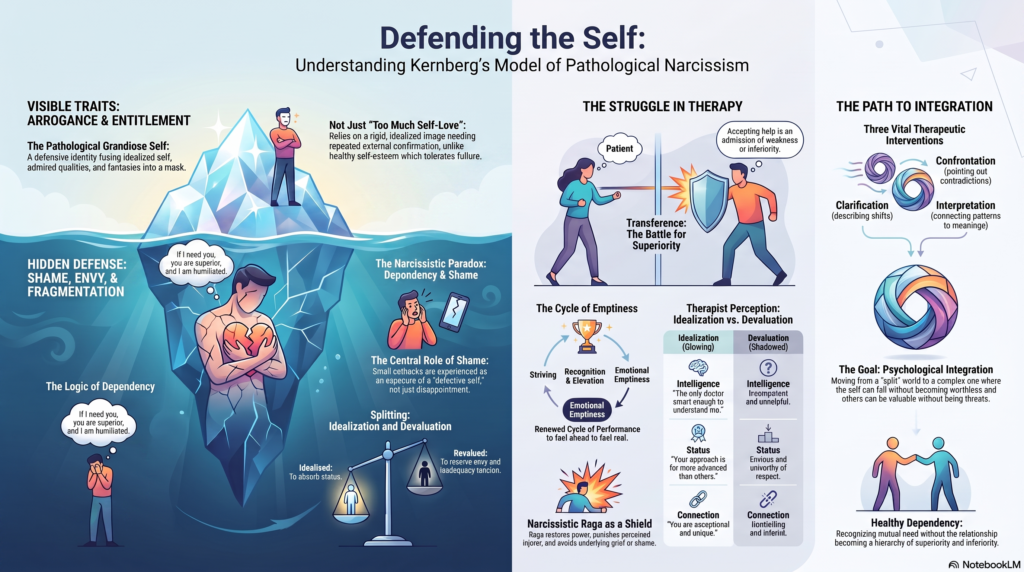 Narcissism is often described as arrogance, self-importance, entitlement or an excessive need for admiration. Although these features may be visible, they do not fully explain the psychological structure underneath.
From the perspective of psychiatrist and psychoanalyst Otto Kernberg, severe narcissistic functioning can be understood as a defensive organisation. Grandiosity may protect the person from a far more unstable internal experience involving shame, dependency, envy, emptiness and fear of psychological fragmentation.
This does not mean that every confident, ambitious or self-focused person has narcissistic personality disorder. Nor does it mean that harmful narcissistic behaviour should be excused. It means that therapy must look beyond the external presentation and understand what the grandiosity is trying to protect.
Kernberg proposed that severe narcissistic personality pathology may develop upon an underlying borderline level of personality organisation, with the narcissistic structure functioning as a secondary defence against fragmentation of the person’s sense of self and their experience of significant others.
Narcissism Is Not Simply “Too Much Self-Love”
A person with healthy self-esteem can recognise both strengths and limitations. They can tolerate failure without feeling completely worthless. They can admire another person without feeling diminished by that person’s abilities.
Pathological narcissism is different.
The person may rely on an idealised image of themselves to maintain psychological stability. They may need to feel exceptional, superior, powerful, attractive, morally correct or uniquely talented.
This grandiose identity can appear strong, but it is often rigid and fragile. It must be repeatedly confirmed because ordinary human experiences—mistakes, uncertainty, dependency, ageing, rejection or criticism—can threaten the person’s underlying sense of coherence.
The difficulty is therefore not merely that the person thinks too highly of themselves. It is that they may not possess a sufficiently stable sense of self when the grandiose image is challenged.
The Pathological Grandiose Self
Kernberg used the term pathological grandiose self to describe the defensive identity constructed in severe narcissism.
This structure may combine:
- Idealised aspects of the person’s actual self
- Admired qualities taken psychologically from other people
- Fantasies and aspirations treated as though they have already been achieved
These elements are fused together to create an experience of superiority and self-sufficiency.
The person may present themselves as unusually intelligent, successful, attractive, insightful or powerful. At times, these claims may contain genuine ability. The difficulty is that the person’s self-esteem becomes excessively dependent on maintaining this idealised position.
Any experience that contradicts it can produce intense shame or humiliation.
Why Dependency Feels Dangerous
One of the central problems in severe narcissism is difficulty tolerating dependency.
To need another person is to acknowledge that the other person has something valuable. They may possess knowledge, emotional stability, affection, competence, recognition or care.
For someone with severe narcissistic vulnerability, this can trigger an immediate comparison:
If I need you, you must be superior to me.
If you are superior, I must be inferior.
If I am inferior, I am humiliated.
The person may therefore deny their need for others. They may insist that they are completely self-sufficient or dismiss the people they secretly depend upon.
Kernberg describes an internal world in which the self is experienced as grandiose and independent, while other people are divided into those who can be admired or appropriated and those who are devalued or treated as enemies.
This dynamic can appear in marriages, friendships, workplaces, families and psychotherapy.
How Narcissistic Defences Enter Therapy
Psychotherapy does not occur outside the patient’s personality. The same patterns that appear in the person’s other relationships usually emerge in the therapeutic relationship.
This is known as transference.
A patient may initially idealise the therapist:
- “You are the only doctor who can understand me.”
- “Other therapists were not intelligent enough.”
- “Your approach is far more advanced than everyone else’s.”
This may feel positive, but idealisation can be unstable. Once the therapist disagrees, sets a limit, makes an error or fails to provide the expected admiration, idealisation may rapidly turn into devaluation.
The therapist may then be experienced as:
- Incompetent
- Envious
- Unhelpful
- Inferior
- Controlling
- Unworthy of respect
The shift may appear sudden, but it often reflects the patient’s difficulty integrating positive and negative experiences of the same person.
The therapist is either exceptional or worthless. It becomes difficult to hold a more realistic position:
“My therapist may be helpful in some ways and limited in others.”
The Struggle for Superiority
Kernberg observed that grandiosity often becomes a dominant issue in therapy.
The patient may feel compelled to remain superior to the therapist. Accepting help would mean acknowledging a need. Acknowledging need may activate feelings of inferiority and humiliation.
Therapy can therefore become organised around an unspoken competition:
- Who understands more?
- Who controls the session?
- Who is more intelligent?
- Who needs whom?
- Who is superior?
- Who is being humiliated?
The patient may try to prove that the therapist has nothing useful to offer. Interpretations may be dismissed, debated endlessly or later repeated as though they were the patient’s own discoveries.
The patient may also appear to improve dramatically and then abruptly withdraw from treatment. Improvement itself can become threatening if it means admitting that the therapist contributed something valuable.
The therapist must recognise this process without retaliating, becoming defensive or entering the competition.
Therapy Must Not Become a Battle
A common mistake is to confront narcissistic grandiosity in a humiliating or moralising manner.
Trying to “break the ego,” expose the patient, defeat them intellectually or force them to admit their vulnerability usually intensifies the defensive structure.
The patient may feel attacked and respond with rage, contempt, withdrawal or premature termination of therapy.
Effective therapy requires a different approach.
The therapist must maintain:
- Emotional steadiness
- Clear boundaries
- Respect without excessive admiration
- Curiosity without submission
- Empathy without collusion
- Directness without humiliation
The goal is not to prove that the patient is inferior. The goal is to understand why superiority has become psychologically necessary.
Clarification, Confrontation and Interpretation
In therapies influenced by Kernberg’s work, especially transference-focused psychotherapy, the therapist carefully examines what is happening in the therapeutic relationship.
Three important interventions are often used.
Clarification
The therapist helps the patient describe their experience more precisely.
For example:
“You initially felt I was the only person capable of understanding you. Today, after I questioned your decision, you feel that I am completely incompetent.”
Clarification slows the process down and makes the internal shift visible.
Confrontation
Confrontation does not mean aggression. It means respectfully drawing attention to contradictory experiences or behaviours.
For example:
“You say you do not need anything from therapy, but you also feel deeply disappointed when you believe I have not understood you.”
This helps the patient recognise that dependency may be present even when it is consciously denied.
Interpretation
Interpretation connects the visible pattern with its possible emotional meaning.
For example:
“It may feel safer to experience me as incompetent than to recognise that you value my opinion. Valuing my opinion might make you feel dependent, and dependency may feel humiliating.”
Interpretation should be carefully timed. When offered too early, it can feel intrusive or shaming. When grounded in a stable therapeutic alliance, it can help the patient understand the protective function of their narcissistic defences.
Understanding Idealisation and Devaluation
Idealisation and devaluation are not random.
They help the person organise relationships in a way that protects self-esteem.
When another person is admired, the narcissistic individual may attempt to absorb that person’s status, abilities or identity. Being associated with an impressive person can temporarily enhance the grandiose self.
However, genuine admiration also creates vulnerability. If someone else possesses valued qualities, the person may feel envy, inadequacy or dependency.
Devaluation resolves this tension:
“They are not actually talented.”
“They only succeeded because of luck.”
“They are threatened by me.”
“I never needed them.”
The therapist helps the patient recognise that admiration does not require submission and that another person’s value does not reduce their own.
Working With Shame
Shame is often central in narcissistic pathology.
The person may experience criticism, rejection or failure not simply as disappointment but as exposure of a defective self.
A relatively small event can produce an overwhelming internal reaction:
- A colleague is promoted
- A partner disagrees
- A friend does not respond immediately
- The therapist misunderstands something
- The patient makes a mistake
- Someone else receives admiration
The underlying experience may be:
“I am nobody.”
“I have been exposed.”
“They can now see that I am inferior.”
Grandiosity, rage and contempt can then emerge to reverse this intolerable position.
Therapy helps the patient differentiate between:
“I made a mistake.”
and
“I am a complete failure.”
This distinction is essential for developing a more stable identity.
Working With Envy
Envy is another difficult emotion in narcissistic functioning.
Admiring another person may produce pain because their qualities highlight what the patient feels they lack.
Instead of tolerating this feeling, the patient may attack, dismiss or spoil what is valuable in the other person.
In therapy, envy may appear when the therapist is experienced as calm, competent, emotionally stable or capable of maintaining relationships.
The patient may attempt to undermine the therapist or prove that the therapist’s abilities are false.
The therapeutic task is not to condemn envy. It is to help the patient recognise it, tolerate it and transform it into realistic admiration, aspiration or gratitude.
A patient may gradually learn:
“Another person can have something valuable without taking anything away from me.”
Working With Emptiness
Grandiosity and emptiness frequently coexist.
A person may be highly accomplished, admired or socially successful but still experience a persistent lack of meaning.
Relationships may become sources of validation rather than emotional connection. Achievements may provide temporary relief but not lasting satisfaction.
The cycle often becomes:
Striving → recognition → temporary elevation → emotional emptiness → renewed striving
The therapist explores what happens when the applause stops.
Who is the patient when they are not performing, winning, impressing or being admired?
This can initially be a frightening question. Over time, therapy helps the person develop an identity based not only on achievement but also on values, relationships, emotional continuity and realistic self-acceptance.
Working With Narcissistic Rage
Narcissistic rage may arise when the grandiose self is threatened.
It can appear as shouting, contempt, revenge, prolonged resentment, passive aggression or abrupt withdrawal.
The rage often serves several functions:
- Restoring a sense of power
- Reversing humiliation
- Punishing the person who caused the injury
- Avoiding grief or shame
- Re-establishing superiority
The therapist must take aggressive behaviour seriously while also examining its underlying meaning.
Boundaries remain essential. Understanding the origin of rage does not mean tolerating abuse.
A therapist may say:
“I want to understand how humiliated you felt, but I also need us to discuss it without attacking or threatening.”
This communicates both empathy and accountability.
Therapy and the Capacity to Depend
One of the most significant achievements in treatment is the ability to experience healthy dependency.
Healthy dependency does not mean helplessness. It means recognising that people need one another without turning the relationship into a hierarchy of superiority and inferiority.
The patient gradually learns:
- Receiving help does not make me weak.
- Admiring someone does not make me inferior.
- Gratitude does not mean submission.
- I can disagree without destroying the relationship.
- I can need someone without losing myself.
- I can be disappointed without devaluing the entire person.
Kernberg describes therapy as a gradual resolution of the superiority–inferiority struggle, allowing the deeper split between idealised and persecutory relationships to become visible and eventually integrated.
From Splitting to Integration
The broader aim of therapy is psychological integration.
Integration means recognising that:
- I have both strengths and weaknesses.
- I can feel love and anger toward the same person.
- Someone can disappoint me and still remain valuable.
- I can fail without becoming worthless.
- I can succeed without becoming superior to everyone.
- I can experience shame without collapsing or retaliating.
This represents a move from a divided internal world toward a more complex and stable one.
The patient no longer has to divide people into heroes and enemies, winners and losers, superior and inferior.
Relationships become more realistic, durable and mutual.
Does Therapy Work for Narcissistic Personality Problems?
Narcissistic personality pathology can be difficult to treat, but it is not untreatable.
Progress may be slow because the very act of entering therapy activates dependency, shame and vulnerability. Patients may miss sessions, abruptly terminate treatment, devalue the therapist or attempt to control the therapeutic frame.
However, meaningful change is possible when treatment is:
- Consistent
- Structured
- Long-term enough to observe recurring patterns
- Focused on relationships and emotional regulation
- Respectful but not overly reassuring
- Boundaried without being punitive
Useful approaches may include:
- Transference-focused psychotherapy
- Psychodynamic psychotherapy
- Mentalization-based treatment
- Schema therapy
- Dialectical behaviour therapy when emotional dysregulation or self-harm is present
- Supportive psychotherapy in patients who are not ready for intensive exploratory work
Medication does not directly treat narcissistic personality structure, but it may be useful for associated depression, anxiety, impulsivity, sleep disturbance or mood instability.
Understanding Is Not the Same as Excusing
A therapy-oriented understanding of narcissism must maintain two truths simultaneously.
First, narcissistic behaviour may arise from deep vulnerability, shame and fear of fragmentation.
Second, the person remains responsible for how they treat others.
Therapy should neither demonise the patient nor excuse exploitation, coercion, emotional abuse or aggression.
The aim is to increase self-awareness, accountability, emotional tolerance and the capacity for mutual relationships.
Conclusion
In Kernberg’s model, narcissistic grandiosity is not merely excessive confidence. It is often a defensive solution to an unstable and fragmented internal world.
The patient protects themselves from dependency, humiliation, envy, shame and emptiness by constructing an idealised identity and devaluing those who threaten it.
In therapy, these dynamics appear directly in the relationship with the therapist. The treatment may become a struggle over superiority, dependency and control.
A skilled therapist does not enter this battle. Instead, the therapist helps the patient observe the process, understand its protective function and gradually tolerate the vulnerable emotions underneath it.
The ultimate goal is not to destroy the patient’s self-esteem. It is to replace brittle grandiosity with a more stable and realistic sense of self.
Successful therapy allows the person to move from admiration-seeking to mutuality, from devaluation to recognition, from humiliation to tolerable vulnerability, and from emotional isolation to genuine connection.
Seeking Help for Narcissistic and Relationship Difficulties
People with narcissistic personality traits do not always seek help because they identify themselves as narcissistic. They may instead present with depression, relationship breakdown, workplace conflicts, anger, repeated feelings of humiliation, emotional emptiness, loneliness or difficulty sustaining close relationships.
A detailed psychiatric and psychological assessment can help identify the underlying personality dynamics, associated mental health conditions and the most appropriate form of psychotherapy.
Dr. Srinivas Rajkumar T
MD Psychiatry, AIIMS New Delhi
Senior Consultant Psychiatrist
Mind & Memory Clinic
Apollo Clinic, Velachery, Chennai
Opposite Phoenix Marketcity
Clinical areas include personality assessment, psychodynamic psychotherapy, adult ADHD, mood disorders, anxiety disorders, relationship difficulties, neuropsychiatry and interventional psychiatry.
Email: srinivasaiims@gmail.com
Phone: +91-8595155808