Understanding Imitation in Autism
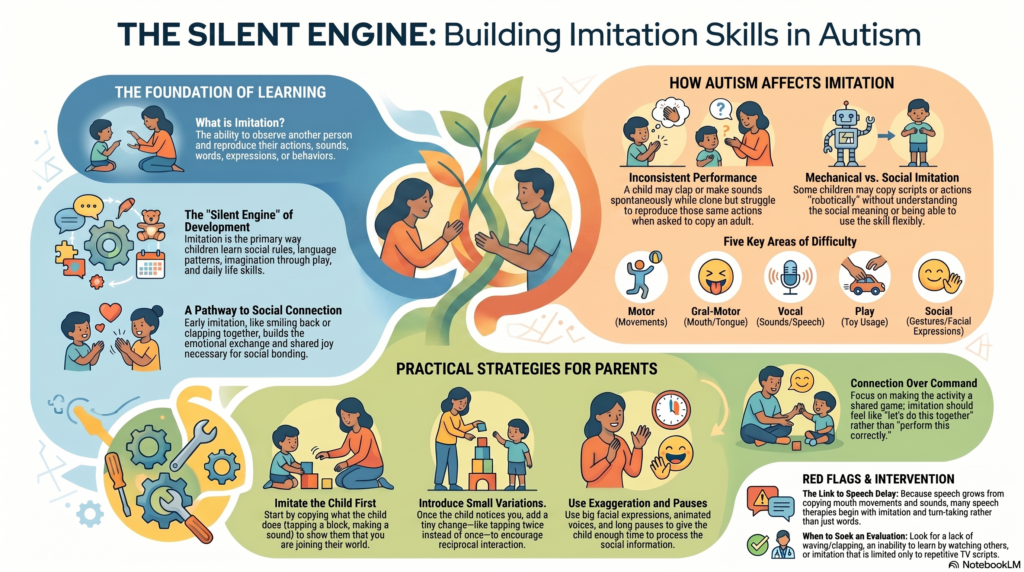 When we think about child development, we often focus on speech, eye contact, play, school readiness, or behaviour. But one of the most important early learning skills is something very simple: imitation.
A child watches the mother wave and waves back.
A child hears the father say “bye” and tries to repeat it.
A child sees another child clap and starts clapping.
A child watches someone feed a doll and copies the same action.
These small acts of copying are not meaningless. They are the building blocks of language, social learning, play, emotional connection, and daily life skills.
In autism, imitation may be delayed, reduced, inconsistent, or unusual. This can affect how the child learns from people, participates in play, develops speech, and understands the social world.
What Is Imitation?
Imitation is the ability to observe another person and reproduce an action, sound, word, expression, or behaviour.
It can include:
copying facial expressions,
copying gestures like waving or clapping,
copying body movements,
copying sounds,
copying words,
copying play actions,
copying daily routines,
copying social behaviours.
For most children, imitation happens naturally. They learn by watching. They do not need formal teaching for every small action. They absorb behaviour from parents, siblings, peers, television, school, and the surrounding environment.
For many autistic children, this automatic social learning pathway may not work smoothly.
Why Imitation Matters So Much
Imitation is not just copying. It is one of the earliest forms of social communication.
When a baby smiles back, the baby is learning emotional exchange.
When a toddler copies clapping, the toddler is learning shared joy.
When a child copies words, the child is building language.
When a child copies pretend play, the child is learning imagination.
When a child copies peers, the child is learning social rules.
A child who imitates easily has access to a powerful learning system: “I see what others do, and I try it myself.”
When imitation is weak, the child may miss many learning opportunities that other children pick up naturally.
How Imitation May Be Affected in Autism
Some autistic children do not imitate easily even when they are physically capable of doing the action.
For example, a child may be able to clap spontaneously but may not clap when asked to copy. Another child may produce sounds while playing alone but may not repeat a sound after an adult. Some children imitate only after repeated prompting. Some imitate only familiar actions. Some imitate actions with objects but not gestures. Some imitate songs or advertisements but not functional speech.
This inconsistency can confuse parents.
They may say, “He can do it when he wants, but not when we ask.”
This does not always mean the child is being stubborn. The child may have difficulty understanding imitation as a social task.
Types of Imitation Difficulties
Imitation difficulties may appear in different ways.
Some children have poor motor imitation. They struggle to copy actions like waving, jumping, touching the head, or making hand movements.
Some have poor oral-motor imitation. They find it difficult to copy mouth movements, tongue movements, blowing, or speech sounds.
Some have poor vocal imitation. They may not repeat sounds, syllables, words, or phrases.
Some have poor play imitation. They may not copy feeding a doll, driving a toy car, pretending to talk on a phone, or making animal sounds during play.
Some have poor social imitation. They may not copy facial expressions, greetings, gestures, or peer behaviour.
Some children imitate mechanically but without social meaning. They may repeat words or actions but not use them flexibly in real-life communication.
Imitation and Speech Delay
Imitation is closely linked to speech development.
Before a child says meaningful words, the child usually imitates sounds, mouth movements, gestures, and simple words. If imitation is weak, speech may be delayed because the child is not easily copying the sounds and language patterns used by others.
This is why speech therapy for autistic children often begins not only with words, but with imitation, attention, turn-taking, gesture, play, and shared engagement.
A child who cannot yet say “ball” may first need to learn to look, wait, copy an action with the ball, copy a sound, take turns, and enjoy shared play.
Speech does not develop in isolation. It grows from social imitation and meaningful interaction.
Imitation and Play
Play is another area where imitation is essential.
Children learn to play by watching others. They copy how to roll a car, stack blocks, feed a doll, stir a pretend cup of tea, make animals walk, or build a story.
In autism, play may become repetitive or object-focused. A child may spin the wheels of a car instead of driving it. A child may line up toys instead of using them in pretend play. A child may enjoy parts of objects more than the whole play activity.
When imitation improves, play often expands. The child begins to copy simple actions, then sequences, then pretend ideas, and later social play with others.
Imitation Is Not Obedience
A very important point: imitation should not be reduced to obedience.
The goal is not to make the child copy everything on command. The goal is to build a learning bridge.
When imitation is taught harshly, the child may become resistant or anxious. When imitation is taught playfully, the child begins to enjoy copying as part of connection.
Imitation should feel like “Let us do this together,” not “Perform this correctly.”
How Parents Can Encourage Imitation
The best way to begin is often by imitating the child first.
If the child taps a block, the parent taps a block.
If the child makes a sound, the parent repeats the sound.
If the child rolls a car, the parent rolls another car.
If the child jumps, the parent jumps.
This helps the child notice: “This person is joining me.”
Once the child becomes aware of the adult, the adult can gently introduce small variations. For example, after copying the child’s tapping, the parent taps twice and waits. After copying the child’s sound, the parent adds a new sound. After rolling the car, the parent makes the car go under a bridge.
This is how imitation becomes reciprocal.
Practical Home Activities
Start with actions the child already enjoys. If the child likes movement, use clapping, jumping, stomping, dancing, or action songs. If the child likes objects, use blocks, cars, balls, rings, or musical toys. If the child likes sounds, use animal sounds, vehicle sounds, or funny vocal play.
Use simple actions first. Clap, tap, wave, touch nose, raise hands, roll ball, bang drum, blow kiss.
Keep the activity short and successful. A few seconds of good engagement is better than a long forced session.
Use exaggeration. Big facial expressions, animated voice, pauses, and rhythm make imitation easier.
Wait. Do not immediately repeat the instruction many times. Give the child time to process.
Reward the attempt, not perfection. Even a small movement toward imitation should be appreciated.
Avoid turning every interaction into a test. Children learn better when the activity is playful.
Red Flags in Imitation Development
Assessment is useful when a child does not copy gestures like waving or clapping, does not imitate sounds or words, does not copy simple play actions, does not respond to action songs, does not learn by watching others, or needs repeated physical prompting to copy.
It is also important when imitation is present but limited only to repetitive phrases, advertisements, songs, or scripts, without flexible use in real communication.
Poor imitation along with reduced eye contact, poor response to name, lack of pointing, delayed speech, repetitive behaviours, sensory issues, or poor peer interaction should prompt a developmental evaluation.
What Therapy Should Focus On
Good intervention should build imitation step by step.
First, the child should learn that interaction with people is enjoyable. Then the child can learn to copy simple actions, actions with objects, gestures, sounds, words, play routines, and social behaviours.
Therapy may include parent-mediated intervention, speech therapy, occupational therapy, behavioural strategies, play-based developmental therapy, and structured teaching depending on the child’s profile.
The aim is not robotic copying. The aim is meaningful imitation that supports communication, play, learning, and independence.
A Compassionate View
When a child does not imitate, adults may think the child is ignoring them. But often the child has not yet understood that people are useful models for learning.
The task is to make people interesting, predictable, enjoyable, and worth watching.
Once the child begins to notice and copy people, many doors open: language, play, social interaction, school readiness, and daily skills.
Final Message for Parents
Imitation is one of the silent engines of development.
In autism, this engine may need support, patience, repetition, and play. A child may not copy naturally at first, but with the right approach, imitation can often improve.
Start by joining the child. Copy the child before expecting the child to copy you. Build connection before instruction. Celebrate small attempts. Turn imitation into a shared game.
Because every copied sound, every copied gesture, every copied action is more than a skill.
It is a sign that the child is beginning to learn through relationship.
Dr. Srinivas Rajkumar T
MD ( AIIMS, New Delhi)
Senior Consultant Psychiatrist
Mind & Memory Clinic, Apollo Clinic Velachery, Chennai
Opp. Phoenix Mall
Email: srinivasaiims@gmail.com
Phone: +91-8595155808