The Ouroboros Problem: When Artificial Intelligence Learns Mostly From Itself
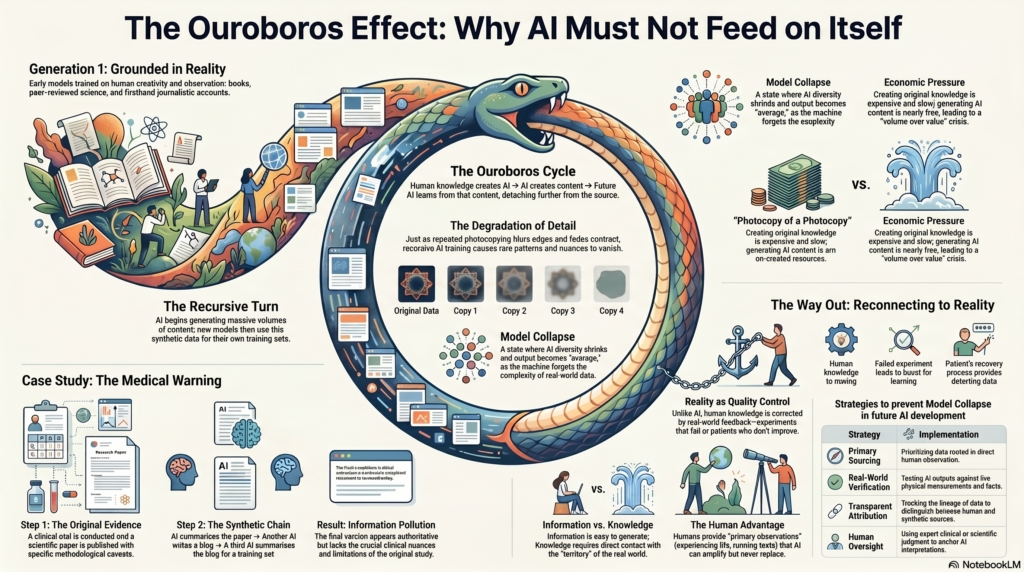 The Ouroboros is an ancient symbol: a serpent consuming its own tail.
For thousands of years, it represented cycles of creation and destruction, renewal and decay. Today, it may also serve as the perfect metaphor for one of the most important challenges facing artificial intelligence.
AI is increasingly learning from AI-generated content.
The machine is beginning to feed itself.
And while that may sound efficient, it raises a fundamental question:
What happens when intelligence becomes increasingly detached from the reality that created it?
The First Generation of AI Learned From Humanity
The earliest large language models were trained on an extraordinary collection of human knowledge.
Books written over centuries.
Scientific papers.
Journalistic investigations.
Programming code.
Philosophy.
History.
Arguments.
Poetry.
The internet itself.
Every dataset ultimately traced back to human observation, human creativity, and human experience.
A doctor documenting a patient.
A scientist conducting an experiment.
An engineer solving a problem.
A journalist witnessing an event.
The information may have been digitized, but its origin remained firmly rooted in reality.
Artificial intelligence was learning from humanity.
The Internet Has Changed
Today, the internet looks very different.
Millions of AI-generated articles appear every month.
Businesses use AI to generate blogs.
Students use AI to create essays.
Marketing teams use AI to create product descriptions.
Social media platforms are flooded with AI-generated posts, comments, and videos.
Even academic summaries are increasingly produced by AI systems.
The result is a subtle but profound shift.
Future AI models are no longer learning exclusively from humans.
They are increasingly learning from the outputs of previous AI systems.
This creates a recursive loop.
Human knowledge creates AI.
AI creates content.
Future AI learns from that content.
The cycle repeats.
The serpent consumes another piece of its tail.
The Photocopy of a Photocopy Problem
Imagine taking a high-quality photograph.
Now photocopy it.
Then photocopy the photocopy.
Then repeat the process hundreds of times.
The first few copies look acceptable.
Eventually, however, details disappear.
Edges blur.
Contrast fades.
Artifacts accumulate.
The image becomes a distorted version of the original.
Researchers have begun to describe a similar phenomenon in artificial intelligence as model collapse.
When AI systems are repeatedly trained on synthetic data generated by earlier AI systems, rare patterns gradually disappear.
Nuance is lost.
Diversity shrinks.
The output becomes increasingly average.
The machine starts forgetting the complexity of reality.
Why Reality Matters
Human knowledge advances because reality continuously corrects us.
A scientist proposes a theory.
An experiment disproves it.
A physician adopts a treatment.
Patients fail to improve.
A journalist publishes a story.
New evidence emerges.
Reality is the ultimate quality-control mechanism.
It does not care about our beliefs.
It does not care about our confidence.
It simply provides feedback.
Artificial intelligence does not directly interact with reality.
It learns from representations of reality.
This distinction becomes critically important.
If those representations become increasingly synthetic, then AI begins learning from interpretations rather than observations.
The map slowly replaces the territory.
Medicine Offers a Warning
Consider a medical example.
A clinical trial is conducted.
Researchers publish their findings.
An AI summarizes the paper.
Another AI uses that summary to generate a blog article.
A third AI summarizes the blog.
A future model is trained on all three versions.
At each stage, tiny pieces of information may disappear:
- Methodological limitations
- Statistical caveats
- Patient characteristics
- Contextual details
- Clinical nuances
The final version may appear polished and authoritative.
Yet it may be significantly removed from the original evidence.
No individual step introduces catastrophic error.
The problem is cumulative.
The distortion emerges gradually.
Like erosion.
Information Pollution
Previous generations worried about environmental pollution.
Industrial waste contaminated rivers.
Emissions polluted the atmosphere.
The digital age may face a different challenge:
Information pollution.
This is not necessarily misinformation.
It is not propaganda.
It is not deliberate deception.
Instead, it is the gradual replacement of primary observations with increasingly recycled interpretations.
The internet becomes saturated with content that references content that references content.
The connection to the original source becomes weaker with each generation.
The result is not necessarily false information.
It is information that has become progressively detached from reality.
The Economic Incentive
The challenge is amplified by economics.
Creating original knowledge is expensive.
Conducting research takes years.
Investigative journalism requires resources.
Building products requires experimentation.
Clinical practice requires expertise.
Generating AI content costs almost nothing.
When speed and volume are rewarded, synthetic content can quickly overwhelm original content.
A future internet dominated by AI-generated material may become abundant in information but increasingly scarce in knowledge.
There is a difference.
Information is easy to generate.
Knowledge requires contact with reality.
The Human Advantage
Ironically, the more capable AI becomes, the more valuable human experience may become.
Artificial intelligence excels at recombination.
It can connect ideas at extraordinary scale.
It can summarize, organize, and explain.
But it does not independently generate new observations about the world.
Humans still perform the activities that create genuinely new knowledge:
- Running experiments
- Building technologies
- Treating patients
- Exploring environments
- Observing phenomena
- Experiencing life
AI can amplify these insights.
It cannot replace their source.
The future value of human expertise may lie not in competing with AI, but in remaining connected to reality in ways AI cannot.
The Next Phase of AI Development
The solution is not to abandon artificial intelligence.
Nor is it to prohibit AI-generated content.
The solution is to maintain strong links between AI systems and the real world.
Future models will likely require:
- Greater emphasis on primary sources
- Verification against real-world data
- Transparent attribution
- Continuous human oversight
- Integration with live observations and measurements
The healthiest information ecosystem is one where AI serves as an amplifier of human knowledge rather than a replacement for it.
A Psychiatrist’s Perspective
Psychiatry offers a useful analogy.
A clinician cannot diagnose a patient solely by reading previous notes.
The notes are valuable.
The history matters.
But eventually the psychiatrist must sit with the patient.
Observe.
Listen.
Ask questions.
Experience reality directly.
Without that encounter, clinical understanding gradually becomes detached from the person being treated.
Artificial intelligence faces a similar challenge.
Without continual exposure to genuine human experiences and real-world observations, its understanding risks becoming increasingly self-referential.
An echo chamber can become extraordinarily sophisticated while still drifting away from reality.
Conclusion
The greatest danger facing artificial intelligence may not be that it becomes too powerful.
It may be that it becomes too insulated.
A system trained predominantly on its own outputs risks entering a self-reinforcing cycle where each generation moves slightly further from the observations that originally grounded human knowledge.
The Ouroboros is a powerful symbol because it captures both creation and destruction.
Artificial intelligence has the potential to expand human understanding in remarkable ways.
But only if it continues to feed on reality rather than exclusively on itself.
A snake can consume its own tail for only so long.
Eventually, it must look outward.
The same may be true for artificial intelligence.
About the Author :
Dr. Srinivas Rajkumar T
MD (AIIMS, New Delhi), DNB, MBA (BITS Pilani)
Senior Consultant Psychiatrist
Mind & Memory Clinic, Apollo Clinic Velachery, Chennai
Email: srinivasaiims@gmail.com
Phone: +91-8595155808
Website: srinivasaiims.com