OROS Concerta Explained: How a Once-Daily ADHD Tablet Works Like a Tiny Pump
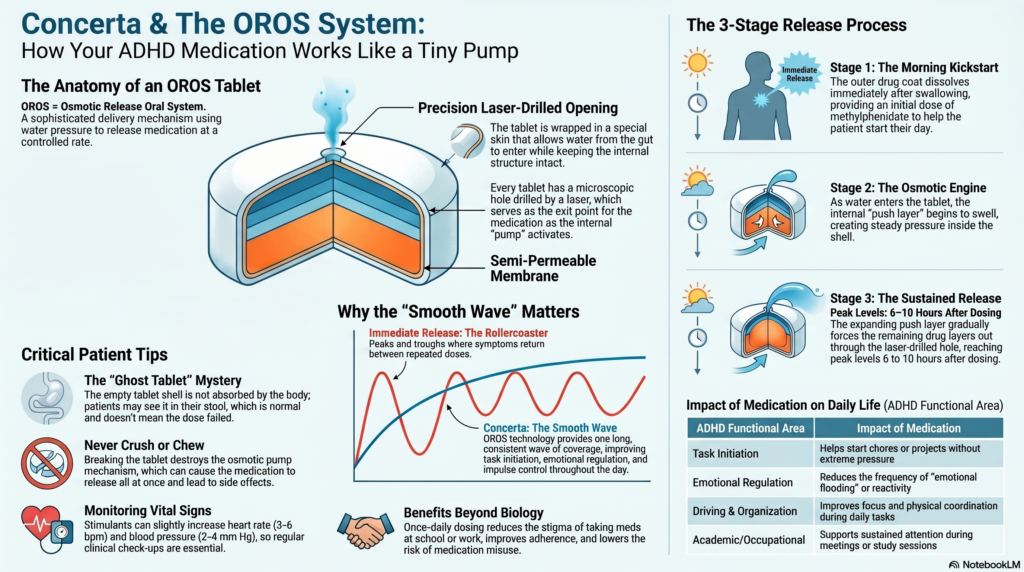 Concerta is a long-acting form of methylphenidate, a stimulant medication used in the treatment of Attention-Deficit/Hyperactivity Disorder (ADHD). What makes Concerta special is not merely the molecule, but the delivery system. It uses a technology called OROS, which allows methylphenidate to be released gradually through the day.
For many patients, this means fewer ups and downs, fewer repeated doses, and more consistent coverage during school, college, work, driving, and daily functioning.
What is OROS?
OROS stands for Osmotic Release Oral System.
In simple terms, Concerta is designed like a miniature osmotic pump. After the tablet is swallowed, water from the gastrointestinal tract enters the tablet through a semi-permeable membrane. This activates the internal system, which slowly pushes methylphenidate out through a tiny laser-drilled opening.
The older product label describes Concerta as having an immediate-release outer drug layer, two internal drug layers, a push layer, a semi-permeable membrane, and a precision laser-drilled orifice. The outer layer dissolves first, while the internal osmotic mechanism provides gradual drug release over several hours.
Why Concerta is different from ordinary methylphenidate
Immediate-release methylphenidate usually works for a few hours. Patients may need repeated doses through the day. This can create a peak-and-trough effect:
A dose works well → effect fades → symptoms return → another dose is needed.
Concerta tries to smooth this pattern. The current FDA label notes that after oral administration, methylphenidate levels rise quickly at first, then continue rising gradually, with mean peak levels occurring around 6 to 10 hours after dosing.
So, clinically:
Immediate-release methylphenidate feels like repeated short waves.
OROS Concerta aims to feel like one longer, smoother wave.
How the tablet releases medicine
Concerta has three broad stages.
1. The outer coat dissolves
After swallowing, the outer layer dissolves relatively quickly. This gives an initial dose of methylphenidate, helping the medicine begin working in the morning.
2. Water enters the tablet
The tablet has a semi-permeable membrane. Water from the gut enters the tablet, but the tablet itself does not dissolve completely.
3. The internal push layer expands
Inside the tablet, an osmotic push layer swells as it absorbs water. This pressure gradually pushes methylphenidate out through the tiny laser-drilled opening.
This is why the tablet must be swallowed whole. It should not be chewed, crushed, or split, because breaking it can destroy the release mechanism. The current prescribing information states that Concerta should be taken once daily in the morning, with or without food, and swallowed whole with liquids.
Why patients may see a “tablet” in stool
This is an important counselling point.
The shell of the Concerta tablet is not fully absorbed. After the medicine has been released, the empty shell may pass in stool. Patients may sometimes see something that looks like a tablet in the toilet.
This does not automatically mean the medicine has failed. It is often just the empty delivery shell.
What methylphenidate does in ADHD
Methylphenidate is a central nervous system stimulant. Its exact therapeutic mechanism in ADHD is not fully known, but it is thought to increase the availability of dopamine and norepinephrine by blocking their reuptake into presynaptic neurons.
In practical clinical language, methylphenidate may help improve:
- sustained attention
- task initiation
- task completion
- impulse control
- emotional regulation
- academic and occupational functioning
- driving and daily organization
ADHD is not simply “lack of discipline.” It is often a disorder of self-regulation, where the person knows what to do but struggles to consistently do it at the right time, in the right sequence, and with the right emotional control.
Why once-daily medication can be useful
Once-daily modified-release preparations are useful for several reasons. NICE recommends considering modified-release once-daily stimulant preparations because of convenience, better adherence, reduced stigma from taking medication at school or work, fewer controlled-drug handling issues, lower diversion risk compared with some immediate-release preparations, and their pharmacokinetic profiles.
For a child, this may mean avoiding a school-time dose.
For a college student, it may mean better academic coverage.
For a working adult, it may mean better consistency through meetings, documentation, commuting, and emotionally demanding tasks.
For a high-functioning adult with ADHD, it may reduce the constant cycle of “I can perform well only when the pressure is extreme.”
Who may benefit from Concerta?
Concerta may be considered in patients with ADHD who need longer daytime coverage, especially when symptoms interfere with school, work, home responsibilities, relationships, or emotional regulation.
The current FDA label indicates Concerta for ADHD in patients aged 6 to 65 years and states that it is not recommended in children younger than 6 years because of higher plasma exposure and higher rates of adverse reactions such as weight loss.
In adults, methylphenidate is also recognised as a first-line pharmacological option for ADHD in NICE guidance, alongside lisdexamfetamine.
Concerta is not a substitute for diagnosis
A common mistake is to treat poor concentration as ADHD without proper evaluation.
Poor focus can occur due to many causes:
- depression
- anxiety
- bipolar disorder
- sleep deprivation
- substance use
- excessive screen use
- thyroid disorders
- anemia or vitamin deficiencies
- trauma and chronic stress
- personality vulnerabilities
- burnout
- early cognitive decline in older adults
A good ADHD evaluation should include developmental history, current impairment, collateral information where possible, screening for mood/anxiety/substance disorders, sleep assessment, and medical review.
The older Concerta label also clearly states that there is no single diagnostic test for ADHD and that diagnosis should be based on a complete history and evaluation, not merely symptom counts.
Dose and timing: practical points
Concerta is usually taken once daily in the morning. Taking it late in the day can increase the risk of insomnia.
The current label recommends pretreatment screening for cardiac disease and evaluation for family history or clinical evidence of tics or Tourette’s syndrome before treatment.
Dose titration should be individualized. The best dose is not the highest dose; it is the dose that gives meaningful improvement with tolerable side effects.
Clinicians usually monitor:
- attention and task completion
- impulsivity
- emotional regulation
- appetite
- sleep
- blood pressure
- pulse rate
- weight
- growth in children
- misuse or diversion risk
Common side effects
Common side effects may include:
- reduced appetite
- weight loss
- insomnia
- headache
- abdominal discomfort
- nervousness or jitteriness
- increased heart rate
- mild blood pressure increase
- dry mouth
- irritability, especially when the effect wears off
The FDA label notes that CNS stimulants may increase blood pressure by an average of about 2 to 4 mm Hg and heart rate by about 3 to 6 beats per minute, though some patients may have larger increases.
Psychiatric cautions
Stimulants can be extremely helpful when correctly used, but they must be prescribed carefully.
They can worsen or unmask:
- marked anxiety or agitation
- psychosis
- mania or bipolar disorder
- severe irritability
- substance misuse patterns
- misuse for studying, weight loss, or performance enhancement
The current FDA label warns about abuse, misuse, and addiction, and advises clinicians to assess risk before prescribing, educate patients and families about safe storage and disposal, and monitor throughout treatment.
In patients with bipolar disorder, mood stabilization is usually the priority before adding stimulants. In patients with psychotic symptoms or active mania, stimulant treatment generally needs to be avoided or stopped until the acute episode is treated.
Cardiac safety
Most healthy patients tolerate methylphenidate well, but cardiac screening matters.
Before starting treatment, clinicians should ask about:
- congenital heart disease
- fainting during exertion
- unexplained syncope
- chest pain
- palpitations
- family history of sudden cardiac death
- hypertension
- arrhythmia
- structural heart disease
The FDA label advises avoiding Concerta in patients with known structural cardiac abnormalities, cardiomyopathy, serious arrhythmia, coronary artery disease, or other serious cardiac disease.
Concerta and anxiety: helpful or harmful?
This is clinically nuanced.
Some patients with ADHD appear anxious because they are chronically overwhelmed, late, disorganized, underprepared, and emotionally flooded. In such patients, effective ADHD treatment may reduce anxiety indirectly.
But in others, stimulants can worsen jitteriness, panic-like symptoms, insomnia, and irritability.
The clinical question is not simply: “Does the patient have anxiety?”
The better question is:
Is anxiety primary, or is it secondary to untreated ADHD and repeated functional failure?
This distinction changes treatment planning.
Concerta in adults with compensated ADHD
Many adults with ADHD do not look obviously hyperactive. They may present as:
- chronic underachievers despite good intelligence
- last-minute performers
- emotionally reactive professionals
- people who need crisis-level pressure to function
- individuals with repeated unfinished projects
- patients labelled as anxious, lazy, inconsistent, or immature
- people who have built elaborate compensatory systems but are exhausted by them
In such patients, a careful developmental history is often more useful than a single attention test. A person may perform normally on a short clinic-based cognitive task but still struggle severely in real-life executive functioning.
The “wearing off” problem
Some patients experience evening irritability, tiredness, sadness, or rebound symptoms as methylphenidate wears off. This is not always a side effect of the medication itself; sometimes it is a contrast effect, where the person suddenly notices the return of ADHD symptoms.
Management may include adjusting dose timing, reviewing sleep and food intake, considering a different formulation, or occasionally adding a small immediate-release dose later in the day under specialist supervision. NICE notes that a modified-release methylphenidate preparation in the morning plus an immediate-release preparation later may sometimes be considered to extend effect duration.
What Concerta cannot do
Concerta can improve the biological capacity for attention and self-regulation, but it does not automatically teach life skills.
Patients may still need:
- sleep correction
- exercise
- structured routines
- task breakdown
- digital distraction control
- emotional regulation work
- CBT for ADHD
- family psychoeducation
- academic or workplace accommodations
- treatment of comorbid anxiety, depression, bipolar disorder, substance use, or personality vulnerabilities
Medication opens a window. Behavioural systems help the patient use that window.
A simple patient explanation
“Concerta is methylphenidate in a special pump-like tablet. The outer layer starts working early, and the inside releases medicine slowly through the day. That is why it is taken once in the morning. Do not break or crush it. You may sometimes see the empty shell in stool, which is usually normal.”
Final message
OROS Concerta is a sophisticated medication delivery system. It is not merely a “stronger stimulant.” Its value lies in controlled, sustained, once-daily methylphenidate release, which can help reduce the functional burden of ADHD across the day.
Used carefully, it can be life-changing. Used casually, without diagnosis and monitoring, it can cause harm. The best outcomes come when medication is combined with proper assessment, psychoeducation, behavioural strategies, sleep correction, and regular follow-up.
Need help with ADHD assessment or treatment in Chennai?
For evaluation of ADHD, attention problems, emotional dysregulation, anxiety, depression, and related concerns, you may consult:
Dr. Srinivas Rajkumar T, MD (AIIMS, New Delhi), DNB, MBA (BITS Pilani)
Senior Consultant Psychiatrist
Mind & Memory Clinic, Apollo Clinic Velachery
Opp. Phoenix Mall, Chennai
✉ srinivasaiims@gmail.com
📞 +91-8595155808