Gaming Addiction Recovery: A Comprehensive, Evidence-Based Treatment Framework
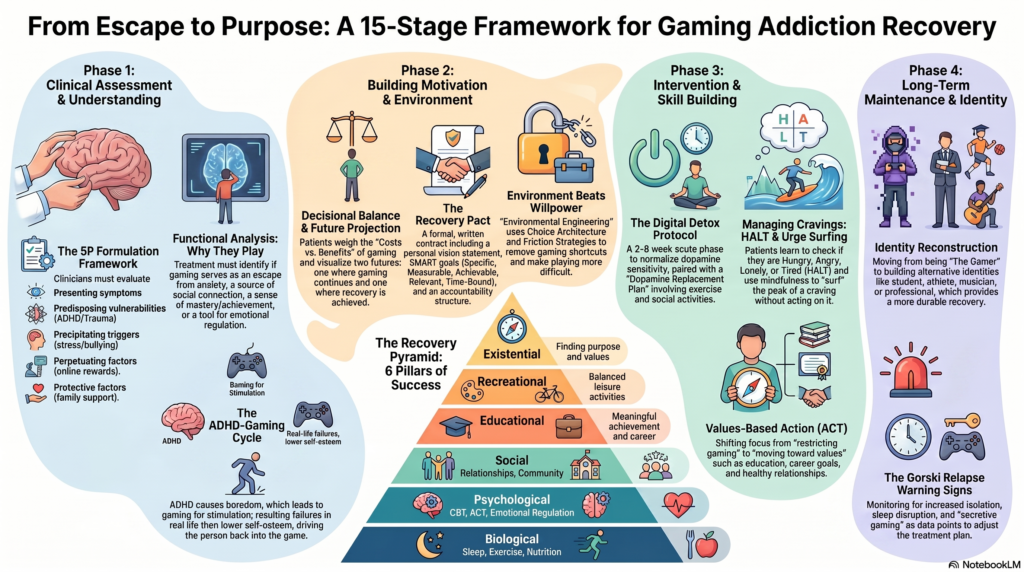 Gaming addiction is often misunderstood as a simple problem of poor self-control or excessive screen time. Contemporary neuroscience and clinical psychology suggest otherwise. Problematic gaming is best understood as a complex interaction between reward circuitry, emotional regulation deficits, neurodevelopmental vulnerabilities, environmental reinforcement, personality factors, and underlying psychiatric disorders.
In 2019, the World Health Organization formally recognized Gaming Disorder in the ICD-11. The diagnosis is characterized by:
- Impaired control over gaming
- Increasing priority given to gaming over other activities
- Continuation despite negative consequences
- Significant impairment in personal, family, educational, occupational, or social functioning
Recovery requires much more than deleting games or imposing restrictions. Effective treatment involves a structured, biopsychosocial approach that addresses the mechanisms driving compulsive gaming.
The Biopsychosocial Model of Gaming Addiction
The biopsychosocial model remains the most useful framework for understanding gaming disorder.
Biological Factors
- Dopaminergic reward sensitivity
- ADHD-related executive dysfunction
- Genetic vulnerability to addictive behaviors
- Sleep deprivation
- Circadian rhythm disruption
Psychological Factors
- Emotional avoidance
- Maladaptive coping
- Low self-esteem
- Perfectionism
- Impulsivity
Social Factors
- Social isolation
- Family dysfunction
- Academic pressures
- Peer influences
- Online identity formation
Gaming addiction rarely develops because of games alone.
It develops because gaming becomes the most efficient solution to multiple unmet psychological needs.
Stage 1: Comprehensive Assessment
A meaningful recovery plan begins with a thorough diagnostic evaluation.
The 5P Formulation Framework
Widely used in clinical psychology.
Presenting Factors
Current symptoms:
- Hours spent gaming
- Sleep disruption
- Academic decline
- Occupational impairment
Predisposing Factors
Vulnerabilities:
- ADHD
- Autism
- Trauma
- Personality traits
- Family history of addiction
Precipitating Factors
Events triggering escalation:
- Relationship breakup
- Examination stress
- Bullying
- Depression
Perpetuating Factors
What keeps the addiction going:
- Online rewards
- Escapism
- Social reinforcement
- Lack of alternatives
Protective Factors
Recovery strengths:
- Family support
- Motivation
- Insight
- Career aspirations
This formulation often provides more clinical value than diagnostic labels alone.
Stage 2: The Four-Lens Assessment Model
Every gaming addiction assessment should examine four domains.
Lens 1: Addiction Severity
Assessment tools:
IGDS9-SF
Internet Gaming Disorder Scale – Short Form
Gaming Addiction Scale (GAS)
Internet Addiction Test (IAT)
Lens 2: Functional Impairment
Evaluate:
- Academic functioning
- Occupational functioning
- Social functioning
- Financial functioning
- Physical health
Lens 3: Psychiatric Comorbidity
The rule rather than the exception.
ADHD
Perhaps the most important comorbidity.
Research consistently demonstrates elevated ADHD rates among problematic gamers.
Assessment should include:
- Childhood symptoms
- Executive dysfunction
- Attention deficits
- Emotional impulsivity
Depression
Gaming often serves as behavioral avoidance.
Anxiety Disorders
Especially:
- Social anxiety disorder
- Generalized anxiety disorder
Autism Spectrum Disorder
Gaming can become a predictable social environment.
Substance Use Disorders
Nicotine, cannabis, and alcohol frequently coexist.
Lens 4: Motivation Assessment
The Transtheoretical Model (Prochaska and DiClemente)
Stages include:
- Precontemplation
- Contemplation
- Preparation
- Action
- Maintenance
- Relapse
Treatment must match the patient’s stage of readiness.
Stage 3: Understanding the Function of Gaming
The Functional Analysis Framework
Based on behavioral psychology.
Ask:
“What does gaming achieve for this person?”
Common functions include:
Escape
Avoiding:
- Anxiety
- Shame
- Failure
- Loneliness
Achievement
Gaming provides:
- Status
- Recognition
- Mastery
which may be lacking in real life.
Social Connection
Online communities become substitutes for offline relationships.
Emotional Regulation
Gaming becomes a mood-modifying behavior.
Similar mechanisms are observed in:
- Alcohol use
- Gambling
- Pornography addiction
Stage 4: Dual-Diagnosis Treatment
One of the most common causes of treatment failure is neglecting underlying disorders.
The ADHD-Gaming Cycle
- ADHD causes boredom.
- Gaming provides stimulation.
- Gaming displaces responsibilities.
- Failures accumulate.
- Self-esteem worsens.
- Gaming increases further.
Unless ADHD is adequately treated, relapse remains highly likely.
The Depression-Gaming Cycle
- Depression reduces activity.
- Gaming becomes primary reward source.
- Real-world functioning declines.
- Depression worsens.
- Gaming increases further.
Behavioral activation becomes essential.
Stage 5: Motivational Enhancement Therapy (MET)
Direct confrontation often fails.
Instead, MET focuses on resolving ambivalence.
Key strategies include:
Decisional Balance
Benefits of gaming:
- Fun
- Achievement
- Escape
Costs of gaming:
- Lost opportunities
- Academic failure
- Health consequences
Future Projection Exercise
Patients imagine:
Future A
Continue current gaming pattern.
Future B
Successful recovery.
This often generates powerful intrinsic motivation.
Stage 6: The Recovery Pact
Inspired by behavioral contracting principles.
The pact should be written and signed.
Components include:
Personal Vision Statement
Why recovery matters.
SMART Goals
Specific
Measurable
Achievable
Relevant
Time-Bound
Accountability Structure
Parents
Partner
Therapist
Coach
Rewards
Positive reinforcement remains more effective than punishment.
Stage 7: Environmental Engineering
Behavioral economists emphasize:
“Environment beats willpower.”
Choice Architecture
Remove:
- Gaming shortcuts
- Auto-login
- Saved payment methods
Friction Strategy
Increase effort required to play.
Examples:
- Store console elsewhere
- Use time-lock systems
- Restrict internet access
Commitment Devices
Concept popularized by behavioral economist Thomas Schelling.
Examples:
- Accountability software
- Parental controls
- Public commitments
Stage 8: Digital Detox Protocol
For severe addiction:
Acute Detox Phase
2–8 weeks
Objectives:
- Normalize dopamine sensitivity
- Improve sleep
- Reduce cue-reactivity
Dopamine Replacement Plan
A critical component.
Patients schedule:
- Exercise
- Social activities
- Creative pursuits
- Skill development
Nature abhors a vacuum.
Removing gaming without replacing rewards almost guarantees relapse.
Stage 9: Cognitive Behavioral Therapy
CBT remains the best-studied psychotherapy for gaming addiction.
Cognitive Restructuring
Common distortions:
All-or-Nothing Thinking
“I am only successful in games.”
Catastrophizing
“I will lose all my friends if I stop gaming.”
Emotional Reasoning
“I feel bored therefore I need gaming.”
Behavioral Experiments
Used to challenge assumptions.
Example:
Test whether boredom truly becomes intolerable without gaming.
Stage 10: Managing Cravings
Marlatt’s Relapse Prevention Model
Cravings are expected.
The goal is management rather than elimination.
Urge Surfing
Developed within mindfulness-based relapse prevention.
Patients observe urges without acting on them.
HALT Framework
Check whether you are:
- Hungry
- Angry
- Lonely
- Tired
Many cravings emerge from these states.
Delay-Distract-Decide Method
- Delay
- Distract
- Reassess
Cravings often peak and decline within minutes.
Stage 11: Acceptance and Commitment Therapy (ACT)
ACT is increasingly useful in behavioral addictions.
Core processes include:
Cognitive Defusion
Learning that thoughts are not commands.
Example:
“I need to play”
becomes
“I am having the thought that I need to play.”
Values-Based Action
Patients reconnect with:
- Education
- Relationships
- Health
- Career goals
Recovery becomes purpose-driven rather than restriction-driven.
Stage 12: Family-Based Interventions
Particularly important for adolescents.
Community Reinforcement and Family Training (CRAFT)
Family members learn:
- Positive reinforcement
- Effective communication
- Boundary setting
without escalating conflict.
Structural Family Approaches
Useful when gaming reflects broader family dysfunction.
Stage 13: Sleep and Circadian Recovery
Sleep disruption is often a hidden driver.
Framework:
Fixed Wake-Up Time
More important than bedtime.
Light Exposure Therapy
Morning sunlight exposure.
Digital Sunset
No gaming 1–2 hours before sleep.
Sleep Restriction Therapy
In selected cases.
Stage 14: Identity Reconstruction
One of the most neglected aspects of treatment.
Many patients have become:
“The gamer.”
Recovery requires building alternative identities.
Examples:
- Student
- Professional
- Musician
- Athlete
- Partner
- Parent
Identity-based recovery is often more durable than behavior-based recovery.
Stage 15: Relapse Prevention Blueprint
Relapse is not failure.
It is data.
The Gorski Relapse Warning Signs Model
Monitor:
- Increased isolation
- Sleep disruption
- Emotional avoidance
- Rationalization
- Secretive gaming
If-Then Planning
Implementation intentions.
Examples:
“If I feel bored after work, then I will walk for 20 minutes before considering gaming.”
Research consistently shows implementation intentions improve self-regulation.
The Recovery Pyramid
Long-term recovery rests upon six pillars:
Biological
Sleep
Exercise
Nutrition
Psychological
CBT
ACT
Emotional regulation
Social
Relationships
Community
Educational/Occupational
Meaningful achievement
Recreational
Balanced leisure
Existential
Purpose and values
Weakness in any pillar increases relapse risk.
Final Thoughts
Gaming addiction is not a problem of laziness, weak character, or poor discipline. It is a sophisticated behavioral addiction involving reward learning, habit formation, emotional regulation, executive functioning, and social reinforcement.
The most successful recovery plans move beyond simple screen-time restrictions. They combine comprehensive assessment, dual-diagnosis treatment, motivational enhancement, behavioral contracting, CBT, ACT, family involvement, environmental restructuring, relapse prevention, and identity reconstruction.
The ultimate goal is not merely spending fewer hours gaming. The ultimate goal is building a life that is sufficiently meaningful, rewarding, and connected that excessive gaming is no longer needed as an escape.
Dr. Srinivas Rajkumar T, MD (AIIMS, New Delhi), DNB, MBA (BITS Pilani)
Senior Consultant Psychiatrist
Mind & Memory Clinic, Apollo Clinic Velachery (Opp. Phoenix Mall)
✉ srinivasaiims@gmail.com
📞 +91-8595155808
Comprehensive assessment and treatment services are available for Gaming Disorder, Internet Addiction, ADHD, Autism Spectrum Disorder, Depression, Anxiety Disorders, Behavioral Addictions, and Dual-Diagnosis conditions. Early intervention can significantly improve academic, occupational, social, and psychological outcomes.