fNIRS-Guided Neurofeedback: Training Attention Through Real-Time Prefrontal Brain Feedback
 Attention is not simply a matter of willpower. Sustaining focus requires coordinated activity across brain networks involved in executive control, working memory, inhibition and cognitive effort—particularly networks involving the prefrontal cortex.
Neurofeedback attempts to make some of this otherwise invisible brain activity visible to the person being trained.
One emerging approach is functional near-infrared spectroscopy-guided neurofeedback, or fNIRS neurofeedback.
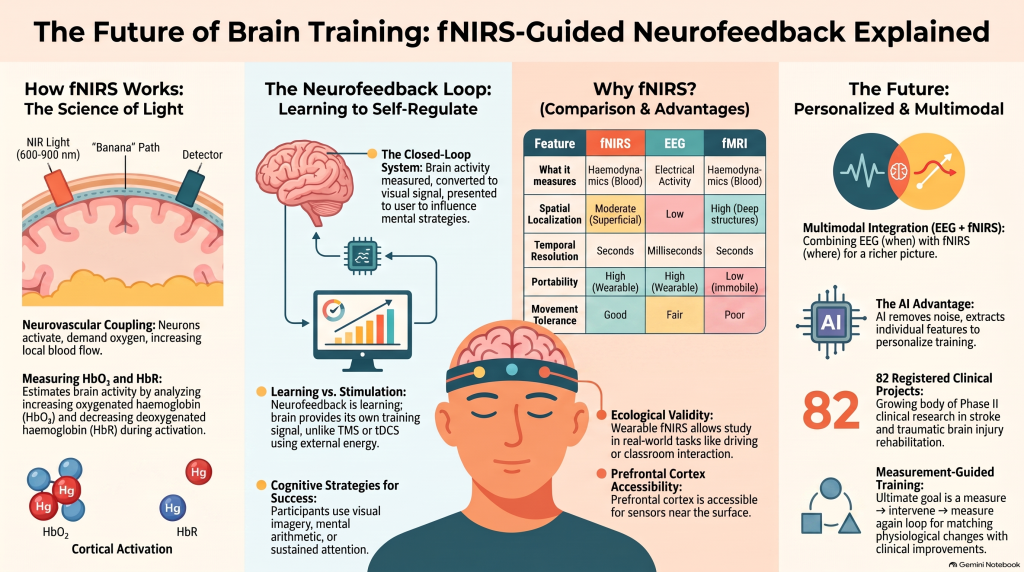
Unlike conventional EEG neurofeedback, which measures the electrical activity of the brain, fNIRS measures changes in blood oxygenation and haemodynamic activity in the superficial cerebral cortex. This makes it possible to provide real-time feedback about changes in prefrontal activation while a person is actively concentrating.
At ATTN Clinic, Chennai, we use this technology as part of a broader, measurement-oriented approach to attention and cognitive performance.
What Is fNIRS?
Functional near-infrared spectroscopy (fNIRS) is a non-invasive optical brain-monitoring technology.
Near-infrared light can penetrate scalp and superficial tissues. Oxygenated haemoglobin and deoxygenated haemoglobin absorb this light differently. By analysing these changes, fNIRS can estimate changes in cortical haemodynamics associated with neuronal activity.
The underlying principle is similar to functional MRI in one important respect: both rely on the relationship between neuronal activity and changes in local blood oxygenation.
But fNIRS has some practical advantages.
It can be:
- portable,
- relatively comfortable,
- used while the person is sitting and performing cognitive tasks,
- repeatedly measured,
- and potentially incorporated into real-time neurofeedback.
This makes fNIRS particularly interesting for attention training and cognitive neuroscience outside a conventional imaging laboratory.
Why Focus on the Prefrontal Cortex?
The prefrontal cortex plays an important role in several functions relevant to attention:
- maintaining a goal,
- resisting distraction,
- working memory,
- response inhibition,
- planning,
- cognitive flexibility,
- and sustaining mental effort.
The dorsolateral prefrontal cortex (DLPFC) is particularly important for working memory and top-down attentional control.
This does not mean ADHD is simply a disorder of one brain region. ADHD involves distributed neural networks, and considerable differences exist between individuals.
However, the prefrontal cortex provides an accessible and biologically relevant target for studying cognitive effort using fNIRS.
What Is fNIRS-Guided Neurofeedback?
Ordinary cognitive training gives feedback about performance.
For example:
Was the answer correct?
How quickly did you respond?
How many targets did you miss?
fNIRS neurofeedback adds another layer:
What was happening in your prefrontal haemodynamic activity while you were making that cognitive effort?
During a training session, fNIRS continuously measures prefrontal oxygenation.
The signal is processed and translated into an understandable form—such as a moving object, graph, animation or other visual feedback.
The participant then attempts to maintain the mental state associated with the desired feedback.
In simple terms:
Concentrate → brain activity changes → fNIRS detects the haemodynamic response → feedback changes → the brain receives information about its own activity.
This creates a closed feedback loop.
From Biofeedback to Brain Biofeedback
People already use biological feedback in many areas of training.
A runner uses heart rate.
A person with diabetes uses glucose monitoring.
An athlete may monitor oxygen consumption.
A patient undergoing rehabilitation may use electromyography to visualise muscle activation.
Neurofeedback applies a similar principle to brain-related physiological signals.
Rather than simply telling someone:
“Concentrate harder.”
we can potentially give them a physiological signal related to their cognitive effort.
That is what makes neurofeedback conceptually interesting.
What Does an fNIRS Neurofeedback Session Look Like?
Modern wearable fNIRS systems allow training to take place while the person is awake, sitting upright and actively engaging with a task.
One system we use incorporates fNIRS sensors over the frontal cortex and translates prefrontal oxygenation into visual feedback.
For example, during an attention-training exercise, increasing and sustaining cognitive effort may cause the visual feedback to progress. If the measured effort falls, the feedback changes accordingly.
The commercial Muse S Athena platform describes its fNIRS system as tracking frontal cortical haemodynamics and oxygenation during active mental-effort training. Its fNIRS system uses a five-optode configuration over the frontal region.
Importantly, the goal is not merely to obtain the highest number on a screen.
The clinically interesting questions are:
- Can the person reliably engage the target cognitive state?
- Can they sustain it?
- Does performance improve across sessions?
- Does neurophysiological regulation become more consistent?
- Do improvements transfer to everyday functioning?
fNIRS Neurofeedback Is Different From EEG Neurofeedback
The two technologies measure fundamentally different signals.
EEG
Electroencephalography measures electrical potentials generated by neuronal activity.
EEG has excellent temporal resolution and can examine features such as:
- frequency bands,
- event-related potentials,
- cortical rhythms,
- and rapid changes in neural activity.
fNIRS
fNIRS measures the haemodynamic consequence of neural activity.
It primarily tracks changes in:
- oxygenated haemoglobin,
- deoxygenated haemoglobin,
- and regional cortical blood oxygenation.
The signal develops more slowly than EEG because vascular responses follow neuronal activity.
Therefore, EEG and fNIRS should not be considered competing technologies.
They provide different windows into brain function.
Modern wearable neurotechnology is increasingly capable of combining both.
Why Combining EEG and fNIRS Is Interesting
EEG asks:
What is the electrical activity of the brain doing?
fNIRS asks:
How is cortical haemodynamic activity changing during cognitive effort?
A multimodal system therefore has the potential to examine attention from more than one physiological dimension.
The Muse S Athena, for example, integrates both EEG and fNIRS in the same wearable device.
That is technologically significant because historically these measurements often required separate laboratory systems.
However, consumer and wearable systems should not be confused with full research-grade multichannel EEG or high-density laboratory fNIRS systems. Each device has limitations in spatial coverage, signal quality and interpretation.
The value lies in using the technology for the question it is capable of answering, rather than making conclusions beyond the data.
What Does the Research Show?
fNIRS neurofeedback is promising, but it remains an evolving field.
That distinction is important.
Can People Learn to Modify Prefrontal Activity?
There is evidence that at least some individuals can.
A randomized controlled study of adults with ADHD compared fNIRS neurofeedback, slow cortical potential EEG neurofeedback and electromyography biofeedback.
Participants underwent 30 training sessions.
Approximately 61.9% of participants receiving fNIRS neurofeedback successfully learned to regulate the targeted prefrontal haemodynamic signal.
That is an interesting neurophysiological finding.
However, the overall fNIRS group did not show superior ADHD symptom improvement compared with the active control group.
This distinction matters enormously.
Learning to modify a brain signal is not automatically the same as demonstrating a clinically effective treatment.
What About Attention and Working Memory?
A randomized sham-controlled study involving 60 healthy adults trained participants using fNIRS feedback from the dorsolateral prefrontal cortex.
Real neurofeedback produced greater target-region activation than sham feedback, and participants demonstrated improvements in spatial working memory and attention-related performance. Some effects remained detectable one week later.
These findings support the biological feasibility of training prefrontal self-regulation using fNIRS.
But translating laboratory cognitive improvements into meaningful treatment effects for ADHD or other psychiatric conditions requires considerably more research.
What Does the Larger Neurofeedback Literature Say?
This is where scientific caution becomes essential.
A major 2025 JAMA Psychiatry systematic review and meta-analysis evaluated 38 randomized clinical trials involving 2,472 participants with ADHD.
When outcomes rated by probably blinded observers were examined, neurofeedback overall did not produce a meaningful improvement in core ADHD symptoms.
For total ADHD symptoms, the pooled standardized mean difference was only 0.04, with the confidence interval crossing zero.
Established standard neurofeedback protocols showed a small effect of approximately 0.21, while processing speed showed a small improvement of approximately 0.35.
Importantly, neurofeedback was not supported as a stand-alone replacement for established ADHD treatment.
The same analysis included a small number of haemodynamic neurofeedback studies using fMRI or fNIRS. These were not sufficient to establish clinical efficacy.
This is the appropriate way to interpret the evidence.
fNIRS Neurofeedback Should Not Replace Evidence-Based ADHD Treatment
For ADHD, the strongest evidence continues to support established treatments such as:
- appropriate stimulant and non-stimulant medication,
- psychoeducation,
- behavioural interventions,
- environmental modification,
- ADHD-focused psychological strategies,
- treatment of sleep problems,
- and management of relevant psychiatric or medical comorbidities.
Neurofeedback should not be marketed as a proven replacement for these interventions.
Instead, fNIRS neurofeedback is better understood as an emerging brain-training and physiological self-regulation approach that may eventually have particular value for selected individuals.
The important scientific question may ultimately become not:
“Does neurofeedback work for everybody with ADHD?”
but:
“Which individuals can learn neurophysiological self-regulation, and does that learning translate into meaningful functional improvement?”
That is a precision-medicine question.
ADHD Is Not the Only Cause of Poor Attention
This distinction is equally important clinically.
Difficulty concentrating does not automatically mean ADHD.
Attention problems can occur with:
- depression,
- anxiety,
- chronic stress,
- sleep deprivation,
- bipolar disorder,
- substance use,
- medication effects,
- nutritional deficiencies,
- thyroid and metabolic disorders,
- cognitive disorders,
- excessive digital distraction,
- and several neurological conditions.
A technology that measures cognitive effort cannot by itself determine why a patient has difficulty concentrating.
That requires clinical assessment.
The Future: Measure → Train → Re-measure
The most interesting application of neurotechnology may not be simply adding another treatment.
It may be creating a closed-loop model of personalised cognitive care.
1. Measure
Understand the patient’s symptoms and functional impairment.
Where appropriate, combine this with objective measures of attention and brain function.
2. Train
Use structured cognitive strategies, behavioural interventions and—where appropriate—neurofeedback to practise attention and self-regulation.
3. Re-measure
Determine whether something objectively changed.
Did sustained attention improve?
Did reaction-time variability decrease?
Did cognitive endurance improve?
Did the physiological signal become easier to regulate?
Most importantly:
Did the person’s life improve?
A sophisticated neurotechnology clinic should ultimately be interested in outcomes rather than impressive-looking graphs.
fNIRS-Guided Neurofeedback at ATTN Clinic, Chennai
At ATTN Clinic, our approach is built around a simple idea:
Attention. Understood.
We are developing a structured pathway for people with ADHD, attention difficulties and cognitive-performance concerns that goes beyond simply asking whether someone “feels distracted.”
Depending on the clinical question, assessment and treatment may incorporate:
Clinical assessment → objective cognitive testing → EEG/qEEG where appropriate → fNIRS/EEG-guided neurofeedback → treatment → objective follow-up measurement.
Our fNIRS-guided training uses wearable neurotechnology capable of measuring prefrontal haemodynamic activity during active cognitive effort, allowing patients to receive immediate feedback while practising sustained mental engagement.
We do not use fNIRS to diagnose ADHD.
We do not present neurofeedback as a substitute for evidence-based ADHD medication or psychological treatment.
Instead, it forms part of our broader attempt to bring measurement, neuroscience and longitudinal tracking into everyday psychiatric practice.
Dr. Srinivas Rajkumar T
Senior Consultant Psychiatrist, Apollo
MD Psychiatry — AIIMS New Delhi
Areas of clinical focus include:
- Adult ADHD and attention disorders
- Objective attention assessment
- EEG/qEEG
- Continuous Performance Testing
- fNIRS and EEG-guided neurofeedback
- Cognitive and executive-function assessment
- Evidence-based pharmacological treatment
ATTN Clinic
Attention. Understood.
Currently functioning from:
Apollo Clinic, opposite Phoenix Market City
Velachery, Chennai
Appointments: +91 85951 55808
Email: srinivasaiims@gmail.com
Measure Attention. Train Attention. Measure Change.
Note: fNIRS neurofeedback is an emerging neurotechnology. Current evidence does not establish it as a stand-alone treatment for ADHD. Clinical decisions should be based on comprehensive assessment and established evidence-based treatment, with neurofeedback used selectively where appropriate.