A Computational Model of the Broad Autism Phenotype
 Autism spectrum disorder (ASD) is often described as a categorical diagnosis — a person either meets diagnostic criteria or does not. But modern research tells a more nuanced story. Autism-related traits exist on a continuum, and many individuals who never meet criteria for autism still show subtle traits that resemble parts of the autism profile.
This set of mild, subclinical characteristics is known as the Broad Autism Phenotype (BAP).
The concept of BAP has become increasingly important in autism research because it helps explain why family members of individuals with autism sometimes display subtle social-cognitive differences, even though they function well and do not have autism themselves.
Recently, computational approaches have begun offering new ways to understand these subtle patterns. Instead of viewing BAP as a vague psychological idea, researchers can now conceptualize it as a latent computational structure emerging from multiple cognitive and behavioral variables.
Let us explore how this works.
What Is the Broad Autism Phenotype?
The Broad Autism Phenotype refers to subclinical traits related to autism that are often observed in first-degree relatives of individuals with ASD, including parents and siblings.
These traits may include:
- Slight differences in social communication
- Mild difficulty interpreting social cues
- A more analytical or literal thinking style
- Subtle challenges in emotion recognition
- Preference for routines or predictability
- Pragmatic language differences
Importantly, individuals with BAP function normally in everyday life. These traits are mild and often appear as personality styles rather than impairments.
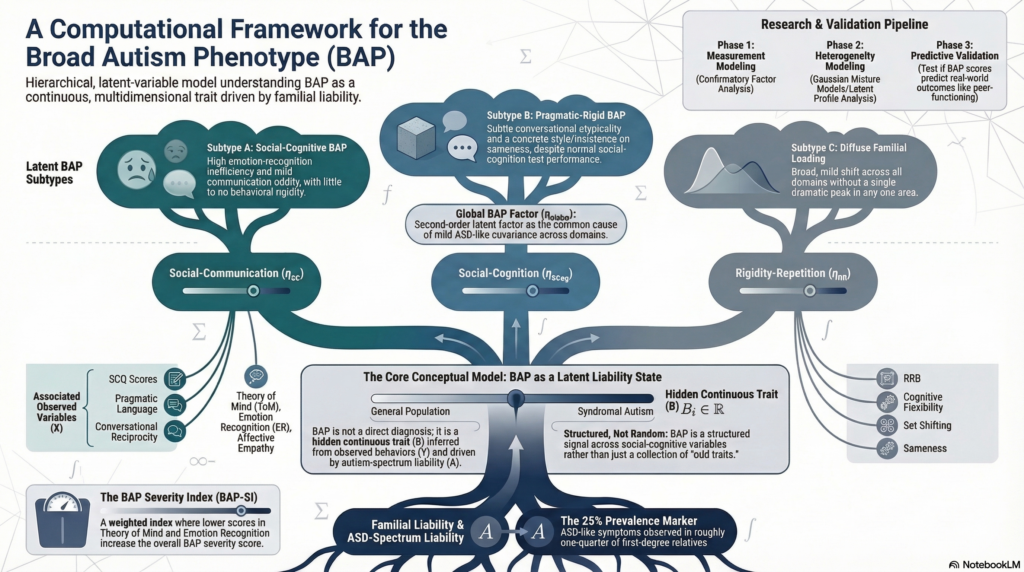
Research suggests that around 20–25% of first-degree relatives of individuals with autism may exhibit aspects of the Broad Autism Phenotype.
This observation led scientists to an intriguing question:
Could BAP represent a milder expression of the same biological mechanisms that produce autism?
Autism Traits as a Spectrum, Not a Switch
Traditional psychiatric classification often works in binary terms: a diagnosis is either present or absent.
However, autism-related traits behave more like continuous variables.
Think of height.
No one asks whether a person has height. Instead, people exist along a distribution from shorter to taller.
Similarly, social cognition, communication style, and behavioral rigidity vary across the population.
A computational perspective therefore treats autism traits not as a binary condition but as a latent dimension of neurodevelopmental variation.
At one end lies typical variation.
At the other end lies clinical autism.
Between them lies the Broad Autism Phenotype.
The Need for a Computational Model
Psychiatric constructs often rely on descriptive observations. But computational modeling allows researchers to do something more powerful:
- Quantify latent traits
- Understand how multiple variables interact
- Identify subtypes within a phenotype
- Predict outcomes based on cognitive patterns
In the case of BAP, a computational model can help answer questions such as:
- Which cognitive domains contribute most strongly to BAP?
- Are there different subtypes within BAP?
- How strongly is BAP linked to familial autism risk?
- Can subtle social-cognitive differences be quantified?
To answer these questions, we must first identify the measurable components of BAP.
Core Cognitive Domains of the Broad Autism Phenotype
Research examining siblings and relatives of individuals with autism consistently highlights several cognitive and behavioral domains.
1. Social Communication
Subtle differences may include:
- Less intuitive social reciprocity
- Slight pragmatic language differences
- Difficulty reading conversational nuance
- A more literal communication style
These features often resemble very mild versions of social communication differences seen in autism.
2. Theory of Mind
Theory of Mind (ToM) refers to the ability to infer the mental states of others — their beliefs, intentions, and emotions.
Individuals with BAP may show:
- Slightly slower or less accurate mental-state inference
- Reduced sensitivity to implicit social cues
Importantly, these differences are often detectable only on structured psychological tasks.
3. Emotion Recognition and Empathy
Some individuals with BAP show subtle difficulty in recognizing emotional expressions or interpreting affective signals.
This does not mean they lack empathy. Rather, the process of interpreting emotional information may require more conscious effort.
4. Behavioral Rigidity and Cognitive Style
Another aspect sometimes observed is a preference for:
- Predictable routines
- Structured environments
- Analytical or rule-based thinking
Again, these tendencies are usually mild and may even confer advantages in certain professions.
Building a Computational Model of BAP
A useful computational framework treats BAP as a latent variable — a hidden trait inferred from observable behaviors and test scores.
In this model, we measure several observable variables:
- Social communication scores
- Theory of mind performance
- Emotion recognition ability
- Pragmatic language measures
- Behavioral rigidity indicators
- Executive function measures
These variables form the observable feature space.
The model then estimates an underlying variable called BAP liability.
Conceptually, the model looks like this:
Familial autism liability → Broad Autism Phenotype → Observable cognitive patterns
In other words, genetic or developmental influences create a latent BAP tendency, which then manifests as subtle patterns in social cognition and behavior.
A Hierarchical Structure of BAP
A robust model organizes BAP into three major domains.
Social Communication Domain
Includes:
- Social communication traits
- Pragmatic language
- conversational reciprocity
Social Cognition Domain
Includes:
- Theory of Mind
- Emotion recognition
- affective inference
Rigidity / Behavioral Style Domain
Includes:
- Restricted interests
- cognitive rigidity
- preference for routines
These domains are correlated and together form a higher-order construct: the Broad Autism Phenotype.
Why BAP Is Likely Heterogeneous
Not all individuals with BAP show the same profile.
Some may primarily show social-cognitive differences.
Others may display a structured cognitive style without social difficulties.
Modern machine-learning approaches suggest that autism-related traits often form clusters or subtypes rather than one uniform pattern.
A computational model therefore allows for multiple BAP subprofiles, such as:
Social-Cognitive BAP
- Mild difficulty with social inference
- subtle emotion recognition differences
Pragmatic-Language BAP
- Slight conversational or pragmatic language differences
Analytical-Rigid BAP
- Strong analytical style
- preference for structured environments
Recognizing these subtypes helps explain the diversity seen among relatives of individuals with autism.
Why This Model Matters
Understanding the Broad Autism Phenotype has several important implications.
1. Genetics of Autism
BAP provides insight into the heritable architecture of autism. It suggests that autism-related traits are distributed across families in graded ways.
2. Early Identification
Subtle cognitive patterns in siblings of autistic children may help researchers understand developmental trajectories of social cognition.
3. Neurodiversity
Recognizing BAP also highlights that traits associated with autism are not always pathological. In many contexts they may reflect cognitive diversity rather than impairment.
4. Precision Psychiatry
Computational models allow psychiatry to move toward data-driven phenotyping, identifying meaningful subgroups rather than relying solely on categorical diagnoses.
A New Way of Thinking About Autism Traits
The Broad Autism Phenotype reminds us that human cognition does not divide neatly into diagnostic boxes.
Instead, it unfolds along dimensions shaped by biology, development, and environment.
Computational modeling provides a powerful framework for understanding these dimensions — revealing how subtle shifts in social cognition, communication style, and behavioral preferences can form structured patterns within families.
In this way, BAP becomes not merely a research term, but a window into the deeper architecture of neurodevelopmental diversity.
Dr. Srinivas Rajkumar T, MD (AIIMS), DNB, MBA (BITS Pilani)
Consultant Psychiatrist & Neurofeedback Specialist
Mind & Memory Clinic, Apollo Clinic Velachery (Opp. Phoenix Mall)
✉ srinivasaiims@gmail.com 📞 +91-8595155808