Postpartum Psychosis and Bipolar Disorder: Understanding the Clinical Features, Neurobiology, Risk Factors and Treatment
 Introduction: Is Postpartum Psychosis a Form of Bipolar Disorder?
Childbirth is one of the most dramatic biological transitions in human life. Within days of delivery, a woman’s body undergoes profound hormonal, metabolic, immunological and physiological changes. At the same time, sleep patterns, social responsibilities and psychological expectations change substantially.
For most women, these changes are managed without serious psychiatric complications. However, in a small proportion, childbirth can precipitate a severe psychiatric episode characterised by mania, depression, psychosis, confusion or a combination of these symptoms.
This condition is traditionally known as postpartum psychosis, also called puerperal psychosis.
Postpartum psychosis is not simply depression after childbirth. It is an acute psychiatric syndrome, frequently associated with severe mood disturbances and a close relationship with bipolar disorder.
Recent research increasingly supports understanding postpartum psychosis as a distinct clinical phenotype within the bipolar spectrum.
A 2026 expert consensus review in Biological Psychiatry has strengthened this position and proposed reconsidering the diagnostic classification of postpartum psychosis.
This has important implications for early detection, treatment selection, relapse prevention and counselling women planning future pregnancies.
1. What Is Postpartum Psychosis?
Postpartum psychosis is an acute and severe psychiatric condition that develops following childbirth.
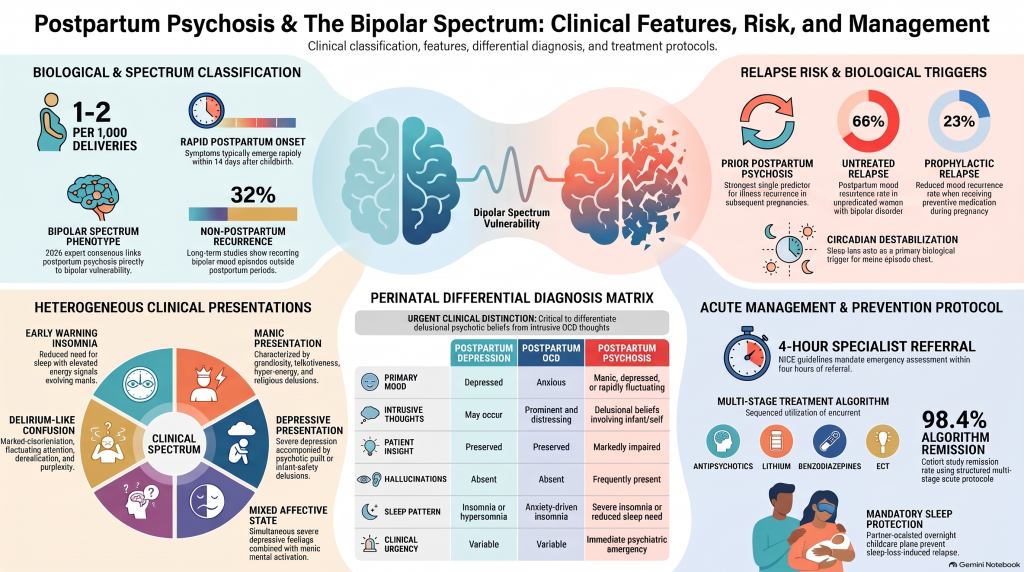
It affects approximately 1–2 women per 1,000 deliveries, although estimates vary between studies and populations.
The onset is typically rapid, with most episodes beginning during the first two weeks after delivery.
Symptoms may develop within a few days and sometimes progress dramatically over 24–48 hours.
Although hallucinations and delusions can occur, the condition is not always dominated by psychotic symptoms.
Many women present with prominent manic, depressive or mixed affective symptoms. Others have marked confusion, fluctuating mental states or catatonic features.
The term postpartum psychosis can therefore be misleading because the illness is often fundamentally affective in nature.
2. The Relationship Between Postpartum Psychosis and Bipolar Disorder
The relationship between postpartum psychosis and bipolar disorder represents one of the most important developments in reproductive psychiatry.
Historically, postpartum psychosis was sometimes grouped with schizophrenia and other primary psychotic disorders.
However, longitudinal research has demonstrated that many women experiencing postpartum psychosis have either an established bipolar disorder or subsequently develop recurrent bipolar-spectrum episodes.
Why is postpartum psychosis considered part of the bipolar spectrum?
Several observations support this relationship.
First, mood symptoms are prominent. Many women experience mania, mixed affective episodes or severe depression with psychotic features rather than isolated hallucinations or delusions.
Second, there is a strong association with bipolar I disorder. Women with a previous history of mania are particularly vulnerable to severe postpartum mood episodes.
Third, postpartum psychosis often responds to treatments used for bipolar disorder. Lithium, antipsychotic medication and electroconvulsive therapy have established roles in acute management.
Fourth, family and genetic studies demonstrate overlapping vulnerability. A personal or family history of bipolar disorder is an important risk factor.
Finally, longitudinal studies show that a substantial proportion of women experience subsequent mood episodes, frequently within the bipolar spectrum.
The 2026 scientific consensus
Bergink and colleagues, in a 2026 expert consensus review, argued that postpartum psychosis should be recognised within the bipolar disorders classification.
Their proposal reflects the view that childbirth may precipitate a distinctive bipolar-spectrum phenotype in biologically vulnerable women.
However, this does not mean every woman who experiences postpartum psychosis will subsequently develop recurrent bipolar disorder.
The relationship is strong but not absolute.
3. Does Postpartum Psychosis Always Lead to Bipolar Disorder?
No.
This is an important distinction when counselling patients and families.
Some women experience a single severe psychiatric episode following childbirth and never develop another episode outside the reproductive period.
Others subsequently experience depression, hypomania, mania or additional psychotic episodes unrelated to childbirth.
A prospective longitudinal study involving 106 women with first-onset postpartum psychosis followed participants for approximately four years.
Around 32% experienced major mood or psychotic episodes outside the postpartum period.
Most of these subsequent episodes were associated with bipolar-spectrum illness.
The remaining women did not experience major non-postpartum recurrence during the observation period.
Longer follow-up studies suggest that additional recurrences can emerge over time.
Thus, postpartum psychosis may follow at least two broad clinical trajectories:
- A childbirth-associated vulnerability, with episodes predominantly or exclusively linked to the postpartum period.
- A broader bipolar-spectrum vulnerability, with mood episodes occurring both within and outside the postpartum period.
Predicting which woman will follow which course remains difficult.
There is currently no reliable clinical biomarker capable of distinguishing these trajectories at the first presentation.
4. Clinical Features of Postpartum Psychosis
Postpartum psychosis is clinically heterogeneous.
The most important mistake is to assume that every affected woman will present with obvious hallucinations or delusions.
Some initially appear excessively energetic, emotionally unstable, anxious or unusually sleepless.
Others present with confusion, withdrawal or severe depression.
A. Prodromal or early warning symptoms
The earliest manifestations may include:
- Severe insomnia
- Increased restlessness or agitation
- Irritability and emotional lability
- Heightened anxiety
- Rapid changes in mood
- Increased talkativeness
- Unusual suspiciousness
- Difficulty concentrating
- Behaviour that family members describe as markedly different from normal
Sleep disturbance deserves particular attention.
Ordinary sleep deprivation is common after childbirth. However, reduced need for sleep accompanied by increased energy, excitement or behavioural disturbance should raise suspicion of an evolving manic episode.
B. Manic presentation
A substantial proportion of women develop symptoms characteristic of mania.
These may include elevated or expansive mood, increased energy, excessive talking, racing thoughts, grandiosity, psychomotor agitation, impulsivity and reduced need for sleep.
Some women develop religious or grandiose delusions.
For example, a woman may believe that her child has been chosen for a special spiritual purpose or that she herself possesses extraordinary powers.
Such beliefs are clinically relevant when they represent a clear change from the person’s usual cultural or religious framework and are associated with impaired reality testing.
C. Depressive presentation
Not all postpartum psychotic episodes are manic.
Some women develop severe depression accompanied by psychotic symptoms.
Clinical features may include profound sadness, hopelessness, psychomotor retardation, guilt, nihilistic beliefs, poor appetite, insomnia and suicidal thoughts.
Psychotic beliefs may involve exaggerated guilt, fears that the baby is doomed or convictions that the mother has caused irreversible harm.
Severe postpartum depression with psychotic features must be differentiated from nonpsychotic postpartum depression because the treatment and safety implications are substantially different.
D. Mixed affective presentation
Mixed states are particularly important in postpartum psychiatry.
A woman may simultaneously experience depressive symptoms and manic activation.
For example, she may feel hopeless and suicidal while also showing racing thoughts, agitation, irritability and a markedly reduced need for sleep.
This combination can be associated with substantial distress and behavioural instability.
Mixed affective presentations also strengthen the need to assess for bipolar disorder rather than assuming that all postpartum depressive symptoms represent unipolar depression.
E. Psychotic symptoms
Psychotic features may include:
- Persecutory delusions
- Referential beliefs
- Grandiose or religious delusions
- Delusions involving the identity or safety of the baby
- Auditory or visual hallucinations
- Disorganised thinking and behaviour
Symptoms can fluctuate rapidly, and insight may be impaired.
The presence of hallucinations or delusions requires careful assessment of their relationship to the underlying mood state.
F. Confusional or delirium-like presentation
One distinctive feature of postpartum psychosis is the possibility of a confusional presentation.
Women may experience disorientation, perplexity, marked distractibility, derealisation, fluctuating attention or rapidly changing levels of behavioural organisation.
This phenomenology has historically contributed to descriptions such as puerperal delirious mania.
However, genuine delirium due to infection, metabolic disturbance, neurological disease or obstetric complications must always be excluded.
G. Catatonic features
Catatonia may occasionally occur as part of a severe postpartum mood or psychotic episode.
Possible symptoms include mutism, stupor, negativism, posturing, rigidity, excitement and other characteristic psychomotor abnormalities.
Catatonia requires urgent medical and psychiatric assessment.
Severe cases may require intensive supportive care and treatment with benzodiazepines or ECT, depending on the clinical circumstances.
5. Why Does Childbirth Trigger Bipolar-Spectrum Episodes?
Postpartum psychosis provides an important example of how biological transitions can interact with vulnerability to mood disorders.
Several mechanisms are being investigated.
A. Rapid reproductive hormonal changes
Oestrogen and progesterone concentrations rise substantially during pregnancy and fall rapidly after delivery.
These changes influence neurotransmitter systems, stress responses and neural circuits involved in emotional regulation.
Research suggests that vulnerability may be related not simply to absolute hormone concentrations, but to individual sensitivity to rapid hormonal fluctuations.
However, hormonal changes alone do not explain postpartum psychosis, since most women undergo these changes without developing psychiatric illness.
B. Sleep deprivation and circadian disruption
Sleep loss is a recognised trigger for mania in susceptible individuals.
Childbirth commonly involves disrupted sleep due to labour, feeding schedules and infant care.
In women with bipolar vulnerability, this disruption may precipitate mood destabilisation.
Research indicates that women with bipolar disorder who report sleep-loss-triggered mania have an increased likelihood of postpartum psychosis.
Sleep protection is therefore not merely a comfort measure. It is an important component of relapse-prevention planning.
C. Immunological mechanisms
Pregnancy involves substantial changes in immune regulation.
Following delivery, immune functioning undergoes another major transition.
Investigators have examined whether inflammatory signalling, immune-cell changes and interactions between immune pathways and the brain contribute to postpartum psychiatric episodes.
These findings remain under investigation.
At present, inflammatory biomarkers are not sufficiently validated to diagnose postpartum psychosis or predict its occurrence in individual patients.
D. Genetic vulnerability
Family studies demonstrate that postpartum psychosis has an important hereditary component.
Its genetic architecture appears to overlap with bipolar disorder, while also potentially containing distinct elements related to childbirth-associated vulnerability.
Genetic risk is not deterministic.
Having a relative with bipolar disorder or postpartum psychosis increases concern but does not mean the condition will inevitably develop.
E. Neurotransmitter and neural-network mechanisms
Dopaminergic systems are relevant to psychosis and mania, while serotonergic, glutamatergic and GABAergic signalling contribute to mood regulation.
Rapid hormonal shifts, sleep disruption and stress may influence these systems.
However, no single neurotransmitter imbalance or neural-network abnormality has been established as the cause of postpartum psychosis.
Research into these mechanisms is biologically plausible but should not be confused with clinically validated diagnostic testing.
6. Risk Factors for Postpartum Psychosis
Important risk factors include:
A previous episode of postpartum psychosis: One of the strongest predictors of future postpartum recurrence.
Bipolar I disorder: Particularly when there is a history of severe mania, psychosis or postpartum mood episodes.
Family history: Especially a history of bipolar disorder or postpartum psychosis in close relatives.
Discontinuation of effective maintenance treatment: This can increase the risk of recurrence among women with established bipolar disorder.
Severe sleep disruption: Particularly in those with a history of mood destabilisation following sleep loss.
First childbirth: Primiparity has been associated with increased risk in some studies.
Obstetric complications: Associations have been reported with certain pregnancy and delivery complications, although these are not sufficiently specific for prediction.
Importantly, postpartum psychosis can develop even without a previous psychiatric history.
The absence of a known diagnosis should never delay assessment when characteristic symptoms appear.
7. How High Is the Risk of Bipolar Relapse After Childbirth?
The postpartum period is among the highest-risk periods for severe mood recurrence in women with established bipolar disorder.
A systematic review and meta-analysis by Wesseloo and colleagues reported postpartum relapse rates of approximately:
- 66% among women with bipolar disorder who were medication-free during pregnancy.
- 23% among women who received prophylactic medication.
These figures describe relapse of mood illness broadly, not postpartum psychosis alone.
A more recent systematic review and meta-analysis published in October 2026 examined lithium prophylaxis and reported pooled postpartum recurrence proportions of 21% in lithium-treated women and 41% in untreated women.
The authors cautioned that the evidence was observational and subject to confounding and other limitations.
These findings reinforce the importance of preventive treatment, but they should not be interpreted as precise individual risk predictions or proof that every woman requires lithium.
Treatment decisions depend on illness history, previous medication response, reproductive plans and the patient’s preferences.
8. Postpartum Depression: Could It Actually Be Bipolar Disorder?
This is an important clinical question.
Not all depression occurring after childbirth is unipolar depression.
Some women who initially present with postpartum depressive symptoms may have an underlying bipolar-spectrum disorder that has not yet been recognised.
Features that should prompt consideration of bipolarity include:
- Previous episodes of elevated or unusually irritable mood with increased energy
- Periods of reduced need for sleep without fatigue
- A history of hypomania or mania
- Previous antidepressant-associated mood elevation
- Family history of bipolar disorder
- Mixed depressive symptoms, including racing thoughts or agitation
- Previous severe postpartum mood episodes
- Psychotic symptoms occurring in association with mood episodes
A careful longitudinal psychiatric history is more important than relying on a single depressive symptom score.
Screening instruments such as the Mood Disorder Questionnaire (MDQ) may assist assessment, but they do not establish the diagnosis.
This distinction matters because antidepressant monotherapy can increase the risk of mood destabilisation in bipolar I disorder.
Where bipolar disorder is suspected, treatment planning should reflect the possibility of manic, mixed or psychotic recurrence.
9. Postpartum Psychosis vs Postpartum OCD vs Postpartum Depression
These conditions can overlap, but distinguishing them is clinically essential.
| Feature | Postpartum depression | Postpartum OCD | Postpartum psychosis |
|---|---|---|---|
| Mood | Usually depressed | Often anxious | Manic, depressed, mixed or rapidly fluctuating |
| Intrusive thoughts | May occur | Prominent and distressing | May involve delusional beliefs |
| Insight | Usually preserved | Often preserved, though variable | May be markedly impaired |
| Hallucinations | Absent in nonpsychotic depression | Not typical | May occur |
| Sleep | Insomnia or increased sleep | Anxiety-related sleep disturbance | Severe insomnia or reduced need for sleep |
| Confusion | Not typical | Not typical | May be prominent |
| Treatment urgency | Depends on severity | Depends on severity and safety | Psychiatric emergency |
A particularly important distinction concerns thoughts of infant-related harm.
In OCD, these thoughts are generally unwanted, frightening and inconsistent with the person’s intentions.
In psychosis, beliefs involving the baby may be experienced as real, with impaired judgment or altered reality testing.
Careful assessment of insight, intent, mood, psychotic symptoms and functional impairment is essential.
10. Diagnostic Evaluation of Postpartum Psychosis
Postpartum psychosis is primarily a clinical diagnosis requiring urgent specialist assessment.
A comprehensive evaluation should include the timing and progression of symptoms, current mental status, previous mood episodes, medication history, family history and collateral information from relatives.
Assessment should specifically examine:
- Manic, depressive and mixed symptoms
- Delusions, hallucinations and disorganisation
- Attention, orientation and fluctuating consciousness
- Sleep changes and reduced need for sleep
- Suicidal thoughts and intent
- Infant-related fears, beliefs and potential safety concerns
- Ability to provide safe care for oneself and the infant
Physical and neurological examination is also important.
Depending on the presentation, investigations may include complete blood count, electrolytes, renal and liver function, thyroid function, glucose, urine testing and relevant toxicology.
Blood pressure assessment is essential when considering postpartum hypertensive complications.
If clinically indicated, EEG, neuroimaging, lumbar puncture or other specialised investigations may be required.
Important differential diagnoses include:
- Postpartum delirium associated with infection or metabolic disturbances
- Postpartum pre-eclampsia or eclampsia
- Thyroid dysfunction
- Seizures or neurological disease
- Autoimmune encephalitis
- Substance- or medication-induced psychiatric symptoms
- Primary psychotic disorders
- Severe major depression with psychotic features
There is no established blood test, EEG pattern or neuroimaging biomarker that independently confirms postpartum psychosis.
11. Treatment of Postpartum Psychosis
Postpartum psychosis is a psychiatric emergency.
The National Institute for Health and Care Excellence (NICE) recommends immediate specialist assessment, within four hours of referral, when symptoms suggest postpartum psychosis.
Treatment usually requires hospital admission.
A specialist mother-and-baby unit is ideal where available and clinically appropriate, although acute safety and treatment should not be delayed when such facilities are unavailable.
A. Antipsychotic medication
Antipsychotic medicines are frequently used to manage acute psychosis, mania, agitation and disorganised behaviour.
Medication selection depends on the clinical presentation, previous response, physical health and breastfeeding considerations.
B. Lithium
Lithium has a particularly important role because postpartum psychosis is closely associated with bipolar-spectrum illness.
It may be used for acute mood stabilisation and prevention of recurrence.
Lithium treatment requires appropriate assessment and monitoring of serum lithium concentrations, renal function, thyroid function and relevant clinical factors.
The postpartum period involves physiological changes that may influence medication handling, making monitoring especially important.
C. Benzodiazepines
Short-term benzodiazepine treatment may be used in selected cases for severe insomnia, agitation or catatonic symptoms.
Restoration of sleep is an important part of acute management.
D. Electroconvulsive therapy (ECT)
ECT is an effective option in severe postpartum psychiatric illness, especially when rapid response is required.
Clinical indications may include severe psychotic depression, catatonia, life-threatening refusal of food or fluids, severe mania or an inadequate response to medication.
ECT should not automatically be viewed as a last resort when clinical urgency supports earlier use.
E. Evidence from structured treatment programmes
Bergink and colleagues studied a structured treatment algorithm involving benzodiazepines, antipsychotic medication, lithium and ECT as a further option.
In a cohort of 64 women with first-onset postpartum psychosis, 98.4% achieved remission through the first three stages.
This is an encouraging finding, although the study was not a randomised controlled trial and should not be interpreted as a universal cure rate.
Psychological support, education, family involvement and rehabilitation remain important after the acute psychiatric episode has stabilised.
12. Breastfeeding and Treatment Decisions
Breastfeeding decisions should be individualised.
Some antipsychotic medications can be used during breastfeeding with appropriate consideration of infant exposure and monitoring.
Lithium presents a more complex situation because it can enter breast milk, and infant monitoring may be necessary where breastfeeding is considered.
In severe illness, establishing sleep, ensuring effective maternal treatment and protecting infant safety may require modifying feeding arrangements.
A mother’s recovery should not be compromised by pressure to breastfeed.
Decisions should be made collaboratively with the psychiatrist, obstetrician and paediatrician.
13. Preventing Postpartum Psychosis in Women With Bipolar Disorder
For women with bipolar disorder or previous postpartum psychosis, prevention should ideally begin before conception.
A written perinatal psychiatric care plan is particularly valuable.
Important components include:
Preconception review: Assessment of diagnosis, previous episodes, medication response, reproductive safety and relapse risk.
Medication planning: Decisions about continuing maintenance treatment during pregnancy and pharmacological prophylaxis after delivery.
Sleep protection: Arrangements for partner or family assistance with night-time childcare and feeding.
Family psychoeducation: Education about early warning signs such as unusual excitement, severe insomnia, agitation, suspiciousness or behavioural change.
Early postpartum follow-up: Close monitoring during the first days and weeks after delivery.
Emergency planning: A clear pathway for urgent psychiatric assessment should symptoms develop.
Women with bipolar disorder generally require a different prevention strategy from those whose previous episodes have occurred exclusively after childbirth.
For some women with isolated postpartum psychosis, prophylaxis beginning immediately after delivery may be considered.
Women with established bipolar disorder often require ongoing maintenance treatment across pregnancy and the postpartum period.
These decisions should be individualised rather than based on a single protocol.
14. Recovery and Long-Term Prognosis
Postpartum psychosis is severe but often highly treatable.
With appropriate treatment, many women experience substantial or complete recovery.
However, recovery involves more than the resolution of hallucinations, delusions or mania.
Women may subsequently experience depression, anxiety, reduced confidence, difficulties processing the experience, concerns about bonding with their baby or fear of future recurrence.
Psychological rehabilitation, family support and continuity of care are important.
Ongoing follow-up is also necessary because the long-term course may reveal a broader bipolar-spectrum disorder.
The absence of further episodes during the first year does not necessarily eliminate future risk.
15. Future Directions in Perinatal Psychiatry
Postpartum psychosis is of considerable scientific interest because it offers an opportunity to study how reproductive biological transitions may trigger severe psychiatric illness.
Important areas of research include:
- The genetic overlap between postpartum psychosis and bipolar disorder
- Sensitivity to reproductive hormonal changes
- Sleep and circadian mechanisms
- Immune and neuroinflammatory pathways
- Biological differences between isolated postpartum psychosis and recurrent bipolar disorder
- Better predictors of relapse after future pregnancies
- More effective preventive treatment strategies
At present, no biomarker can reliably determine which woman will develop postpartum psychosis or predict whether the illness will later follow a recurrent bipolar course.
The future of perinatal psychiatry lies in integrating longitudinal clinical assessment with reproductive biology, genetics, sleep research and personalised prevention.
16. Frequently Asked Questions
Is postpartum psychosis a type of bipolar disorder?
Postpartum psychosis is strongly associated with bipolar-spectrum illness. A major 2026 expert consensus recommends recognising it within the bipolar spectrum, although postpartum psychosis is not currently a standalone DSM diagnosis.
Can bipolar disorder first appear after childbirth?
Yes. Childbirth may be associated with the first recognised manic, mixed or severe mood episode in a woman with previously unrecognised bipolar vulnerability.
Can postpartum psychosis occur without hallucinations?
Yes. Severe postpartum mania, mixed affective episodes and other mood-dominant presentations may occur without prominent hallucinations.
Does every woman with postpartum psychosis develop lifelong bipolar disorder?
No. Some women experience episodes confined to the postpartum period, while others subsequently develop mood episodes at other times.
Is postpartum psychosis hereditary?
Genetic vulnerability contributes to risk, particularly through family histories of bipolar disorder or postpartum psychosis. However, inheritance does not determine the outcome for an individual woman.
Can postpartum psychosis be prevented?
Risk can often be reduced through specialist planning, appropriate preventive medication, sleep protection and close postpartum monitoring. Prevention cannot be guaranteed.
Is postpartum psychosis curable?
Many women recover substantially or completely following appropriate treatment. Nevertheless, continued psychiatric follow-up is important because relapse or later bipolar-spectrum episodes can occur.
Conclusion: Postpartum Psychosis as a Distinct Bipolar-Spectrum Phenotype
Postpartum psychosis illustrates how reproductive biological changes can interact with an underlying vulnerability to severe mood disorders.
Its characteristic early onset, prominent affective symptoms, association with bipolar disorder, response to lithium and ECT, and longitudinal course support its close relationship with bipolar-spectrum illness.
However, postpartum psychosis is not necessarily synonymous with lifelong bipolar disorder.
Some women experience a reproductive-event-associated illness, while others subsequently develop a broader pattern of recurrent mood episodes.
Recognising this heterogeneity is essential for diagnosis, treatment and counselling.
The most important clinical lesson is that postpartum psychosis should be approached as an acute affective and neuropsychiatric emergency, with particular attention to bipolarity, sleep disruption, early treatment and relapse prevention.
Psychiatric Consultation for Bipolar Disorder and Perinatal Mental Health in Chennai
Pregnancy and childbirth can create important challenges for women with existing psychiatric disorders, particularly bipolar disorder, recurrent depression, OCD and anxiety disorders.
Preconception psychiatric counselling, medication review and postpartum relapse-prevention planning can help women and families make informed decisions.
Dr. Srinivas Rajkumar T
MBBS, MD Psychiatry (AIIMS New Delhi), DNB Psychiatry
Consultant Psychiatrist, Chennai
Assistant Professor of Psychiatry
Clinical areas include bipolar disorder, depression, anxiety disorders, OCD and other psychiatric conditions requiring comprehensive assessment and individualised treatment.
Consultations may include diagnostic evaluation, medication review, discussion of psychiatric treatment during pregnancy, and planning for postpartum monitoring in coordination with other treating specialists.
Clinic: Apollo Clinic, Velachery, Chennai
Online consultations: Available by appointment
Appointments: 8595155808
For suspected postpartum psychosis, seek immediate assessment at an emergency department. Do not wait for a routine clinic appointment.
Selected Scientific References
- Bergink V, et al. Postpartum Psychosis and Bipolar Disorder: Review of Neurobiology and Expert Consensus Statement on Classification. Biological Psychiatry. 2026;99:740–747. DOI: 10.1016/j.biopsych.2025.10.016.
- Wesseloo R, et al. Risk of Postpartum Relapse in Bipolar Disorder and Postpartum Psychosis: A Systematic Review and Meta-Analysis. American Journal of Psychiatry. 2016;173:117–127.
- Bergink V, et al. Treatment of Psychosis and Mania in the Postpartum Period. American Journal of Psychiatry. 2015;172:115–123.
- Bergink V, et al. Long-term Outcome of Postpartum Psychosis: A Prospective Clinical Cohort Study in 106 Women. International Journal of Bipolar Disorders. 2021.
- Jairaj C, et al. Postpartum Psychosis: A Proposed Treatment Algorithm. Journal of Psychopharmacology. 2023.
- Vigod SN, et al. Canadian Network for Mood and Anxiety Treatments Clinical Practice Guideline for the Management of Perinatal Mood, Anxiety, and Related Disorders. Canadian Journal of Psychiatry. 2025.
- American College of Obstetricians and Gynecologists. Screening and Diagnosis of Mental Health Conditions During Pregnancy and Postpartum. Clinical Practice Guideline No. 4. 2023.
- American College of Obstetricians and Gynecologists. Treatment and Management of Mental Health Conditions During Pregnancy and Postpartum. Clinical Practice Guideline No. 5. 2023.
- Sharma V, et al. Lithium in the Prevention of Postpartum Recurrence of Mood Disorders: A Systematic Review and Meta-Analysis. Journal of Clinical Psychiatry. 2026;87(4):26r16567.
- National Institute for Health and Care Excellence. Antenatal and Postnatal Mental Health: Clinical Management and Service Guidance. NICE CG192.