Writer’s Cramp: A Patient’s Guide to Understanding, Treatment and Recovery
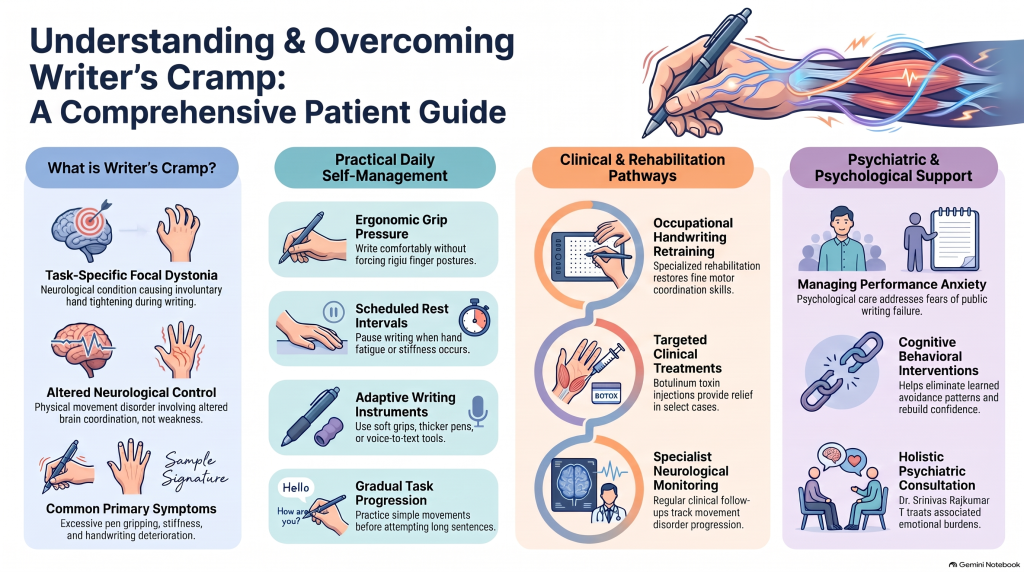 Practical advice for comfortable writing and regaining confidence
What is writer’s cramp?
Writer’s cramp is a neurological movement disorder known as task-specific focal hand dystonia. It causes involuntary tightening, abnormal posturing, or loss of coordination of the fingers, hand, or wrist, particularly during writing.
Patients may experience excessive gripping of the pen, stiffness, unusual finger movements, deterioration in handwriting, or difficulty writing for prolonged periods.
Writer’s cramp is not simply a psychological condition or a consequence of stress. It involves altered neurological control of skilled movements. However, stress, anxiety, fatigue, and fear of symptoms returning can aggravate difficulties in some individuals.
The encouraging news is that many patients can achieve meaningful improvement in writing comfort and function with appropriate treatment, rehabilitation, and supportive care.
Practical advice for patients
1. Write comfortably rather than forcefully
- Avoid gripping the pen excessively tightly.
- Maintain a comfortable sitting posture with appropriate forearm support.
- Use smooth, controlled movements without forcing your fingers into position.
- Concentrate on completing the writing task rather than achieving perfect handwriting.
2. Take regular breaks
- Divide longer writing activities into manageable sessions.
- Pause when your hand begins to feel tired, stiff, or uncomfortable.
- Avoid repeatedly forcing yourself to write through painful or sustained spasms.
- Gradually increase writing duration as tolerated and advised by your therapist.
3. Choose suitable writing instruments
- Experiment with thicker pens, soft grips, or ergonomic pens.
- Choose a pen that glides smoothly across the paper.
- Adjust your grip or writing position under the guidance of an occupational therapist when necessary.
4. Practise writing gradually
- Begin with simple movements, letters, or short sentences.
- Progress towards paragraphs and routine writing tasks as your control improves.
- Prioritise comfort, coordination, and function over speed.
- Avoid excessive or repetitive practice that aggravates symptoms.
5. Avoid constantly checking your handwriting
Repeatedly testing your hand to see whether the cramp has returned can increase frustration and anxiety.
Instead, focus on the purpose of writing. Formal writing exercises can be practised during your rehabilitation sessions, while ordinary writing should become a natural part of everyday life again.
6. Manage anxiety and fear of recurrence
It is understandable to feel worried when a previously difficult activity begins to improve.
Remember:
- Feeling anxious does not necessarily mean your condition is worsening.
- An occasional difficult writing session does not automatically indicate relapse.
- You do not need to write perfectly every time.
- Gradual practice can help rebuild confidence.
Relaxation exercises, cognitive behavioural therapy, and psychological support may be helpful when anxiety or avoidance interferes with recovery.
7. Use alternative methods when necessary
Typing, voice-to-text applications, digital note-taking, and workplace accommodations can reduce unnecessary writing demands.
These are practical adaptations, not signs of failure. They help you remain independent and productive while undergoing rehabilitation.
8. Follow recommended treatment
Depending on the clinical presentation, treatment may include:
- Specialised handwriting retraining.
- Occupational therapy and sensorimotor rehabilitation.
- Botulinum toxin injections for selected patients.
- Psychological treatment for associated anxiety, frustration, or avoidance.
- Regular follow-up with a neurologist, preferably one specialising in movement disorders.
9. Maintain healthy routines
Adequate sleep, regular physical activity, appropriate rest, and managing daily stress can support general well-being during recovery.
10. Seek reassessment when needed
Consult your doctor if writing becomes progressively more difficult, abnormal movements spread to other tasks, significant pain or weakness develops, or anxiety substantially interferes with everyday functioning.
A final message: Progress matters more than perfection
Writer’s cramp can be frustrating, particularly when writing is closely associated with education, professional work, personal independence, or self-confidence.
Recovery may not always follow a straight line. There may be good days and difficult days.
The objective is not simply to eliminate every uncomfortable sensation, but to help you regain useful writing ability and confidence in your everyday activities.
Do not let the fear of writer’s cramp become a greater limitation than the writing difficulty itself.
With appropriate care, patience, and a structured rehabilitation plan, meaningful functional improvement is possible.
Specialist Psychiatric Care and Psychological Support
Dr. Srinivas Rajkumar T
MBBS | MD Psychiatry (AIIMS, New Delhi) | DNB Psychiatry | MBA (HHSM)
Consultant Psychiatrist, Chennai
Assistant Professor of Psychiatry, Sree Balaji Medical College & Hospital, Chennai
When neurological symptoms affect emotional well-being
Living with a neurological movement disorder involves more than managing its physical symptoms. Many patients experience anxiety, frustration, loss of confidence, embarrassment, or fear about their future ability to perform everyday activities.
This is particularly relevant in writer’s cramp, where the difficulty often affects an activity that was previously effortless and automatic.
At my psychiatric practice, I place particular emphasis on understanding the interaction between neurological symptoms, emotional responses, learned avoidance patterns, and everyday functioning.
My approach is to address not only the symptoms that patients experience, but also the ways those symptoms affect their confidence, relationships, professional responsibilities, and quality of life.
How psychiatric consultation may help
Patients with writer’s cramp may benefit from psychiatric assessment and psychological support when they experience:
- Anticipatory anxiety: Persistent worry that the cramp will return whenever they attempt writing.
- Performance-related anxiety: Fear of writing in front of colleagues, teachers, examiners, or other people.
- Loss of confidence: Hesitation to return to writing despite improvement in neurological symptoms.
- Avoidance behaviours: Gradually withdrawing from writing-related activities because of fear.
- Emotional distress: Frustration, low mood, self-criticism, or feelings of helplessness associated with the condition.
- Difficulty adjusting to illness: Challenges in adapting to changes in occupational or academic functioning.
An individualised, evidence-informed approach
Treatment is planned according to the patient’s clinical needs rather than following a single approach for everyone.
Where appropriate, care may involve psychological assessment, cognitive behavioural interventions, graded return to feared activities, stress management, and treatment of associated anxiety or depressive disorders.
Importantly, writer’s cramp is a neurological movement disorder. Psychiatric consultation complements, rather than replaces, appropriate neurological evaluation, occupational therapy, and specialist rehabilitation.
When needed, coordinated care with neurologists, movement-disorders specialists, and rehabilitation professionals can help address both the motor and emotional aspects of the condition.
Why seek help early?
Sometimes, even after the physical symptoms begin to improve, the fear associated with previous writing difficulties persists.
Recognising and addressing this psychological burden may help patients return to everyday activities with greater confidence, reduce unnecessary avoidance, and improve overall quality of life.
You deserve care that recognises both the neurological condition and the person living with it.
Consult Dr. Srinivas Rajkumar T
For psychiatric consultation, assessment of associated anxiety, psychological support, and individualised treatment planning:
Dr. Srinivas Rajkumar T
Consultant Psychiatrist | Chennai
Apollo Clinic, Velachery / Tansi Nagar, Chennai
Online consultations may also be available.
Website: https://srinivasaiims.com
Appointments and clinic availability are subject to confirmation.
Better understanding. Evidence-informed treatment. Compassionate care.
This patient education material is intended to improve awareness and encourage appropriate medical care. It does not substitute for individual neurological or psychiatric assessment.