Food Selectivity in Autism: Why Some Children Eat Only a Few Foods—and What Parents Can Do About It
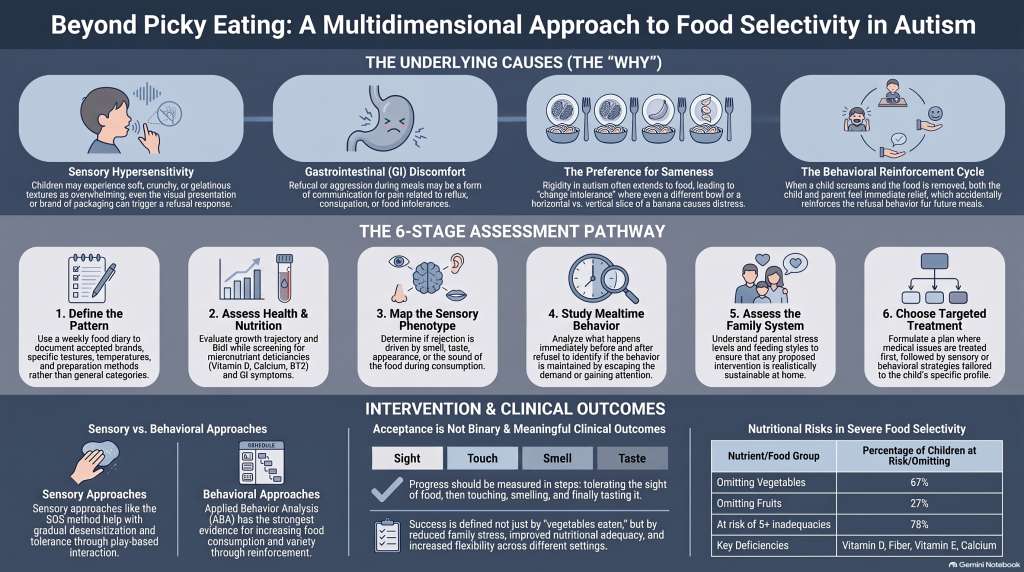 Food is never merely about hunger. Eating brings together taste, smell, texture, temperature, visual appearance, oral-motor coordination, gastrointestinal comfort, learned behaviour, family routines and social interaction.
For many children with autism spectrum disorder (ASD), several of these processes may work differently at the same time. What families casually describe as “picky eating” can therefore represent something much more complex.
A child may eat only a handful of foods. Another may refuse anything soft or wet. Some children accept only one particular brand, colour, temperature, shape or preparation. Others may eat only pureed foods or liquids. A change in packaging may be enough to trigger refusal.
The 2023 review Food Selectivity in Children with Autism: Guidelines for Assessment and Clinical Interventions emphasizes that feeding problems in autistic children are often multidimensional, involving medical, sensory and behavioural factors. It argues that a careful assessment should come before treatment.
The important question is therefore not simply:
“How do we make this child eat?”
A better question is:
“Why is this child refusing this particular food in this particular situation?”
Food Selectivity Is More Than Ordinary Picky Eating
Selective eating is common in typically developing children. Many young children temporarily dislike vegetables, prefer familiar foods or become suspicious of new tastes.
In autism, however, food selectivity can be much more rigid, persistent and disruptive.
It may involve:
- refusal of large numbers of foods
- an extremely limited food repertoire
- preference for only particular textures
- insistence on specific brands
- refusal when packaging changes
- insistence that food be prepared in exactly the same way
- avoidance based on colour, smell or temperature
- eating only pureed food
- dependence on liquids
- rituals surrounding meals
- distress, aggression or escape behaviour during mealtimes.
The review describes food selectivity as including food refusal, restricted dietary variety and, in severe situations, single-food or liquid intake.
This distinction matters because a child who eats fifteen reasonably nutritious foods and is slowly becoming more flexible requires a very different intervention from a child who eats only three foods and progressively loses previously accepted foods.
Food Selectivity and ARFID Are Not Exactly the Same
Food selectivity is a descriptive clinical phenomenon.
A related diagnosis is Avoidant/Restrictive Food Intake Disorder, or ARFID.
ARFID refers to food restriction severe enough to interfere with nutritional or energy requirements or produce clinically significant functional consequences. The review emphasizes the importance of distinguishing different causes of food refusal before treatment because biomedical and behavioural factors may coexist.
Not every autistic child with selective eating has ARFID.
Likewise, ARFID can occur in people without autism.
The key issue is severity and clinical impact.
Why Is Food Selectivity So Common in Autism?
There is rarely one single cause.
One child may reject food because of texture.
Another may have gastro-oesophageal reflux and associate eating with pain.
A third may tolerate the food itself but refuse it because the packaging has changed.
A fourth may have learned that crying or leaving the table reliably makes the unwanted food disappear.
In many children, several mechanisms operate simultaneously.
A useful clinical framework is to consider at least four broad domains:
sensory factors, medical factors, behavioural learning and cognitive rigidity.
1. The Sensory World of Food Can Be Overwhelming
Eating is one of the most sensory-intensive activities humans perform.
A food has:
- appearance
- colour
- shape
- smell
- temperature
- surface texture
- internal texture
- flavour
- sound while chewing
- consistency as it changes inside the mouth.
For a child with altered sensory processing, eating can therefore become surprisingly demanding.
The review describes sensitivities to soft, gelatinous, crunchy or hard textures, as well as taste, smell, visual presentation and temperature. Even stimuli in the surrounding environment can influence eating.
This explains behaviours that may otherwise appear irrational.
A child may eat potato chips but refuse mashed potato.
From an adult perspective, both are potatoes.
From the child’s sensory system, they may be completely different experiences.
Likewise, a child may accept:
one brand of yoghurt
but refuse:
another yoghurt with an almost identical nutritional composition.
The problem may not be yoghurt itself.
The rejected product may smell slightly different, have a different consistency, packaging, colour or visual presentation.
2. Texture Can Be More Important Than Taste
Parents often assume that children reject food because they dislike the taste.
That is not always the case.
For some autistic children, texture is the dominant variable.
One child may prefer only crunchy foods.
Another may accept only soft foods.
Another may struggle when two textures are combined—for example, yoghurt containing fruit pieces.
Mixed foods may be particularly difficult because every mouthful becomes less predictable.
A uniform biscuit is relatively consistent.
A vegetable curry may vary in texture, temperature, smell and appearance with every spoonful.
Predictability itself can therefore become rewarding.
3. Smell Can Be a Powerful Trigger
Smell is another underestimated component.
A food may be rejected before it even reaches the mouth.
Research discussed in the review suggests that olfactory familiarisation can influence food preference. In one study, repeated familiarisation with a particular food odour increased positive responses, and 68% of participants subsequently selected food associated with the familiarised odour.
This helps explain why forcing a child to taste a strongly disliked food immediately may sometimes be counterproductive.
For some children, the therapeutic sequence may need to begin much earlier:
seeing → tolerating → smelling → touching → tasting → chewing → swallowing.
Eating does not necessarily begin with the first bite.
4. Autism Involves a Preference for Sameness and Predictability
Restricted and repetitive patterns are central features of autism.
The same need for predictability may extend into eating.
A child may want:
the same plate,
the same spoon,
the same chair,
the same brand,
the same packaging,
and the same preparation every day.
The review describes relationships between repetitive behaviour and problematic mealtime behaviour and notes greater insistence on sameness surrounding food presentation among autistic children.
This introduces an important distinction.
Sometimes the problem is:
sensory intolerance.
At other times it is:
intolerance of change.
And frequently it is both.
5. Food Neophobia: Fear or Avoidance of New Foods
Many children show food neophobia—the reluctance to try unfamiliar foods.
In autism, this may become considerably more pronounced.
New food introduces uncertainty.
The child does not know:
What will it taste like?
How will it feel?
Will it be crunchy?
Will it suddenly become soft?
Will there be an unexpected smell?
For a sensory-sensitive and predictability-seeking nervous system, refusing the unfamiliar food may therefore be an understandable protective response.
Repeated, low-pressure exposure can gradually reduce this uncertainty.
6. Gastrointestinal Problems Must Not Be Missed
Behaviour is sometimes communication.
This becomes especially important in autistic children with limited expressive language.
A child may suddenly:
refuse meals,
cry while eating,
arch the body,
become aggressive,
push food away,
or lose previously accepted foods.
It is easy to interpret these behaviours purely as behavioural resistance.
Sometimes the child is experiencing pain.
The review recommends assessing gastrointestinal problems including:
- constipation
- diarrhoea
- vomiting
- abdominal discomfort
- gastro-oesophageal reflux
- possible food allergies or intolerances where clinically appropriate.
Dental and oral-motor problems may also contribute.
This leads to a simple clinical principle:
If eating hurts, behavioural pressure alone will not solve the problem.
Medical contributors should be evaluated before assuming that refusal is purely behavioural.
7. The Nutritional Consequences May Be Hidden
A child does not have to look thin to have nutritionally important food selectivity.
Some children consume a restricted diet dominated by:
biscuits,
chips,
processed carbohydrates,
sweet foods,
or calorie-dense preferred snacks.
They may therefore gain adequate weight—or even develop overweight—while still having a poorly balanced diet.
Studies summarized in the review found nutritional concerns involving nutrients such as calcium, vitamin D, protein and vitamin B12 in some autistic populations.
In one study of children with severe food selectivity:
67% omitted vegetables
and
27% omitted fruits.
Furthermore, 78% were considered at risk of five or more nutritional inadequacies, particularly involving vitamin D, fibre, vitamin E and calcium.
Other studies described both underweight and obesity in autistic children.
Therefore, asking only:
“Is the child’s weight normal?”
is insufficient.
A better question is:
“What nutrients is this child actually receiving from the foods they eat?”
8. Mealtime Behaviour Can Become a Reinforcing Cycle
Consider a common scenario.
A parent places an unfamiliar vegetable on the child’s plate.
The child refuses.
The parent persuades.
The child starts crying.
The parent continues encouraging.
Crying becomes screaming.
Eventually the parent removes the vegetable and gives the child’s favourite food because otherwise the child may not eat anything.
Everyone experiences immediate relief.
But two things may have happened.
The child learns:
“If I escalate enough, the unpleasant food disappears.”
The parent learns:
“If I replace the food, the screaming stops.”
Neither intended to create a behavioural cycle.
Yet both behaviours can become reinforced.
The review describes how attention, persuasion, reprimands and escape from eating may unintentionally maintain food refusal. It also highlights the considerable stress these situations place on families.
This is why treatment sometimes needs to address the entire mealtime interaction rather than only the food.
Food Selectivity Can Affect the Whole Family
Persistent feeding difficulties rarely remain confined to the child.
Parents may begin cooking separate meals.
Siblings may stop receiving foods the autistic child dislikes because serving them creates conflict.
Restaurants become difficult.
Travel becomes stressful because the accepted brand may not be available.
Birthday parties become complicated.
Parents may begin carrying preferred foods everywhere.
Eventually, the family’s entire routine can revolve around avoiding feeding crises.
Studies reviewed in the paper report greater parental stress and significant effects on family eating patterns.
Therefore, one important treatment outcome is not merely:
“How many vegetables does the child now eat?”
It is also:
“Has family life become easier?”
How Should Food Selectivity Be Assessed?
The review strongly supports a comprehensive assessment rather than immediately starting dietary or behavioural intervention.
Clinical evaluation should combine history, direct observation and indirect measures such as questionnaires.
A useful assessment can be organised into several steps.
Step 1: Map the Child’s Existing Food Repertoire
Parents can prepare a detailed list of foods the child currently eats.
Do not simply write:
“Rice.”
Specify:
plain rice,
curd rice,
lemon rice,
rice mixed with dal,
specific restaurant rice,
particular consistency,
specific temperature.
The more precise the information, the better.
It can also be useful to identify common characteristics among accepted foods.
Are they mostly:
crunchy?
white?
bland?
sweet?
dry?
cold?
uniform in texture?
packaged?
Predictable patterns can reveal the underlying sensory phenotype.
Step 2: Identify Previously Accepted Foods
Foods that the child ate in the past but stopped eating may be particularly useful treatment targets.
Reintroducing a previously accepted food is sometimes easier than introducing a completely unfamiliar food.
Loss of previously accepted foods can also provide clues.
Did refusal begin after:
vomiting?
gastroenteritis?
choking?
dental pain?
constipation?
a change in packaging?
a frightening feeding experience?
The timeline matters.
Step 3: Maintain a Food Diary
A structured food diary can document:
- foods eaten
- quantities
- time of eating
- drinks
- snacks
- refusals
- behavioural responses
- bowel habits
- environmental circumstances.
Patterns often become apparent only after several days.
The review recommends detailed assessment of dietary repertoire and recurrently excluded food categories rather than relying on general impressions.
Step 4: Examine Growth and Nutritional Status
Assessment should include:
height,
weight,
BMI or appropriate growth indices,
growth trajectory,
food groups consumed,
and possible nutritional inadequacies.
Laboratory evaluation should be guided by clinical findings rather than performed indiscriminately.
A child with substantial food restriction may require nutritional review even if body weight appears satisfactory.
Step 5: Assess Gastrointestinal and Medical Factors
Clinicians should look for:
constipation,
reflux,
abdominal pain,
vomiting,
diarrhoea,
allergic symptoms,
oral-motor difficulties,
dental problems,
swallowing problems,
and other medical contributors.
In some children with limited communication, unusual behaviour around meals may be the only visible sign of discomfort.
Step 6: Map the Sensory Profile
The clinician should ask:
Does the child avoid soft foods?
Does smell trigger refusal?
Are brightly coloured foods avoided?
Does the child tolerate warm foods but not cold foods?
Does mixed texture cause distress?
Does the child dislike food touching other food?
Does packaging matter?
Does the environment matter?
Some children eat reasonably well at home but refuse in noisy restaurants.
Others tolerate school food better because the routine is predictable.
Understanding these differences helps identify the relevant mechanism.
Step 7: Analyse the Behaviour Functionally
The clinician should examine:
What happens before refusal?
What exactly does the child do?
What happens immediately afterwards?
Does refusal result in:
attention?
escape from the table?
removal of the food?
replacement with a preferred food?
access to a screen?
A behaviour can continue because of its consequences even when it originally began for sensory or medical reasons.
Step 8: Assess Parent Feeding Practices
Parents are usually trying to solve the problem with the best tools they have.
Common strategies include:
persuasion,
reward,
threats,
feeding while the child watches television,
providing alternative meals,
following the child around with food,
or allowing grazing throughout the day.
Some strategies may help temporarily while making structured eating more difficult later.
The review discusses parental feeding-style instruments and emphasises evaluating caregiver behaviour as part of the overall assessment.
Standardised Feeding Assessments
Several tools can support clinical evaluation.
The Brief Autism Mealtime Behavior Inventory (BAMBI) evaluates domains including limited variety and food refusal as well as autism-related mealtime behaviours.
The Behavioral Pediatrics Feeding Assessment Scale (BPFAS) evaluates both child and parent mealtime behaviours and separates behaviour frequency from whether the behaviour is regarded as problematic.
Other tools described in the review include:
- Screening Tool of Feeding Problems
- Children’s Eating Behavior Inventory-Revised
- Pediatric Assessment Scale for Severe Feeding Problems.
Sensory assessment may additionally involve instruments such as the Short Sensory Profile or Sensory Profile 2, which examine sensory seeking, avoidance, sensitivity and registration.
Questionnaires, however, should supplement—not replace—clinical observation.
How Is Food Selectivity Treated?
There is no universal treatment.
The intervention should follow the formulation.
Broadly, treatment may involve:
medical treatment, nutritional intervention, sensory intervention, behavioural intervention and parent training.
The combination depends on the child.
Sensory-Based Intervention
When sensory intolerance is prominent, gradual familiarisation may help.
One approach discussed in the review is the Sequential Oral Sensory, or SOS, approach.
Rather than expecting immediate eating, the child gradually progresses through stages such as:
visual tolerance → interaction → smell → touch → taste → eating.
The review describes SOS as a systematic desensitisation approach intended to progressively increase interaction with different foods and textures.
This progression highlights an important idea.
For a severely avoidant child, progress may begin long before swallowing.
A child who previously screamed when a carrot appeared on the table may initially achieve something clinically meaningful simply by tolerating the carrot nearby.
Later the goals may be:
touching it,
smelling it,
placing it against the lips,
taking a tiny bite,
chewing,
and eventually swallowing.
Behavioural Intervention
Behavioural approaches have an important evidence base in severe food selectivity.
The review describes Applied Behaviour Analysis principles including:
- preference assessment
- functional assessment
- differential reinforcement
- gradual exposure
- stimulus fading
- texture fading
- shaping
- non-contingent reinforcement
- sequential presentation
- simultaneous presentation
- mixing preferred and non-preferred foods.
These approaches attempt to systematically increase food acceptance while reducing maladaptive mealtime behaviours.
Shaping: Rewarding Small Steps
A child does not have to go directly from refusal to eating an entire serving.
Shaping means reinforcing successive approximations.
For example:
First, tolerate the food on the table.
Then tolerate it on the plate.
Then touch it.
Then smell it.
Then touch it to the lips.
Then bite.
Then chew.
Then swallow.
The size and speed of progression should depend on the child.
Texture Fading
Suppose a child accepts only pureed food.
Immediately presenting normal solid food may create overwhelming difficulty.
Instead, texture can sometimes be altered gradually.
The review describes studies where food consistency was systematically modified from more processed textures toward increasingly textured food while monitoring acceptance.
A similar principle can sometimes be used with:
temperature,
colour,
shape,
brand,
and food presentation.
Positive Reinforcement
Positive reinforcement can help establish new feeding behaviours.
If a meaningful preferred activity or stimulus follows a successful attempt at eating, the child may gradually become more willing to repeat the behaviour.
Crucially, the reinforcer must actually be valuable to that particular child.
This is why behavioural programmes may include structured preference assessments before treatment.
What motivates one child may be irrelevant to another.
Escape Extinction Requires Specialist Supervision
One behavioural strategy discussed in feeding research is escape extinction.
The principle is that refusal should no longer automatically result in escape from the feeding demand.
Although it can be effective in selected severe feeding disorders, it is not something parents should simply attempt after reading about it online.
The review specifically warns that extinction procedures can produce:
crying,
tantrums,
aggression,
behavioural escalation,
and other potentially unsafe responses.
Professional expertise and an appropriate therapeutic environment are important.
The review subsequently cautions that techniques involving physical guidance, pressure, punishment or some extinction procedures can increase challenging behaviours and require appropriately trained practitioners.
This becomes even more important if sensory distress or medical pain has not yet been adequately evaluated.
Parent Training Is Often Essential
Children eat most of their meals at home.
Therefore, even an excellent clinic-based intervention may have limited value unless the improvement generalises to everyday life.
Parent-mediated approaches allow families to learn:
how to introduce foods,
how to respond to refusal,
how to reinforce progress,
how to avoid accidentally strengthening avoidance,
and how to maintain improvement over time.
The review discusses behavioural skills training involving:
instruction,
modelling,
practice,
feedback,
video modelling,
and teleconsultation.
Family-centred programmes have also been explored.
The EAT-UP intervention was associated with increased food acceptance and dietary diversity alongside reduced challenging behaviours.
The structured MEAL Plan for moderate food selectivity produced a positive treatment response in 47.3% of participants in one group trial.
That figure itself illustrates an important clinical lesson:
no single intervention works for every autistic child.
What About Gluten-Free and Casein-Free Diets?
Parents frequently encounter claims that removing gluten or casein can improve autism.
The evidence does not support routinely prescribing such restrictive diets as a general treatment for autism.
The review describes some reports of improvement among children who had gastrointestinal symptoms, but also discusses a systematic review that did not support gluten-free/casein-free diets as a routine autism treatment and raised potential concerns including effects on bone health.
This distinction is important.
If a child has a genuine allergy, intolerance or gastrointestinal disorder, dietary modification may of course be appropriate.
But unnecessarily removing major food groups from the diet of a child who already eats very few foods can make nutritional restriction even worse.
The Gut Microbiome: Interesting, but the Science Is Still Developing
There is substantial interest in the relationship between autism, gastrointestinal symptoms, diet and the gut microbiome.
The review discusses the possibility of a bidirectional relationship.
Selective eating may reduce consumption of fibre-rich foods such as fruits and vegetables, potentially influencing the gut microbiome.
Conversely, gastrointestinal disturbances may make eating uncomfortable and contribute to further avoidance.
However, the authors also emphasize that much more research is needed to clarify these relationships.
Therefore, microbiome hypotheses should not distract from more established clinical priorities such as nutrition, gastrointestinal assessment, sensory evaluation and behavioural analysis.
Early Intervention Matters
Parents sometimes hope that selective eating will disappear naturally with age.
That can happen to some degree.
But it cannot be assumed.
The review describes longitudinal findings in which food refusal improved while the overall number of unique foods eaten did not substantially increase.
This means a child may become less disruptive during meals while remaining nutritionally and behaviourally restricted.
Early intervention therefore does not mean aggressive feeding.
It means identifying the problem early and gradually preventing the food repertoire from becoming narrower and more rigid.
When Should Parents Seek Professional Assessment?
Professional evaluation becomes particularly important when:
the child’s diet is progressively narrowing;
the child eats only a handful of foods;
entire food groups are missing;
the child depends predominantly on purees or liquids;
there is weight loss or impaired growth;
there is significant overweight despite a poor-quality diet;
constipation, vomiting, reflux or abdominal pain are present;
there is choking or swallowing difficulty;
pica occurs;
the child becomes severely distressed around meals;
aggression or self-injury occurs during feeding;
school meals become impossible;
family functioning is significantly affected;
or parents feel they must organise the entire household around the child’s accepted foods.
For children with severe nutritional restriction, the review recommends interdisciplinary management involving medical, nutritional and psychological perspectives.
Depending on the child’s needs, occupational therapy, speech and feeding therapy, paediatrics or other developmental specialists may also be involved.
What Should Successful Treatment Actually Aim For?
The goal should not simply be:
“Make the child eat vegetables.”
A more meaningful set of goals might be:
increase the number of tolerated foods;
improve nutritional adequacy;
increase flexibility across brands and preparation;
reduce distress around unfamiliar foods;
allow the child to eat in different environments;
reduce disruptive mealtime behaviour;
decrease family conflict;
and make meals easier for everyone.
Even modest improvements can have major effects on quality of life.
Treat the Mechanism, Not Merely the Refusal
The visible behaviour is:
“The child refuses food.”
But underneath that behaviour may be:
sensory hypersensitivity,
olfactory aversion,
gastrointestinal pain,
oral-motor difficulty,
fear of novelty,
autistic insistence on sameness,
learned escape behaviour,
or several of these simultaneously.
That is why the most useful clinical questions are:
What does the child currently eat?
What characteristics do the accepted foods share?
Which sensory features trigger refusal?
Has the child lost previously accepted foods?
Is eating painful?
What happens immediately before refusal?
What happens immediately afterwards?
Is nutrition adequate?
What allows the child to feel safe enough to explore something unfamiliar?
Once these questions are answered, intervention becomes far more rational.
The review ultimately recommends precisely this kind of multidimensional approach: assess concurrent causes first and then select appropriate nutritional, medical, sensory, behavioural and environmental interventions according to the individual child.
The evidence base is still evolving. Definitions of food selectivity differ between studies, assessment approaches are heterogeneous, and several intervention studies involve relatively small samples. The review itself emphasizes these methodological limitations and the need for further research.
Nevertheless, one principle is already clear:
The goal is not to overpower the child’s refusal. The goal is to understand why eating has become restricted, protect nutrition and physical health, reduce distress, gradually build flexibility and help the family develop a sustainable way forward.
Assessment for Autism, Food Selectivity and Related Neurodevelopmental Concerns in Chennai
Significant food selectivity in an autistic child deserves more than the label of “picky eating.”
The difficulty may involve an interaction between sensory processing, rigidity, anxiety, behavioural learning, developmental factors and physical health. A structured clinical evaluation can help identify which of these mechanisms are most relevant before deciding on treatment.
Dr. Srinivas Rajkumar T is a Senior Consultant Psychiatrist with Apollo Hospitals, Chennai, with postgraduate training in Psychiatry from AIIMS New Delhi and clinical interests spanning autism, ADHD, cognition and technology-assisted psychiatric assessment.
At ATTN Clinic, the emphasis is on understanding the individual’s broader cognitive, behavioural and neurodevelopmental profile rather than looking at one symptom in isolation. Where clinically appropriate, evaluation may incorporate structured clinical interviewing, standardized psychological measures and objective technology-assisted assessments, followed by an individualized treatment plan.
Children with substantial feeding difficulties may additionally require coordinated care with other professionals—including psychologists, occupational therapists, paediatricians, nutrition specialists and feeding or speech-language professionals—depending on the underlying formulation.
ATTN Clinic — Attention. Understood.
ATTN Clinic currently functions from:
Apollo Clinic (Opp. Phoenix Market City), Velachery, Chennai
Appointments: +91 85951 55808
Email: srinivasaiims@gmail.com
Website: srinivasaiims.com
This article is intended for education and awareness. Persistent or severe feeding problems require individualized clinical assessment and should not be managed solely through information available online.