Understanding Emotional Responses in Autism
 One of the most misunderstood parts of autism is emotion.
Many parents say:
“He cries suddenly for no reason.”
“She laughs at odd times.”
“He has terrible meltdowns for small things.”
“She does not react even when someone is upset.”
“He becomes angry if we change a routine.”
“She looks calm outside, but later breaks down completely.”
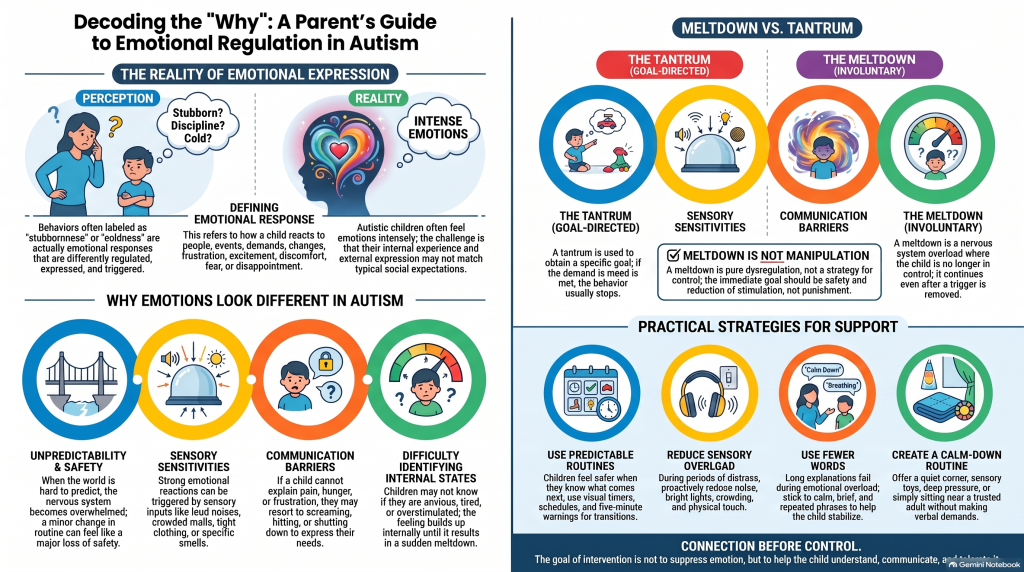
These behaviours are often wrongly interpreted as stubbornness, bad parenting, lack of discipline, or emotional coldness. In reality, emotional responses in autism are not absent — they are often differently regulated, differently expressed, and differently triggered.
Autistic children do feel emotions. In fact, many feel them intensely. The challenge is that the emotional system, sensory system, communication system, and social understanding system may not work together smoothly.
What Do We Mean by Emotional Response?
Emotional response refers to how a child reacts emotionally to people, events, demands, changes, frustration, excitement, discomfort, fear, or disappointment.
In a typically developing child, emotions are usually connected to the situation in a way adults can understand. A child may cry when hurt, smile when praised, show fear when threatened, or become upset when denied something.
In autism, the emotional reaction may sometimes appear unusual. The child may become extremely distressed over a small change, laugh when others are serious, show little visible emotion in a situation where emotion is expected, or remain stuck in one emotional state for a long time.
This does not mean the emotion is fake. It means the child’s internal experience and external expression may not match what others expect.
Why Emotional Responses May Look Different
There are several reasons why emotions may appear unusual in autism.
First, many autistic children have difficulty understanding and predicting the world around them. When events are unpredictable, the nervous system can become overwhelmed. A small change in routine may feel like a major loss of safety.
Second, sensory sensitivities can trigger strong emotional reactions. A loud mixer, a crowded mall, a tight shirt collar, bright lights, hair cutting, or the smell of food may cause distress that looks like anger or tantrum.
Third, communication difficulties can intensify emotions. A child who cannot explain pain, hunger, fear, confusion, or frustration may cry, scream, hit, run away, or shut down.
Fourth, autistic children may have difficulty identifying their own emotional state. They may not know whether they are anxious, tired, overstimulated, angry, or sad. The feeling builds inside until it comes out as a sudden meltdown.
Fifth, social expectations may be confusing. The child may not understand why others are upset, why a joke is funny, why a situation is serious, or why a certain emotional response is expected.
Meltdown Is Not the Same as Tantrum
This distinction is very important.
A tantrum is usually goal-directed. The child wants something and uses behaviour to obtain it. If the demand is met, the tantrum often stops.
A meltdown is different. It is a nervous system overload. The child is no longer fully in control. The behaviour may continue even after the trigger is removed. During a meltdown, the child may cry, scream, run, hit, bite, throw objects, cover ears, or collapse.
A meltdown is not manipulation. It is dysregulation.
The immediate response should not be punishment. The first goal is safety, reduction of stimulation, calm presence, and later understanding the trigger.
Why Some Children Seem Emotionless
Some autistic children may not show emotion in expected ways. They may not smile when praised, may not comfort someone who is crying, or may not look visibly excited during happy events.
This can be misread as lack of empathy. But empathy has many layers.
A child may feel distress but not know how to respond.
A child may care but not know what facial expression to show.
A child may notice sadness but become overwhelmed and withdraw.
A child may express affection through actions rather than words or facial expression.
We should not assume that a child does not feel simply because the child does not express emotion conventionally.
Laughter, Crying, and “Inappropriate” Emotion
Parents often worry when a child laughs without obvious reason or cries in a situation that seems neutral.
Sometimes the child may be responding to an internal thought, memory, sensory experience, sound pattern, visual movement, or private association. Sometimes laughter may occur due to anxiety, excitement, or difficulty understanding the emotional tone of the room.
Similarly, crying may not always mean sadness. It may indicate sensory overload, fatigue, confusion, hunger, pain, transition difficulty, or inability to communicate.
The question should not be, “Why is the child behaving strangely?”
The better question is, “What is the child’s nervous system reacting to?”
Emotional Rigidity
A common feature in autism is difficulty shifting emotional states.
Once upset, the child may take a long time to calm down. Once excited, the child may become difficult to redirect. Once afraid, the child may avoid the situation for weeks or months.
This emotional rigidity is often linked to cognitive rigidity. The brain finds it hard to shift from one expectation to another. When reality does not match the expected script, distress increases.
For example, if the child expected to go by one route and the parent takes another route, the child may have a major reaction. To others it looks minor. To the child, the entire mental map has collapsed.
What Parents Can Do
The first step is to observe patterns rather than react only to behaviour.
Ask:
What happened before the emotional reaction?
Was there a change in routine?
Was the child tired or hungry?
Was the environment noisy or crowded?
Was there a demand placed on the child?
Was the child unable to communicate something?
Did the child have to stop a preferred activity?
Was there pain, illness, constipation, sleep disturbance, or medication change?
When we understand the trigger, we can prevent many emotional storms.
Practical Strategies
Use predictable routines. Many autistic children feel safer when they know what is coming next.
Prepare for transitions. Give warnings before changing activities: “Five minutes more, then bath.” Visual timers, pictures, or simple schedules can help.
Reduce sensory overload. During distress, reduce noise, crowding, bright light, touch, and verbal demands.
Use fewer words during meltdowns. Long explanations during emotional overload usually do not work. Calm, brief, repeated phrases are better.
Teach emotion words gradually. Use simple labels: happy, sad, angry, scared, tired, hurt, too loud, need break.
Create a calm-down routine. This may include a quiet corner, deep pressure if the child likes it, soft music, breathing games, sensory toys, or simply sitting near a trusted adult.
Praise recovery, not just control. When the child calms down, acknowledge it: “You were upset, but you came back. Good calming.”
When to Seek Professional Help
Professional assessment is needed when emotional reactions are very frequent, intense, dangerous, prolonged, or interfere with school, family life, sleep, feeding, or learning.
Assessment is also important if there is self-injury, aggression, severe anxiety, sudden change in behaviour, regression, extreme irritability, sleep disturbance, seizures, or suspicion of pain or medical illness.
In autistic children, emotional dysregulation may coexist with anxiety, ADHD, intellectual disability, language disorder, sleep problems, sensory processing difficulties, epilepsy, gastrointestinal issues, or mood disorders. A good clinical assessment looks at the whole child, not just the behaviour.
What Good Intervention Should Aim For
The goal is not to suppress emotion. The goal is to help the child understand, communicate, tolerate, and regulate emotion.
A child should be helped to say or signal:
“I need a break.”
“Too loud.”
“I am scared.”
“I don’t understand.”
“I want help.”
“I am angry.”
“I am tired.”
“My body hurts.”
When communication improves, emotional storms often reduce.
When the environment becomes more predictable, anxiety reduces.
When sensory needs are respected, meltdowns reduce.
When parents understand the child’s emotional language, the relationship becomes calmer and stronger.
Final Message for Parents
Autistic children are not emotionless. They are often emotionally intense, sensitive, and vulnerable — but their emotional expressions may not follow the usual pattern.
Instead of asking, “Why is my child overreacting?” we can ask, “What is my child trying to manage?”
Instead of saying, “He is doing this deliberately,” we can ask, “Is he overwhelmed?”
Instead of forcing the child to behave normally, we can help the child feel safe, understood, and gradually more regulated.
Emotional growth in autism is possible. It begins with understanding before correction, connection before control, and support before judgment.
Dr. Srinivas Rajkumar T
MD, DNB, MBA
Senior Consultant Psychiatrist
Mind & Memory Clinic, Apollo Clinic Velachery, Chennai
Opp. Phoenix Mall
Email: srinivasaiims@gmail.com
Phone: +91-8595155808