The Psychology of Political Persuasion: From India to MAGA and Beyond
 Elections across the world may differ in language, culture, and institutions—but the psychology that drives persuasion is strikingly similar.
Whether it is messaging around civilizational pride in India, “Make America Great Again” in the United States, or nationalist revival narratives in Europe, the core question remains:
How do campaigns shape not just opinions—but perception, identity, and emotional reality?
This article expands the framework of political persuasion with a global lens, drawing parallels across major campaigns and movements.
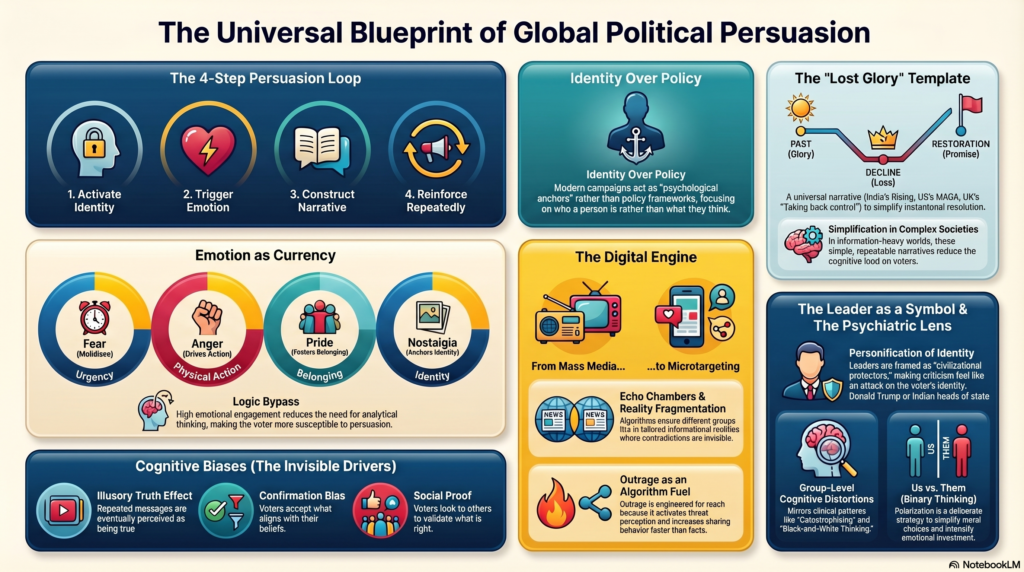
🧠 1. The Universal Blueprint: Identity → Emotion → Narrative → Reinforcement
Across geographies, successful political persuasion follows a pattern:
- Activate identity (Who are you?)
- Trigger emotion (What do you feel?)
- Construct narrative (What story explains this?)
- Reinforce repeatedly (Why should you keep believing this?)
This sequence is visible in:
- Indian electoral narratives invoking civilizational pride
- The Make America Great Again (MAGA) campaign
- Brexit messaging in the UK
- Nationalist movements across Europe
🏛️ 2. The “Lost Glory → Restoration” Template
One of the most powerful persuasion templates globally is:
👉 Glorious Past → Decline → Restoration through current leadership
🇮🇳 India
- References to ancient knowledge systems, cultural greatness
- Narrative: “We were great → We were suppressed → We will rise again”
🇺🇸 United States (MAGA)
- Industrial strength, global dominance, cultural cohesion
- Narrative: “America has declined → We must make it great again”
🇬🇧 Brexit
- Sovereignty, empire legacy, independence
- Narrative: “We lost control → We take it back”
👉 This template works because it:
- Simplifies history
- Personalizes collective identity
- Offers a clear emotional resolution
🔥 3. Emotion as the Primary Currency
Across all major campaigns:
| Emotion | Function in Persuasion |
|---|---|
| Fear | Mobilizes urgency |
| Anger | Drives action |
| Pride | Creates belonging |
| Nostalgia | Anchors identity |
Example:
- MAGA leveraged fear of loss (jobs, identity, borders)
- Indian campaigns often leverage pride + restoration
- European far-right movements often combine fear + identity protection
👉 Emotion reduces the need for analytical thinking.
🧩 4. Simplification in Complex Societies
Modern societies are:
- Economically complex
- Information-heavy
- Politically fragmented
Campaigns succeed when they offer:
👉 Simple, repeatable narratives
Examples:
- “Make America Great Again”
- “Take Back Control” (Brexit)
- “Development + Identity” blends in India
These are not policy frameworks—they are psychological anchors.
🧠 5. Cognitive Biases: The Invisible Drivers
Across cultures, persuasion exploits the same cognitive mechanisms:
🔁 Illusory Truth Effect
Repeated messages feel true.
🔍 Confirmation Bias
People accept what aligns with beliefs.
👥 Social Proof
“What everyone believes must be right.”
⚡ Availability Heuristic
“What I see often must be important.”
👉 Technology has amplified these biases exponentially.
📲 6. Digital Ecosystems: The New Propaganda Machines
While earlier propaganda relied on:
- Radio
- Newspapers
- Television
Modern persuasion uses:
- Social media algorithms
- Messaging platforms (WhatsApp, Telegram)
- Microtargeted ads
🇺🇸 MAGA Campaign
- Heavy use of Facebook microtargeting
- Data-driven voter segmentation
🇮🇳 Indian Elections
- WhatsApp-based local networks
- Regional language targeting
🇬🇧 Brexit
- Targeted digital ads emphasizing immigration and sovereignty
👉 The shift is from mass messaging → personalized persuasion
🧵 7. Echo Chambers and Reality Fragmentation
Today, different groups live in:
👉 Different informational realities
- Each group receives tailored narratives
- Contradictions are invisible across groups
Result:
- Polarization increases
- Dialogue decreases
👉 Persuasion becomes environmental, not argumentative
🧨 8. Outrage and Virality
Across all contexts, outrage spreads faster than facts.
Why?
- It activates threat perception
- It demands immediate reaction
- It increases sharing behavior
From viral clips in India to controversial tweets in the US:
👉 Outrage is engineered for reach
🧠 9. Leader as Symbol
In many campaigns, the leader becomes:
- A personification of identity
- A symbolic figure beyond policy
🇺🇸
Donald Trump became a symbol of:
- Anti-establishment sentiment
- Cultural resistance
🇮🇳
Leaders are often framed as:
- Civilizational protectors
- Developmental architects
👉 Criticism of the leader becomes criticism of identity itself
🧪 10. The Psychology of “Us vs Them”
Polarization is not a side effect—it is a strategy.
By creating:
- In-group (“us”)
- Out-group (“them”)
Campaigns:
- Simplify moral choices
- Intensify emotional investment
This is seen globally:
- Immigration debates in the US and Europe
- Religious/cultural polarization in India
👉 Binary thinking replaces nuance.
🧭 11. A Psychiatric Lens: Collective Cognition
From a clinical perspective, large-scale persuasion often mirrors:
- Group-level cognitive distortions
- Reinforcement loops (like habit formation)
- Emotional contagion
Examples:
- Catastrophizing (“Everything is under threat”)
- Black-and-white thinking (“Either you are with us or against us”)
- Selective abstraction
👉 At scale, this creates a shared psychological reality
⚖️ 12. Persuasion vs Manipulation
Not all persuasion is unethical.
Healthy persuasion:
- Informs
- Engages
- Encourages debate
Manipulative persuasion:
- Exploits fear
- Distorts facts
- Suppresses nuance
The boundary is often blurred in high-stakes elections.
🧩 Final Insight
Across India, the US, and beyond, one truth stands out:
👉 Political persuasion works not because it is logically superior—but because it is psychologically aligned with how humans think and feel.
Campaigns that succeed:
- Don’t fight human psychology
- They work with it—often masterfully
📢 About the Author
Dr. Srinivas Rajkumar T, MD (AIIMS, New Delhi), DNB, MBA (BITS Pilani)
Consultant Psychiatrist & Neurotechnology Specialist
Mind & Memory Clinic, Apollo Clinic Velachery (Opp. Phoenix Mall)
✉ srinivasaiims@gmail.com 📞 +91-8595155808
For deeper insights into how cognition, emotion, and behavior shape not just mental health—but society itself—follow the blog at srinivasaiims.com.