First Rank Symptoms of Schizophrenia
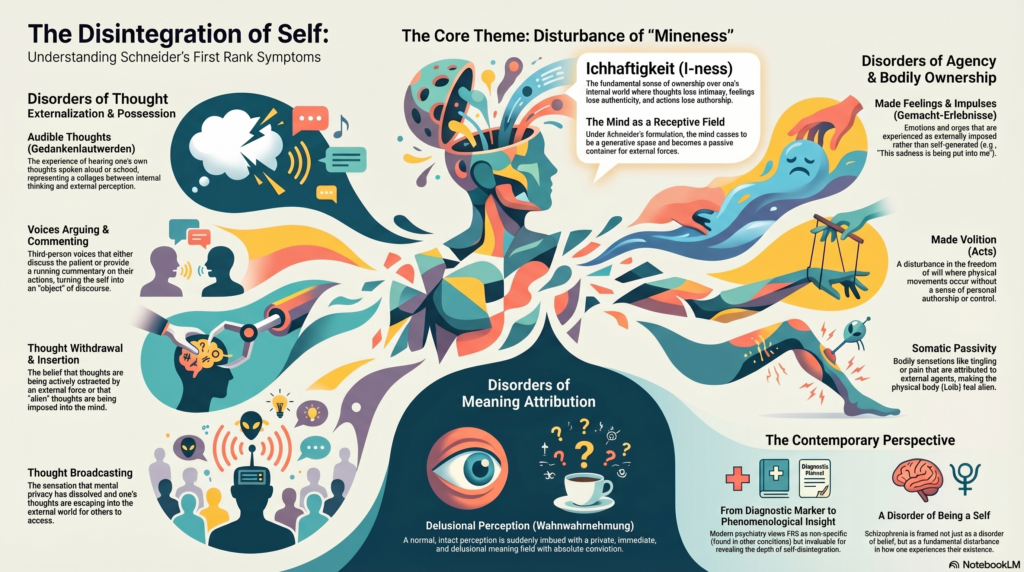 The concept of First Rank Symptoms (FRS), introduced by Kurt Schneider, occupies a unique place in the evolution of psychiatric thought. While contemporary diagnostic systems such as DSM-5 and ICD-11 have moved away from granting these symptoms diagnostic primacy, their phenomenological richness remains unparalleled.
To study First Rank Symptoms is to move beyond surface-level symptomatology and engage with a deeper question:
What happens when the mind no longer feels like one’s own?
Rooted in the German tradition of descriptive psychopathology, influenced by Karl Jaspers, Schneider’s formulation emphasizes not merely what patients experience, but how they experience themselves in relation to their thoughts, feelings, and actions.
🧠 The Central Theme: Disturbance of “Mineness”
(Ichhaftigkeit — ikh-haf-tig-kite)
At the core of First Rank Symptoms lies a disruption in the basic sense of ownership:
- Thoughts lose their intimacy
- Feelings lose their authenticity
- Actions lose their authorship
This disturbance of Ichhaftigkeit—the sense of “I-ness”—forms the conceptual backbone of Schneiderian phenomenology.
🧠 I. Disorders of Thought Externalization
(Störungen der Gedankenverlautbarung — SHTUR-ung-en der geh-DAN-ken fer-LOWT-ba-roong)
1. Audible Thoughts (Gedankenlautwerden — geh-DAN-ken-lout-VAIR-den)
Thoughts, ordinarily silent, are heard aloud.
- May occur simultaneously with thinking or as an echo
- Represents a collapse between Denken (thinking) and Wahrnehmen (perception)
This is not mere inner speech—it is perception of thought.
2. Voices Heard Arguing (Streitende Stimmen — SHTRY-ten-de SHTIM-men)
Two or more voices discuss the patient in the third person.
- Often critical or evaluative
- The individual becomes the object of discourse
A subtle but profound shift occurs:
the self is no longer the center, but the topic of mental life.
3. Voices Commenting (Kommentierende Stimmen — ko-men-TIER-en-de SHTIM-men)
A running commentary accompanies actions.
“He is walking… now he is sitting…”
This produces a doubling of experience—an actor and an observer coexisting within the same consciousness.
🧠 II. Disorders of Thought Possession
(Gedankeneingriffe — geh-DAN-ken-EYE-n-griff-eh)
4. Thought Withdrawal (Gedankenentzug — geh-DAN-ken-ent-TSOOG)
Thoughts are experienced as being removed by an external force.
- Sudden cessation of thought
- Not perceived as forgetting, but as active extraction
5. Thought Insertion (Gedankeneingebung — geh-DAN-ken-EYE-n-geh-boong)
Thoughts are experienced as imposed.
- Alien in quality
- Lacking ownership
The mind becomes a receptive field rather than a generative space.
6. Thought Broadcasting (Gedankenausbreitung — geh-DAN-ken-OWS-bry-tung)
Thoughts are believed to escape into the external world.
- Others are perceived to have access to them
- Mental privacy dissolves
⚡ III. Disorders of Agency (Passivity Phenomena)
(Gemacht-Erlebnisse — geh-MAKHT er-LEB-nis-seh)
7. Made Feelings (Gemachte Gefühle — geh-MAKH-teh geh-FYOO-leh)
Emotions are experienced as externally imposed.
“This sadness is not mine—it is being put into me.”
8. Made Impulses (Gemachte Impulse — geh-MAKH-teh im-PUL-seh)
Urges arise, but are not experienced as self-generated.
9. Made Volition / Acts (Gemachter Wille — geh-MAKH-ter VIL-eh)
Actions occur without a sense of authorship.
- Movements are experienced as controlled
- The individual becomes a passive executor
This reflects a disturbance in Willensfreiheit (freedom of will).
⚡ IV. Disorders of Bodily Ownership
10. Somatic Passivity (Somatische Beeinflussung — zo-MA-ti-she be-EYE-n-floos-soong)
Bodily sensations are experienced as imposed by external forces.
- Tingling, pain, visceral sensations
- Often attributed to external agents
The body (Leib) ceases to feel like one’s own.
🔍 V. Disorders of Meaning Attribution
11. Delusional Perception (Wahnwahrnehmung — VAHN-vahr-NAY-moong)
A normal perception is imbued with a sudden, private, and delusional meaning.
- Immediate
- Unmediated
- Held with conviction
The perception remains intact—the meaning becomes pathological.
🔬 Contemporary Perspective: From Diagnostic Marker to Phenomenological Insight
Modern psychiatry has re-evaluated the role of First Rank Symptoms.
They are now understood to be:
- Non-specific (seen in mood, dissociative, and neurological conditions)
- Inconsistently present in schizophrenia
- Culturally influenced in expression and interpretation
- Limited in prognostic value
As a result, current frameworks emphasize:
- Symptom dimensions (positive, negative, cognitive)
- Course and functional impairment
- Neurodevelopmental context
Yet, despite their reduced diagnostic centrality, First Rank Symptoms remain invaluable for what they uniquely offer:
A direct glimpse into the disintegration of self-experience.
🧩 Closing Reflection
First Rank Symptoms do not define schizophrenia with precision—but they reveal it with depth.
They remind us that beyond hallucinations and delusions lies a more fundamental disturbance:
- Thoughts that are no longer private
- Feelings that are no longer owned
- Actions that are no longer authored
In this sense, schizophrenia is not merely a disorder of perception or belief—
but a disorder of being a self.
(An Excerpt from the Upcoming “Digital Handbook of Psychiatry”)
📘 About the Author
Dr. Srinivas Rajkumar T, MD (AIIMS, New Delhi), DNB, MBA (BITS Pilani)
Senior Consultant Psychiatrist
Author of the upcoming “Digital Handbook of Psychiatry”, a clinically grounded, student-friendly, and India-focused guide integrating ICD-11, DSM-5, case-based learning, and modern neuropsychiatric insights.
Through his work at the Mind & Memory Clinic, Apollo Clinic Velachery (Opp. Phoenix Mall), Chennai, Dr. Srinivas brings together clinical expertise, objective diagnostic tools (QEEG, CPT), and AI-assisted frameworks to enhance diagnostic clarity and patient care.
📩 srinivasaiims@gmail.com
📞 +91-8595155808