🎮 Loot Boxes and the Gateway Hypothesis: Are We Training the Next Generation to Gamble?
 “It’s just a game.”
That’s how it often begins.
A child opens a loot box. Bright colors flash. A rare item appears. There’s excitement, anticipation, and a subtle but powerful psychological imprint.
But beneath this seemingly harmless mechanic lies a deeper question—one that psychiatry, neuroscience, and public health are beginning to take very seriously:
Are loot boxes a gateway to gambling behavior?
🧠 Understanding the Gateway Hypothesis
The gateway hypothesis suggests that early exposure to certain behaviors—often perceived as benign—can increase the likelihood of progressing to more harmful or risky behaviors later.
Traditionally, this model has been used in substance use:
- Nicotine → Alcohol → Illicit drugs
Today, we are witnessing a behavioral equivalent:
- Gaming → Loot boxes → Gambling
However, unlike substances, this pathway is digitally engineered, widely accessible, and often unregulated.
🎯 What Exactly Are Loot Boxes?
Loot boxes are in-game purchases where players spend real or virtual money to receive randomized rewards.
They are:
- Uncertain (you don’t know what you’ll get)
- Reinforcing (rare rewards feel disproportionately valuable)
- Repeatable (you can keep trying)
If this sounds familiar, it should.
Loot boxes mimic the core mechanics of gambling.
⚙️ The Psychology Behind Loot Boxes
To understand their impact, we must look at how the brain learns reward.
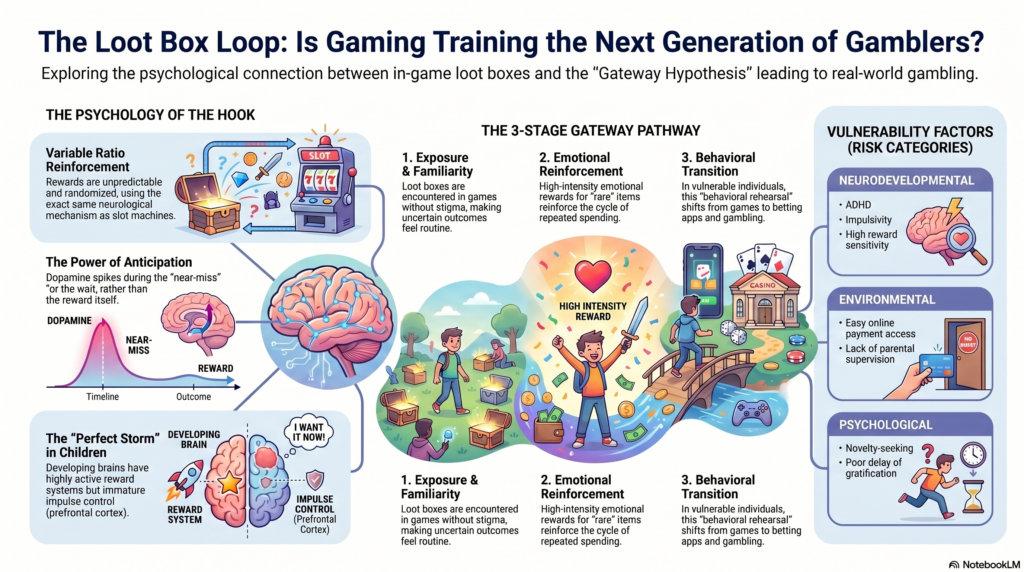
1. Variable Ratio Reinforcement
The most addictive reward schedule in behavioral science.
- Same mechanism used in slot machines
- Rewards are unpredictable
- Leads to persistent engagement
2. Dopamine and Anticipation
It’s not the reward—it’s the possibility of reward.
- Anticipation spikes dopamine
- Near-misses intensify motivation
- “Almost winning” keeps the cycle alive
3. Conditioning Without Awareness
Children are not told:
“This is gambling.”
Instead, they experience:
“This is fun.”
And that distinction matters.
🔁 The Gateway Pathway: Step by Step
Stage 1: Exposure
Children encounter loot boxes in games
→ No stigma, socially normalized
Stage 2: Familiarity
They learn:
- Spend → Open → Reward (sometimes)
Stage 3: Normalization
Spending money for uncertain outcomes becomes routine
Stage 4: Reinforcement
Emotional highs reinforce repetition
Stage 5: Transition
In some individuals:
- Loot boxes → betting apps → real gambling
⚠️ Does This Happen to Everyone?
No.
And this is where clinical nuance is essential.
The gateway hypothesis does not claim inevitability—it suggests increased vulnerability.
🧬 Who Is at Higher Risk?
Certain individuals are more susceptible to this pathway:
🔹 Neurodevelopmental Factors
- ADHD
- Impulsivity
- Reward sensitivity
🔹 Emotional Factors
- Low distress tolerance
- Need for quick gratification
- Emotional dysregulation
🔹 Environmental Factors
- Easy access to online payments
- Lack of parental supervision
- Peer normalization
🔹 Psychological Traits
- Novelty-seeking
- Risk-taking behavior
- Poor delay of gratification
🧠 Alternative Explanations (And Why They Matter)
The gateway hypothesis is not the only model.
1. Common Liability Model
- Same traits (e.g., impulsivity) lead to both gaming and gambling
2. Bidirectional Model
- Early exposure and later behaviors reinforce each other
🧩 Reality Check:
These models are not mutually exclusive.
The most accurate view is an interactional model:
Biology + environment + exposure → behavior
🚨 Why This Is a Public Health Concern
Loot boxes differ from traditional gambling in one critical way:
They reach the brain earlier.
Children and adolescents are in a sensitive developmental window where:
- Reward systems are highly active
- Control systems (prefrontal cortex) are still maturing
This creates a perfect storm:
- High reward drive
- Low impulse control
📉 What Does Research Suggest?
Emerging evidence shows:
- Strong associations between loot box spending and problem gambling severity
- Behavioral overlap between gamers who spend on loot boxes and gamblers
- Early exposure correlates with later risk-taking tendencies
While causation is still being studied, the signal is strong enough to warrant caution.
🧠 A Clinician’s Perspective
From a psychiatric lens, loot boxes can be understood as:
“Behavioral rehearsals for gambling, delivered in a child-friendly, gamified format.”
They do not merely entertain—they train:
- How to tolerate uncertainty
- How to chase rewards
- How to associate money with excitement
🛑 What Can Be Done?
👨👩👧 For Parents
- Be aware of in-game purchases
- Use parental controls
- Discuss probability and randomness openly
🧑⚕️ For Clinicians
- Screen for gaming-related spending
- Assess impulse control and reward sensitivity
- Psychoeducate families about behavioral addictions
🏫 For Policy Makers
- Age restrictions on loot box purchases
- Transparency in reward probabilities
- Regulation similar to gambling frameworks
🧭 A Shift in Perspective
Instead of asking:
“Are loot boxes harmful?”
We should be asking:
“What kind of learning are they shaping in the developing brain?”
Because the answer to that question determines the future trajectory.
✍️ Final Thought
The modern child is not just playing games—they are interacting with carefully engineered reward systems.
And the real concern is not the game itself.
It is the lesson the brain learns from the game.
👨⚕️ About the Author
Dr. Srinivas Rajkumar T, MD (AIIMS), DNB, MBA (BITS Pilani)
Consultant Psychiatrist & Neurofeedback Specialist
Mind & Memory Clinic, Apollo Clinic Velachery (Opp. Phoenix Mall)
✉ srinivasaiims@gmail.com 📞 +91-8595155808