How to Improve Outcomes in Psychiatry: Moving Beyond Medication and Technique
 In modern psychiatry, we are trained to focus on diagnosis, pharmacology, and structured psychotherapy. Yet, every clinician who has spent time in practice recognizes a deeper truth:
👉 Two patients with the same diagnosis, receiving the same treatment, can have very different outcomes.
Why does this happen?
The answer lies not only in what we do—but in how we do it.
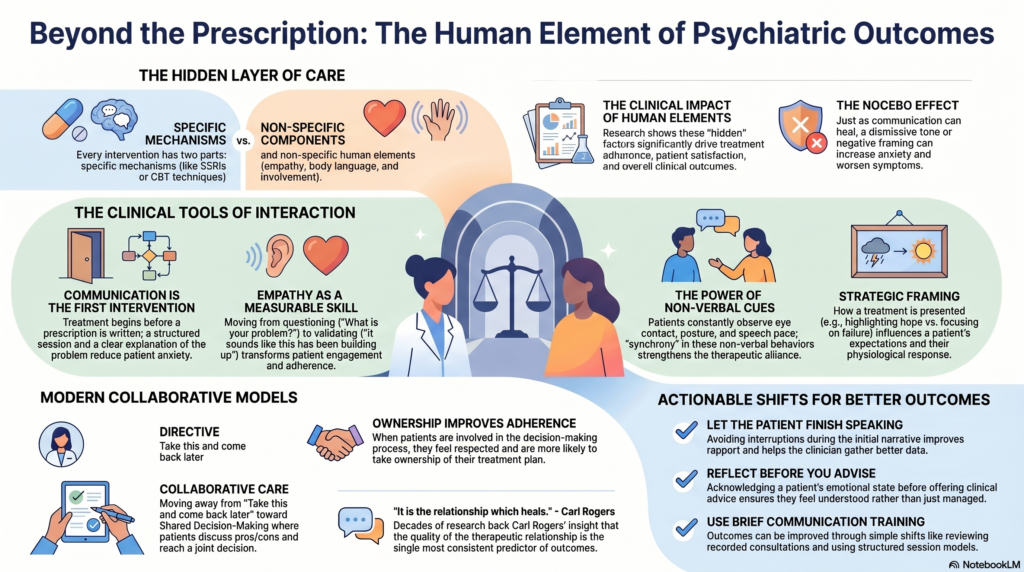
The Hidden Layer of Psychiatric Care
Every psychiatric intervention—whether medication, psychotherapy, or social support—has two components:
- Specific components → Mechanism-based (e.g., SSRIs, CBT techniques)
- Non-specific components → The human elements of care
These include:
- Communication
- Empathy
- Body language
- Framing of treatment
- Patient involvement
Research shows that these “non-specific” elements can significantly influence:
- Treatment adherence
- Patient satisfaction
- Therapeutic alliance
- Clinical outcomes
In fact, they may account for a large proportion of therapeutic effectiveness.
1. The First Intervention Is Communication
Before a single prescription is written, treatment has already begun.
How you introduce yourself, how you structure the consultation, and how clearly you explain the problem—all of these shape outcomes.
What works in practice:
- A clear explanation of the problem
- A structured outline of the session
- A confident yet compassionate tone
Patients tend to improve more when:
- They understand what is happening
- They feel there is a plan
- They sense the clinician is in control yet collaborative
👉 Clarity reduces anxiety.
👉 Structure builds trust.
2. Empathy: The Most Powerful Clinical Tool
Empathy is not simply being kind—it is a clinical skill.
It involves:
- Recognizing emotional cues
- Responding to unspoken concerns
- Validating the patient’s experience
When patients feel understood:
- Anxiety decreases
- Engagement increases
- Adherence improves
What effective clinicians do differently:
Instead of asking:
“What is your problem?”
They reflect:
“It sounds like this has been building up for a long time, and you’ve been managing it on your own.”
That shift—from questioning to understanding—transforms the interaction.
👉 Patients may forget advice—but they rarely forget being understood.
3. Non-Verbal Communication: The Silent Influence
A large part of communication is non-verbal.
Patients are constantly observing:
- Eye contact
- Posture
- Tone of voice
- Pace of speech
Research shows that:
- Warm, attentive body language increases satisfaction
- Positive tone improves follow-up adherence
- Synchrony in interaction strengthens therapeutic alliance
Practical insights:
- Slow down your speech → reduces patient anxiety
- Avoid interrupting → improves rapport
- Maintain eye contact → signals presence
👉 The body often communicates more than words.
4. Framing: How You Say It Changes Outcomes
The way treatment is presented can influence how well it works.
Consider:
- “This medication works in most people”
- “There’s a chance this may not work”
Same information. Different emotional impact.
Why this matters:
- Positive framing increases engagement
- Expectations influence outcomes
- Hope enhances adherence
At the same time:
- Over-optimism may not work in chronic patients
- Framing must be individualized
👉 Treatment is not just pharmacology—it is also psychology.
5. Shared Decision-Making: From Compliance to Collaboration
Traditionally, psychiatry followed a directive model:
“Take this medication and come back in two weeks.”
Modern practice emphasizes:
👉 Shared decision-making
This involves:
- Explaining options
- Discussing pros and cons
- Understanding patient preferences
- Reaching a joint decision
Evidence shows that this approach leads to:
- Better adherence
- Greater satisfaction
- Improved outcomes across disorders
Why it works:
When patients are involved:
- They feel respected
- They take ownership of treatment
- They are more likely to follow through
6. The Therapeutic Relationship: The Core Medium of Change
Across all treatments, one factor consistently predicts outcome:
👉 The quality of the therapeutic relationship
A strong alliance leads to:
- Better engagement
- Lower dropout rates
- Improved symptom outcomes
As Carl Rogers famously said:
“It is the relationship which heals.”
This is not philosophy—it is now backed by decades of research.
7. The Risk We Often Ignore: The Nocebo Effect
Just as communication can heal—it can also harm.
- Dismissive tone
- Rushed consultation
- Negative framing
These can:
- Increase anxiety
- Reduce adherence
- Worsen symptoms
This is known as the nocebo effect.
👉 There is no neutral consultation.
👉 Every interaction has an impact.
8. Can These Skills Be Improved?
Yes—and often with simple interventions.
Evidence suggests:
- Brief communication training improves outcomes
- Reviewing recorded consultations enhances awareness
- Structured consultation models improve engagement
Simple changes that make a difference:
- Let the patient finish speaking
- Reflect emotions before giving advice
- Summarize the session clearly
- Involve the patient in decisions
These are small shifts—but powerful ones.
Final Perspective: Psychiatry as a Human Science
Psychiatry is unique among medical specialties.
It does not treat organs—it treats:
- Experiences
- Emotions
- Meaning
And therefore, outcomes depend not only on:
- The correctness of diagnosis
- The appropriateness of treatment
But also on:
👉 The quality of human interaction
Key Takeaways
- Communication is the first intervention
- Empathy is a measurable therapeutic tool
- Non-verbal behavior shapes outcomes
- Framing influences expectations and response
- Shared decision-making improves adherence
- The therapeutic relationship is central
- Poor communication can worsen outcomes
Closing Thought
Viktor Frankl
“What is to give light must endure burning.”
In psychiatry, clinicians often hold that light.
And sometimes, what heals is not just the treatment—
👉 but the way it is delivered.
Clinical Services & Consultation
If you are looking for a structured, empathetic, and evidence-based psychiatric approach, integrating both scientific treatment and patient-centered care:
Dr. Srinivas Rajkumar T, MD (AIIMS), DNB, MBA (BITS Pilani)
Consultant Psychiatrist & Neurofeedback Specialist
Mind & Memory Clinic, Apollo Clinic Velachery (Opp. Phoenix Mall)
✉ srinivasaiims@gmail.com 📞 +91-8595155808