Early Diagnosis of Autism: Why the First Signs Matter More Than We Think
Autism Spectrum Disorder (ASD) is a neurodevelopmental condition that influences how a child perceives the world, communicates, and connects with others. It is called a spectrum because there is no single presentation—strengths, challenges, and needs vary widely from one child to another. That variability is precisely why early diagnosis is both powerful and protective.
Neurodevelopment is a race against time only in one sense: the brain is most plastic, most adaptable, in the first few years of life. Identifying autism early does not label a child—it liberates development.
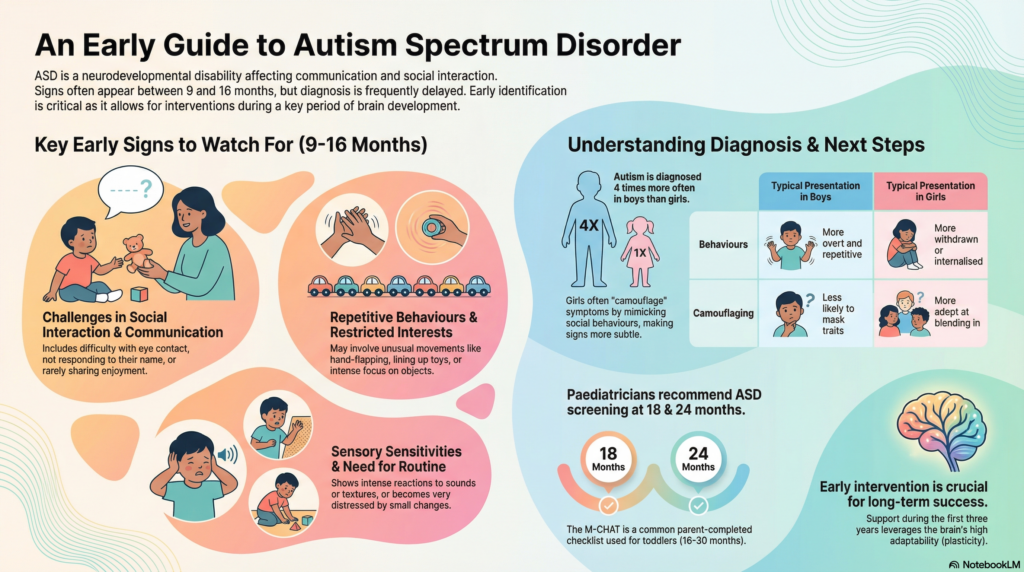
Early Identification: The 16 Red Flags (9–16 Months)
Autistic traits often begin to appear subtly between 9 and 16 months. By the age of two, a reliable diagnosis is often possible, yet many children are still diagnosed years later. Early signs tend to cluster around four domains.
Social and Communication Signals
Early social communication is not about words alone—it is about coordination. Red flags include:
-
Limited or fleeting eye contact
-
Not responding consistently when their name is called
-
Difficulty coordinating eye contact, sounds, and gestures together
Sharing Joy and Interests
Most infants naturally try to share their happiness.
-
A child with ASD may smile or laugh, but rarely looks at others to share that joy
-
Limited use of gestures like pointing, showing, or waving by 12–14 months
Repetitive Behaviours
Repetition is soothing for many autistic children.
-
Hand-flapping, finger movements, body stiffening
-
Repetitive play such as spinning wheels or lining up objects instead of using them functionally
Sensory Sensitivities and Routines
The autistic brain processes sensory input differently.
-
Strong reactions to sounds, textures, lights, or food
-
Distress with small changes in routine
These are not behavioural problems; they are neurobiological responses.
Gender Differences and the Art of Camouflaging
Autism is diagnosed about four times more often in boys, but this does not mean it is rare in girls. Girls are frequently missed because they learn to camouflage.
Girls may:
-
Appear quieter, compliant, or socially observant
-
Imitate peers to blend in, at great emotional cost
-
Internalise distress, later presenting with anxiety, depression, or burnout
Interestingly, autistic girls often use more cognitive process language—words like think, know, or wonder—which can mask underlying social communication difficulties.
Early diagnosis in girls is not just helpful; it is preventive mental healthcare.
Teachers: The Unofficial First Diagnosticians
Teachers occupy a unique vantage point. They see children in socially demanding environments every day.
In classrooms, autism may appear as:
-
Difficulty with reciprocal play during games
-
Trouble reading social cues in group activities
-
Distress during unstructured time
Structured routines, visual schedules, and predictable transitions often bring out the best functioning in autistic students. Many show remarkable strengths—deep focus, pattern recognition, creativity, or analytical thinking—when their interests are respected rather than suppressed.
Screening and Early Intervention
The American Academy of Pediatrics recommends routine autism screening at 18 and 24 months.
One widely used screening tool is the M-CHAT (Modified Checklist for Autism in Toddlers), designed for children aged 16–30 months. It is a parent-completed questionnaire that helps identify children who may benefit from further evaluation.
Early intervention works because the young brain is still wiring itself. Support during this window improves:
-
Social engagement
-
Language and communication
-
Emotional regulation
-
Long-term independence
Early support does not erase autism—it supports the child’s natural developmental trajectory.
A Simple Analogy for Developmental Milestones
Think of developmental milestones as stone markers along a road. They do not determine how fast a child must travel, but they tell us whether the journey is unfolding as expected. Missing a marker is not failure—it is information.
And information, when acted upon early, changes outcomes.
A Note from My Clinical Practice
As a psychiatrist working closely with children, families, and schools, I see one truth repeatedly:
early recognition transforms lives—not by changing who the child is, but by changing how early we support them.
If you are a parent, teacher, or caregiver with concerns about a child’s development, trust your observation. Seeking an evaluation early is not an overreaction; it is an act of foresight.
About the Author
Dr. Srinivas Rajkumar T, MD (AIIMS, New Delhi), DNB, MBA (BITS, Pilani)
Consultant Psychiatrist & Neurofeedback Specialist
Mind & Memory Clinic – Apollo Clinic Velachery (Opp. Phoenix Mall)
I work with children, adolescents, and families using a developmental, neuroscience-informed approach, integrating clinical assessment, psychoeducation, and early intervention planning.
📧 srinivasaiims@gmail.com
📞 +91-8595155808
Early diagnosis is not about prediction. It is about possibility.