Diagnosing Trump and Modi? Think Again: The Danger of Armchair Diagnoses and the Relevance of the Goldwater Rule Today
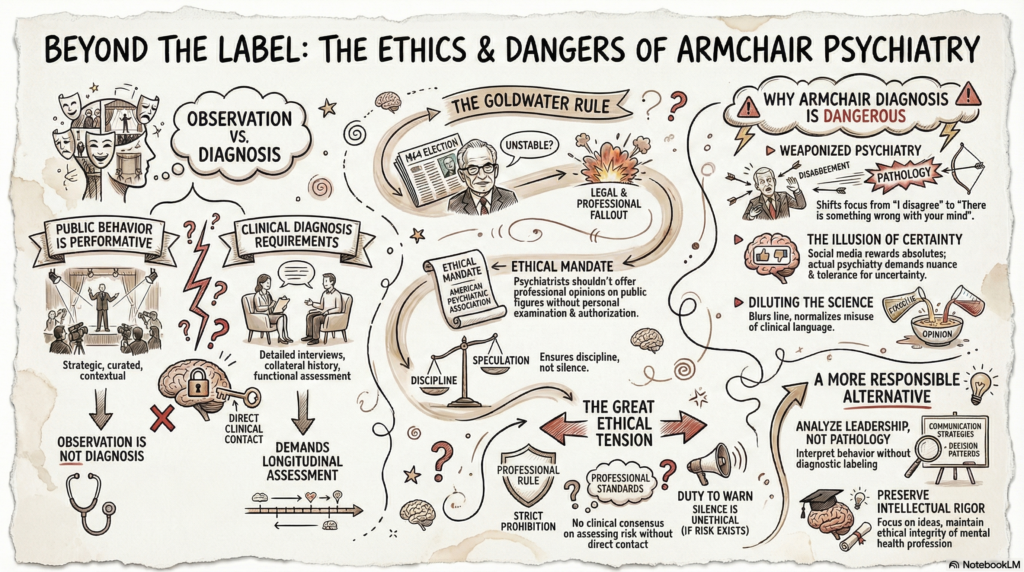 In today’s hyperconnected world, public figures are no longer just leaders—they are endlessly analyzed personalities. Every speech, pause, tweet, or gesture is dissected in real time. Somewhere along the way, a troubling trend has emerged:
The casual diagnosis of leaders from a distance.
From Donald Trump to Narendra Modi, psychiatric labels are frequently used in public discourse—often with conviction, but rarely with clinical validity.
“Narcissistic.”
“Paranoid.”
“Mentally unstable.”
These are not just words. They are clinical constructs, used outside their rightful context.
🧠 The Rise of Armchair Psychiatry
Humans are wired to interpret behavior. When leaders display:
- Strong conviction
- Emotional rhetoric
- Dominant or polarizing communication
We instinctively try to fit these patterns into psychological categories.
This creates a dangerous illusion:
That observation is equivalent to diagnosis.
It is not.
Public behavior is:
- Curated
- Contextual
- Often strategic
Psychiatric diagnosis, on the other hand, is:
- Longitudinal
- Structured
- Context-rich
- Functionally grounded
Reducing one to the other is not just inaccurate—it is irresponsible.
⚖️ The Goldwater Rule: Ethics in Action
The American Psychiatric Association introduced the Goldwater Rule to address precisely this issue.
It states:
A psychiatrist should not offer a professional opinion on a public figure’s mental health without a personal examination and proper authorization.
This principle emerged after psychiatrists publicly labeled Barry Goldwater during the 1964 U.S. election—without ever evaluating him.
The aftermath was instructive:
- Legal consequences
- Professional embarrassment
- A lasting ethical recalibration
🧩 Why Armchair Diagnosis Is Problematic
1. Behavior Is Not Diagnosis
What we see in public is:
- Fragmented
- Performative
- Often politically mediated
A diagnosis requires:
- Detailed clinical interviews
- Collateral history
- Assessment of functional impairment
👉 Without this, we are engaging in narrative interpretation, not clinical reasoning
2. Psychiatry Should Not Be Weaponised
When diagnostic labels enter political debate:
- Disagreement becomes pathology
- Opponents become patients
This shifts discourse from:
“I disagree with your ideas”
to
“There is something wrong with your mind”
That is neither scientific nor ethical.
3. The Illusion of Certainty
Social media rewards:
- Confidence
- Simplicity
- Absolutes
Psychiatry demands:
- Nuance
- Uncertainty
- Context
The louder the diagnosis, the weaker the science behind it.
⚖️ Goldwater Rule vs “Duty to Warn”
In recent years, some professionals have argued that silence is unethical when a leader’s behavior appears concerning. Figures like Bandy X. Lee have suggested a duty to warn the public.
This creates a genuine ethical tension:
| Principle | Core Idea |
|---|---|
| Goldwater Rule | Do not diagnose without examination |
| Duty to Warn | Act if there is a credible risk of harm |
The unresolved question remains:
Can risk be responsibly assessed without clinical contact?
There is no consensus.
🌍 What This Trend Reveals About Us
The impulse to diagnose leaders is less about them—and more about us.
It reflects:
- A desire to simplify complexity
- A need to morally position ourselves
- An attempt to make sense of power
But in doing so, we risk:
- Diluting psychiatric science
- Blurring the line between expertise and opinion
- Normalizing misuse of clinical language
🧠 A More Responsible Alternative
We can—and should—analyze leaders. But responsibly:
- Discuss leadership styles
- Examine decision-making patterns
- Interpret communication strategies
Without crossing into:
- Diagnostic labeling
- Pathologizing political disagreement
This preserves both:
Intellectual rigor and ethical integrity
🧠 Final Reflection
Not every strong personality is a disorder.
Not every controversial decision reflects pathology.
And not every observer is qualified to diagnose.
The Goldwater Rule is not about silence.
It is about discipline in the use of knowledge.
In a world eager to label, the responsibility of psychiatry is not to speculate—but to clarify, contextualize, and uphold standards.
✍️ About the Author
Dr. Srinivas Rajkumar T, MD (AIIMS), DNB, MBA (BITS Pilani)
Consultant Psychiatrist & Neurofeedback Specialist
Mind & Memory Clinic, Apollo Clinic Velachery (Opp. Phoenix Mall)
✉ srinivasaiims@gmail.com 📞 +91-8595155808
With a clinical approach integrating structured diagnostic frameworks, neurodevelopmental understanding, and technology-assisted tools such as QEEG and cognitive assessments, Dr. Srinivas focuses on evidence-based clarity over labels and ethical precision over speculation.
If you are seeking thoughtful, scientifically grounded mental health care—beyond oversimplified labels—professional evaluation can make all the difference.
Related posts:
- The Origins and Current Relevance of Hypnosis in Psychotherapy
- The Future of Psychodynamic Therapy: Innovations and Enduring Relevance
- Reich and Works : Relevance in Contemporary Therapy
- Life After Divorce: Therapy, Healing, and Finding Yourself Again
- Troubled by Scary Dreams? Here’s How You Can Sleep Peacefully Again
- Rewriting the Nightmare – How Image Rehearsal Therapy (IRT) Helps You Sleep Again