Autism Spectrum Disorder: Why Early Signs Matter More Than You Think
 Autism Spectrum Disorder (ASD) is a neurodevelopmental condition that affects how a child:
- Connects with others
- Communicates
- Experiences the world
It is called a spectrum because it can range from very mild to more significant differences, and every child presents uniquely.
Scientifically, ASD is characterised by:
- Differences in social communication
- Presence of repetitive behaviours and restricted interests
But in real life, parents don’t see “diagnostic criteria.”
They see small, subtle differences in their child’s development.
Why Early Detection Is So Important
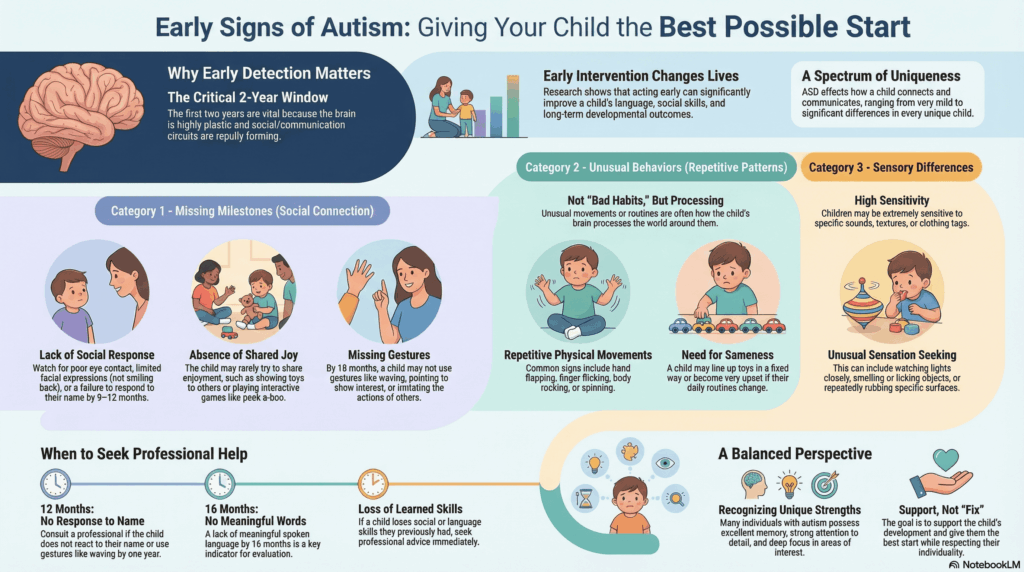
The first 2 years of life are a critical window for brain development.
During this time:
- The brain is highly plastic (adaptable)
- Social and communication circuits are rapidly forming
Research shows that early signs of autism often appear before the age of 2 years
👉 And more importantly:
Early intervention can significantly improve language, social skills, and long-term outcomes.
This is why recognising early signs is not about labeling—
it is about giving the child the best possible start.
Early Signs of Autism: What Parents Should Look For
Most early signs fall into two broad categories:
1. When Expected Development Is Missing
The earliest clues are often not unusual behaviors—but missing milestones.
Watch for:
- Poor or no eye contact
- Does not respond to name by 9–12 months
- Limited facial expressions (doesn’t smile back much)
- Rarely tries to share enjoyment (no showing toys)
- No simple interactive games (like peek-a-boo)
- Does not use gestures (no waving, no pointing)
- Does not try to copy others (imitation)
- No pretend play
- Does not point to show interest by 18 months
👉 In simple terms:
The child may be physically present—but socially less connected.
2. When Unusual Behaviors Start Appearing
Alongside what is missing, some behaviors may seem repetitive or different.
Common signs:
- Lines up toys in a fixed way
- Gets upset if routines change
- Repeats the same words or phrases
- Shows unusual movements:
- Hand flapping
- Finger flicking
- Body rocking
- Spinning
👉 These are not “bad habits”—they are part of how the child’s brain is processing the world.
3. Sensory Differences (Often Overlooked)
Many children with autism experience sensory differences.
They may:
- Be very sensitive to:
- Sounds
- Textures
- Clothing tags
- Or seek unusual sensations:
- Watching lights closely
- Smelling or licking objects
- Rubbing surfaces repeatedly
👉 Parents often describe this as:
“He is very particular” or “She is very sensitive.”
Why These Signs Are Often Missed
Many parents delay seeking help because:
- “He will talk later”
- “Boys develop late”
- “She is just quiet”
- “He is very intelligent”
And sometimes, they are right—development varies.
But when multiple signs come together and persist, it is worth evaluating.
When Should You Consult a Professional?
Consider seeking help if:
- No response to name by 1 year
- No gestures (pointing, waving)
- No meaningful words by 16 months
- Loss of previously learned skills
- Limited interaction or engagement
👉 You don’t need to wait for things to become obvious.
A Balanced Perspective
Autism is not just about difficulties.
Many individuals also have:
- Strong attention to detail
- Excellent memory
- Deep focus on areas of interest
👉 The goal is not to “fix” the child, but to
support development while respecting individuality.
Final Take-Home Message
Early signs of autism are often quiet—but meaningful.
If something feels different:
- Observe
- Understand
- Act early
Because early support can change the trajectory of a child’s life.
About the Author
Dr. Srinivas Rajkumar T, MD (AIIMS), DNB, MBA (BITS Pilani)
Consultant Psychiatrist & Neurofeedback Specialist
Mind & Memory Clinic, Apollo Clinic Velachery (Opp. Phoenix Mall)
✉ srinivasaiims@gmail.com 📞 +91-8595155808