Photobiomodulation in 2026: From Mitochondrial Biology to Brain Neuromodulation — What Does the Evidence Actually Show?
A rapidly evolving field, but not yet one treatment
Photobiomodulation (PBM) has moved considerably beyond the era in which it was simply described as “low-level laser therapy.” Red and near-infrared light are now being investigated across oncology supportive care, dermatology, wound healing, pain medicine, ophthalmology, rehabilitation, neurology and psychiatry.
The scientific question in 2026 is therefore no longer simply:
“Does red light have biological effects?”
There is substantial evidence that appropriately delivered light can influence cellular physiology.
The more important questions are:
Which wavelength? At what power? Delivered to which tissue? For how long? At what pulse frequency? At what total energy dose? And for which disorder?
These distinctions are critical because PBM is not a single treatment. A 660-nm intraoral laser for chemotherapy-induced mucositis, an 808-nm device directed at the prefrontal cortex for depression, an 850-nm 40-Hz system being investigated in autistic children and a multiwavelength ophthalmic system for age-related macular degeneration are biologically and clinically very different interventions.
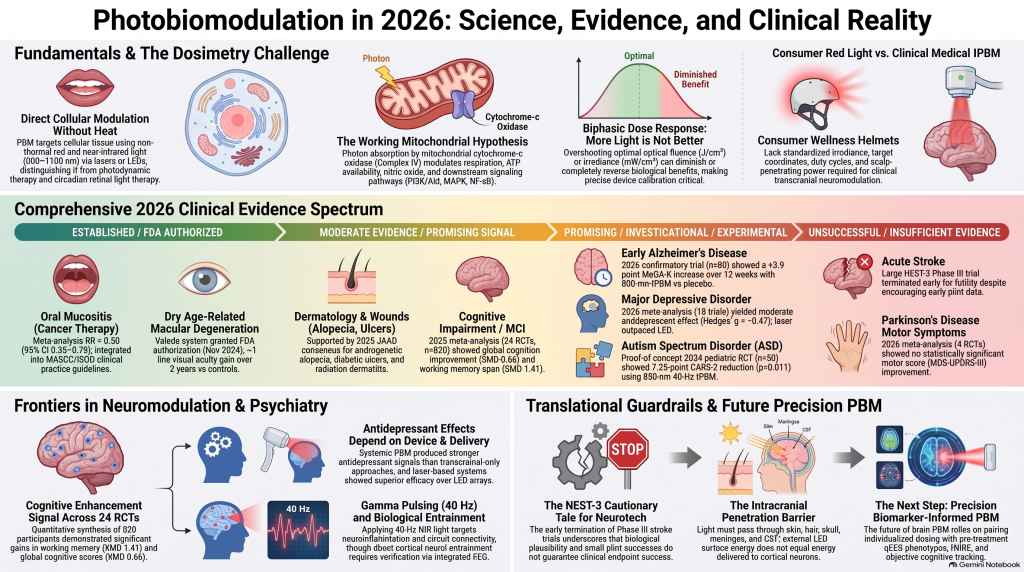
A major 2025 umbrella review encompassing 15 meta-analyses, 204 randomized trials and more than 9,000 participants provides perhaps the best high-level perspective. PBM showed significant benefit for several outcomes, but the certainty of evidence was generally low to moderate rather than high. Moderate-certainty evidence was identified for outcomes including burning-mouth pain, knee-osteoarthritis disability, fibromyalgia-related fatigue, androgenetic alopecia, and cognitive function.
That finding captures the current status of the field well:
PBM is biologically credible and clinically established for some indications, promising for several others, and distinctly experimental in many neurological and psychiatric applications.
What exactly is photobiomodulation?
PBM involves exposing biological tissue to relatively low-intensity visible red or near-infrared light, commonly within approximately 600–1100 nm, without deliberately heating or destroying the tissue.
Modern PBM can use:
- lasers,
- light-emitting diodes,
- continuous-wave illumination,
- pulsed illumination,
- local surface treatment,
- transcranial delivery,
- intranasal approaches,
- oral application,
- or whole-body/systemic strategies.
It should not be confused with photodynamic therapy, in which light activates an administered photosensitizing compound to produce cytotoxic effects.
It is also fundamentally different from conventional bright-light therapy for seasonal depression, whose major biological action occurs through retinal pathways affecting circadian and neuroendocrine regulation.
PBM attempts instead to alter cellular physiology directly through photon-tissue interactions.
The mitochondrial hypothesis
The most widely discussed PBM mechanism centres on the mitochondrion.
One proposed photoacceptor is cytochrome-c oxidase (Complex IV) of the mitochondrial electron-transport chain. Absorption of red or near-infrared photons may alter mitochondrial respiration, nitric-oxide interactions, membrane potential and cellular ATP availability.
Downstream effects proposed in experimental systems include alterations in:
- ATP production,
- reactive oxygen species signalling,
- nitric oxide,
- calcium signalling,
- inflammatory pathways,
- transcription factors,
- cellular survival signalling,
- neurotrophic factors,
- angiogenesis,
- synaptic plasticity,
- cerebral oxygenation and blood flow.
A 2026 mechanistic review describes PBM-associated regulation of mitochondrial metabolism and signalling pathways including PI3K/Akt, MAPK and NF-κB, while emphasizing the wavelength- and dose-dependent nature of these responses.
However, one should be careful about reducing PBM to the simplistic statement:
“Light stimulates cytochrome-c oxidase and produces ATP.”
The molecular mechanism remains incompletely resolved. An important critical review pointed out that direct evidence that cytochrome-c oxidase explains all clinically relevant PBM effects is considerably less definitive than often portrayed. Nitric oxide, alternative chromophores, ion channels, water-related photophysics and secondary signalling mechanisms may also contribute.
Thus the mitochondrial model is useful, but it is a working biological model rather than a completely settled mechanism.
The dose problem: more light is not necessarily better
One of the greatest difficulties in PBM research is dosimetry.
Important parameters include:
Wavelength — for example 660, 810, 850 or 1064 nm.
Optical power — how much light energy the device produces.
Irradiance — power delivered per unit area, usually expressed as mW/cm².
Fluence or energy density — energy delivered per unit area, usually J/cm².
Exposure time.
Duty cycle for pulsed devices.
Pulse frequency — for example 10 Hz or 40 Hz.
Beam or LED area.
Distance from tissue.
Hair, skin pigmentation and skull thickness.
Number and spacing of treatment sessions.
This is not merely an engineering issue. PBM frequently demonstrates a biphasic dose response: too little energy may have little biological effect, while excessively intense or prolonged exposure may reduce or even reverse the desired biological response.
Consequently, two devices that both advertise “850-nm near-infrared therapy” cannot automatically be regarded as therapeutically equivalent.
This is especially important for transcranial PBM, where only a fraction of emitted photons ultimately reach intracranial tissue.
What happens when light is directed through the skull?
Near-infrared wavelengths penetrate tissue more effectively than visible red wavelengths, which is one reason wavelengths around 808–850 nm and 1064 nm have been heavily investigated in brain applications.
A 2025 systematic review examining cerebral circulation and neural oscillations identified 45 studies, including 27 human studies and 19 randomized trials. Commonly studied wavelengths were approximately 810 and 1064 nm. The review found evidence that tPBM can alter cerebral oxygenation, blood flow, metabolism and neural oscillatory activity.
This is an important conceptual development.
Transcranial PBM may therefore be more appropriately regarded as a form of non-invasive neuromodulation rather than simply a form of light therapy.
Yet it differs fundamentally from TMS and tDCS.
TMS directly induces cortical electrical currents through electromagnetic fields.
tDCS applies weak electrical currents across the scalp.
tPBM instead attempts to modify cellular metabolism, vascular physiology and neuronal network behaviour using photons.
That potentially makes its effects slower and more biologically distributed.
Where is PBM already clinically credible?
The evidence differs enormously depending on the indication.
1. Oral mucositis — one of PBM’s strongest clinical applications
Perhaps the clearest established medical indication is prevention and management of oral mucositis associated with cancer therapy.
MASCC/ISOO clinical practice guidelines include PBM protocols for defined oncology settings.
The evidence has continued to accumulate.
A 2026 systematic review and meta-analysis of recent randomized trials found a substantial reduction in oral mucositis with PBM, with:
RR = 0.50
95% CI 0.35–0.73
although treatment wavelengths and protocols remained heterogeneous.
This is an important point because it demonstrates that PBM has already moved beyond experimental medicine in selected areas.
2. Dermatology, wounds and peripheral disorders
A multidisciplinary evidence-based consensus published in the Journal of the American Academy of Dermatology in 2025 concluded that PBM is generally safe in adults and identified evidence supporting applications including:
- androgenetic alopecia,
- peripheral neuropathy,
- wound ulcers,
- decubitus ulcers,
- diabetic-foot-ulcer pain,
- and acute radiation dermatitis.
This does not mean that every commercial red-light panel is medically effective.
The consensus applies to specific PBM protocols studied for specific conditions.
3. Ophthalmology: an important regulatory milestone
An especially significant development occurred in November 2024 when the US FDA granted De Novo authorization to the Valeda Light Delivery System for selected patients with dry age-related macular degeneration.
The device uses multiple wavelengths of light. FDA documentation indicates that treatment produced approximately one line of mean visual-acuity improvement after around two years compared with untreated patients meeting the specified criteria.
The FDA described this as the first therapeutic option authorized for that group of adults with dry AMD.
This milestone is important for PBM generally because it demonstrates that a light-based photobiomodulatory intervention can pass a formal regulatory pathway when evidence, device standardization and patient selection are sufficiently developed.
What about the brain?
This is where PBM becomes particularly interesting—and considerably less settled.
PBM and cognition
Cognition currently has one of the stronger emerging neurological evidence bases.
A 2025 meta-analysis evaluated 24 randomized trials involving 820 participants.
PBM was associated with improvements in:
- global cognition: SMD 0.66,
- working-memory span: SMD 1.41,
- attention,
- and some executive-function measures.
Effects appeared particularly interesting in individuals with cognitive impairment.
The 2025 umbrella review likewise identified cognitive function as one of the PBM outcomes supported by moderate-certainty evidence, although the literature still contained substantial heterogeneity.
Alzheimer’s disease and mild cognitive impairment
The Alzheimer’s/MCI literature has strengthened further during 2025–26.
A randomized, double-blind sham-controlled study published in 2025 investigated home-administered tPBM in patients with MCI due to Alzheimer’s disease. Participants administered treatment six times weekly for 12 weeks, and the active group demonstrated significantly greater improvement on the Montreal Cognitive Assessment than sham.
More importantly, a larger confirmatory randomized trial published in 2026 included 80 participants with MCI due to Alzheimer’s disease. Treatment consisted of 808-nm NIR stimulation over bilateral dorsolateral prefrontal regions six times weekly for 12 weeks.
Mean MoCA-K scores reportedly increased by approximately 3.9 points in the active group, whereas the placebo group declined slightly.
This is encouraging.
It is nevertheless premature to conclude that tPBM is disease-modifying therapy for Alzheimer’s disease.
Future work needs:
- larger multicentre replication,
- biomarker confirmation,
- longer follow-up,
- amyloid/tau or neurodegeneration endpoints,
- functional outcomes,
- and demonstration that improvement persists beyond treatment.
For now, the best description is promising symptomatic neuromodulation for cognitive impairment rather than established anti-Alzheimer’s therapy.
Depression: perhaps the most mature psychiatric application
Depression has attracted particularly strong interest because mitochondrial dysfunction, altered cerebral energy metabolism, oxidative stress, inflammation and prefrontal network dysfunction are all biologically plausible PBM targets.
A 2026 systematic review and meta-analysis included 18 PBM intervention trials involving major depression or clinically significant depressive symptoms.
The pooled antidepressant effect was approximately:
Hedges’ g = −0.47
95% CI −0.73 to −0.22
representing a moderate effect overall.
Interestingly, the analysis found differences depending on the treatment method. Systemic PBM produced larger effects than transcranial PBM, and laser devices appeared to produce larger effects than LED systems. Longer treatment duration was associated with greater improvement.
That heterogeneity reinforces a recurring theme:
PBM cannot yet be prescribed like a drug with a universally accepted dose.
A randomized double-blind trial published in 2025 also evaluated a wearable self-administered tPBM headband in 48 outpatients with major depressive disorder, using daily treatment over eight weeks and examining depression and sleep outcomes.
Separately, dose-ranging work has demonstrated encouraging short-term tolerability of 808-nm tPBM in patients with MDD.
The field is therefore moving from proof-of-concept studies toward genuine randomized neuromodulation trials.
However, tPBM should still be considered investigational for depression, rather than a replacement for antidepressants, psychotherapy, ECT, TMS or other established interventions.
Sleep and insomnia
Sleep is another rapidly developing area.
A randomized trial reported in 2025 that transcranial PBM improved subjective sleep quality and daytime sleepiness in chronic insomnia while also producing changes in EEG delta activity.
A systematic review and meta-analysis specifically examining PBM and sleep was published in 2026, demonstrating that this area has now developed sufficiently to permit quantitative evidence synthesis.
Again, however, protocols remain heterogeneous and PBM has not displaced CBT-I or established sleep-disorder treatment.
Traumatic brain injury and concussion
PBM has a particularly attractive theoretical rationale in TBI because mitochondrial dysfunction, cerebral hypometabolism, neuroinflammation and altered cerebral blood flow can persist after injury.
The clinical literature is encouraging but inconsistent.
A 2024 systematic review found cognitive improvements in several chronic-TBI studies but highlighted the small samples, heterogeneous protocols and lack of adequately powered randomized trials.
A randomized double-blind placebo-controlled concussion trial was published in 2024, illustrating that the field is progressing toward higher-quality designs.
At present PBM should not be regarded as established concussion treatment.
Stroke: an important cautionary lesson
PBM research in stroke illustrates why promising early studies should not automatically be translated into clinical treatment.
Earlier transcranial-laser trials produced encouraging signals.
But the large NEST-3 phase III study ultimately failed to demonstrate the necessary clinical efficacy and was terminated early for futility.
This negative trial is scientifically important.
It demonstrates that biological plausibility, promising pilot studies and even encouraging earlier trials do not guarantee success at phase III.
That lesson should remain central when interpreting today’s autism, depression and dementia PBM literature.
Parkinson’s disease
PBM has generated enthusiasm in Parkinson’s disease, driven partly by mitochondrial hypotheses and extensive preclinical research.
Human trials now exist, including randomized studies.
However, the most recent 2026 systematic review and meta-analysis is sobering.
Eight trials involving 279 participants were identified. Meta-analysis of four randomized trials found no statistically significant improvement in the MDS-UPDRS-III motor score and no meaningful improvement in Timed Up-and-Go performance.
PBM appeared safe and feasible, but the authors concluded that available evidence does not currently establish a clinically meaningful motor benefit in Parkinson’s disease.
This is another example of why PBM needs indication-specific evidence rather than generalized enthusiasm.
The particularly interesting frontier: autism spectrum disorder
Autism represents one of the newest and most intriguing applications of transcranial photobiomodulation.
The proposed rationale includes several biological findings reported in subsets of individuals with ASD:
- altered mitochondrial metabolism,
- oxidative-stress abnormalities,
- neuroimmune signalling differences,
- atypical cerebral connectivity,
- altered excitation/inhibition relationships,
- and differences in oscillatory EEG activity.
However, these observations should not be interpreted as meaning that autism is fundamentally a “mitochondrial disorder.”
Autism is a highly heterogeneous neurodevelopmental condition.
PBM is therefore better conceptualized as potentially modifying specific neuronal and network processes associated with ASD symptoms, rather than “correcting the cause of autism.”
The first randomized pediatric autism trial
A pivotal proof-of-concept trial was published in 2024.
Thirty children aged 2–6 years with ASD were randomized to active or sham treatment.
The active treatment used:
850-nm near-infrared light
40-Hz pulsing
twice weekly
for eight weeks
delivered using the investigational COGNILUM™ device.
Autism severity was measured using the CARS-2.
The difference between active and sham groups in CARS change was:
7.23 points
95% CI 2.36–12.11
p = 0.011
No moderate or severe treatment-related adverse effects were reported.
For such a small clinical trial, that is an intriguing signal.
But several limitations are important.
There were only 30 participants.
EEG data were sufficiently available for longitudinal assessment in only 17 children.
Some EEG findings were trends rather than conventionally statistically significant effects.
Most importantly, the study was funded by JelikaLite, and company-affiliated investigators participated in study design, data collection, analysis, manuscript preparation and the decision to publish.
This does not invalidate the findings.
It does mean that independent replication is particularly important.
EEG findings: particularly interesting for neuroscience
The study also attempted to examine electrophysiological effects.
There were signals involving delta and theta activity. The treatment versus sham difference in theta power reached approximately the conventional threshold for statistical significance, while some treatment-by-time interactions remained at trend level.
This may ultimately be one of the most valuable aspects of PBM research.
Rather than treating ASD response as a purely behavioural outcome, future studies could examine whether PBM produces measurable neurophysiological target engagement.
Potential measures include:
- absolute and relative spectral power,
- delta/theta activity,
- alpha peak frequency,
- beta and gamma activity,
- functional connectivity,
- EEG complexity,
- event-related potentials,
- source-space network activity,
- and possibly quantitative EEG-derived phenotypes.
But at present there is no validated qEEG biomarker that can identify which autistic child should receive PBM.
The 2025 pediatric follow-up study
A subsequent open-label study involved 23 children aged 2–7 years.
Participants received:
850 nm
40-Hz pulsed NIR
twice weekly
for 10 weeks
targeting cortical regions associated with the default-mode network, language areas and occipital regions.
The study reported an average approximately seven-point reduction in CARS-2 scores.
EEG findings included decreased delta activity and increased beta and gamma power, with statistically significant changes in gamma and relationships between some electrophysiological changes and clinical improvement.
Again, the results are interesting.
But this study had no sham group.
It therefore cannot adequately control for:
- developmental maturation,
- concomitant therapy,
- regression to the mean,
- parental expectations,
- rater expectation,
- behavioural adaptation to the study environment.
JelikaLite was also directly involved in the study, and company relationships and paid consultancy were disclosed.
These findings should consequently be regarded as hypothesis-generating rather than confirmatory.
What about autistic adults?
Earlier evidence exists in adults.
An open-label proof-of-concept study enrolled 11 adults with higher-functioning ASD, of whom 10 completed treatment.
Following eight weeks of twice-weekly tPBM, five of the ten completers met predefined responder criteria, with improvements in measures including the Social Responsiveness Scale.
Once again, however:
there was no control group,
the sample was tiny,
and placebo/expectancy effects cannot be separated from treatment effects.
How strong is the autism evidence in 2026?
A reasonable evidence classification would be:
| Domain | Status in ASD |
|---|---|
| Biological plausibility | Moderate |
| Human feasibility | Demonstrated |
| Short-term tolerability | Encouraging |
| Open-label efficacy signal | Positive |
| Sham-controlled evidence | Positive but only small study |
| Independent replication | Insufficient |
| Optimal wavelength | Unknown |
| Optimal frequency | Unknown |
| Optimal cortical target | Unknown |
| Optimal dose | Unknown |
| Long-term efficacy | Unknown |
| Developmental outcomes | Unknown |
| Validated EEG biomarker | No |
| Evidence of disease modification | No |
| Routine clinical recommendation | No |
| Research use | Reasonable |
A 2025 systematic review of non-invasive brain stimulation in neurodevelopmental disorders confirms the broader picture: tPBM is emerging alongside TMS and tDCS but remains substantially less developed than established therapeutic neuromodulation modalities.
What is special about 40 Hz?
The use of 40-Hz stimulation deserves particular attention.
Gamma-frequency neural oscillations around 40 Hz have been investigated extensively in systems neuroscience, cognition and neurodegeneration.
Light or auditory stimulation delivered at gamma frequencies has produced interesting effects in experimental models, particularly in Alzheimer’s research.
But it is important not to assume that:
40-Hz optical pulsing = direct 40-Hz cortical entrainment.
When light is delivered through the scalp, several mechanisms could contribute:
- direct cellular photobiomodulation,
- vascular effects,
- metabolic modulation,
- secondary network changes,
- true rhythmic neural entrainment,
- or some combination.
Demonstrating entrainment would require simultaneous electrophysiological measurements showing phase-locked cortical effects.
That makes EEG-integrated PBM studies especially valuable.
Is PBM safe?
The short-term safety profile is one of the most encouraging aspects of PBM.
A 2025 expert consensus concluded that PBM is generally safe in adults and found no evidence that appropriately administered red-light PBM causes DNA damage.
Reported adverse effects in transcranial studies are generally mild and may include:
- headache,
- scalp warmth,
- transient discomfort,
- irritability,
- sleep changes,
- fatigue,
- or occasional light sensitivity.
A 2025 dose-ranging randomized trial in depression found no statistically significant increase in adverse-event rates across the studied tPBM doses.
However, short-term tolerability should not be confused with established long-term safety, particularly in very young children.
Pediatric ASD trials remain small.
Long-term developmental follow-up is lacking.
The eye deserves special attention
Even though therapeutic PBM is non-ionizing and generally low-energy, optical radiation can still injure the retina when inappropriate wavelengths, intensities or exposure conditions are used.
Eye protection and device-specific optical safety standards therefore matter.
Consumer “red-light” devices should not automatically be adapted for transcranial clinical use.
Why consumer red-light devices are not equivalent to medical tPBM
One of the biggest risks in this rapidly commercializing area is the assumption that any red or infrared helmet produces the same treatment.
Consider two devices:
Device A:
850 nm
40 Hz
specific LED placement
known irradiance
controlled duty cycle
validated treatment duration.
Device B:
“Red/NIR wellness helmet”
630 + 850 nm
unknown irradiance at scalp
unknown pulse characteristics
unknown fluence.
These are not scientifically interchangeable.
Clinical PBM requires documentation of at least:
wavelength
optical output
irradiance
fluence
spot area
duty cycle
frequency
treatment duration
target coordinates
session frequency.
Without these parameters, replicability is impossible.
A systematic review devoted specifically to devices used for brain photobiomodulation has highlighted the extraordinary heterogeneity across tPBM systems.
Regulation remains indication-specific
PBM devices are increasingly entering formal regulatory pathways. The FDA has even issued dedicated guidance addressing PBM-device premarket submissions.
But regulatory approval is device- and indication-specific.
The FDA authorization of Valeda for selected dry-AMD patients does not validate PBM for depression, dementia or autism.
Likewise, the device used in the pediatric ASD studies is explicitly described in those publications as an investigational medical device.
Therefore clinicians considering neuropsychiatric PBM should distinguish carefully between:
commercial availability, regulatory clearance, experimental access and established clinical efficacy.
They are not synonymous.
A useful 2026 evidence map
| Indication | Evidence status |
|---|---|
| Cancer therapy–related oral mucositis | Established / guideline-supported in defined settings |
| Selected dry AMD | Regulatory authorization exists for a specific device/population |
| Androgenetic alopecia | Moderate evidence |
| Wounds / pressure ulcers | Moderate evidence in selected settings |
| Peripheral neuropathy | Moderate evidence in selected settings |
| Knee osteoarthritis / fibromyalgia outcomes | Moderate but heterogeneous evidence |
| Cognitive impairment | Promising, increasingly supported |
| MCI / early Alzheimer’s disease | Promising randomized evidence; not established disease-modifying therapy |
| Major depression | Promising; meta-analytic signal; investigational |
| Insomnia | Emerging evidence |
| Chronic TBI | Promising but insufficient |
| Acute stroke | Major phase III trial unsuccessful |
| Parkinson’s disease | Insufficient evidence for meaningful motor benefit |
| Autism spectrum disorder | Promising early signal; experimental |
Where PBM could become particularly important
The future of PBM may not lie in giving every patient an identical helmet.
The more interesting direction is precision photobiomodulation.
That could integrate:
Phenotyping
Clinical symptoms, cognition, sleep, sensory phenotype and functional outcomes.
Neurophysiology
EEG and qEEG measures before and during treatment.
Target selection
Prefrontal, default-mode, language, motor or other networks depending on the disorder.
Dose optimization
Individualized irradiance, fluence and session duration.
Closed-loop treatment
Using ongoing electrophysiological changes to adjust optical stimulation.
Multimodal biomarkers
Combining EEG with functional near-infrared spectroscopy, cerebral oxygenation, MRI, spectroscopy or digital cognitive measures.
This would transform PBM from:
“shine infrared light on the head”
into a genuine biomarker-informed neuromodulation platform.
Autism may be particularly suitable for this research model
The autism literature provides an intriguing opportunity because the earliest trials have already incorporated EEG.
A future high-quality study could potentially examine:
Baseline
CARS-2
SRS-2
Vineland Adaptive Behavior Scales
Clinical Global Impression
language assessment
sensory profile
sleep measures
CPT/attention measures where developmentally appropriate
qEEG.
Intervention
Standardized tPBM versus credible sham.
Serial outcomes
Behavioural ratings
sleep
language
attention
adaptive functioning
side effects.
Neurophysiological outcomes
delta/theta/beta/gamma power
connectivity
coherence
phase synchrony
source localization
EEG complexity.
Follow-up
1 month
3 months
6 months.
Such a design would begin to answer a much more interesting question than whether average CARS scores change:
Can we identify an electrophysiological responder phenotype for PBM?
Why sham-controlled research is absolutely necessary
PBM devices present unusual placebo challenges.
Participants or parents may notice:
- warmth,
- indicator lights,
- device sound,
- treatment duration,
- or sensations from active stimulation.
A scientifically credible sham must mimic the treatment experience without delivering a biologically meaningful optical dose.
This is particularly important in autism research, where many outcome measures depend on parent or clinician ratings.
Objective measures such as EEG, eye tracking, actigraphy, language samples and digital behaviour measures can therefore considerably strengthen trials.
The biggest unresolved question: what is the optimal brain dose?
We still do not know the ideal intracranial dose.
Energy measured at the LED surface is not equivalent to energy reaching the cerebral cortex.
Between device and neuron lie:
skin
hair
subcutaneous tissue
periosteum
skull
meninges
cerebrospinal fluid.
Age matters.
Skull thickness matters.
Hair matters.
Anatomical site matters.
Wavelength matters.
For pediatric treatment these variables may be even more important because cranial anatomy changes substantially during development.
Consequently, simply reproducing the external power settings of an existing device does not necessarily reproduce its cerebral dose.
This is one of the field’s most important translational challenges.
PBM should not repeat the mistakes of poorly regulated “neurotechnology”
Neurotechnology frequently follows a predictable cycle:
- interesting mechanism,
- small pilot study,
- dramatic media coverage,
- rapidly marketed devices,
- clinics offering the treatment,
- scientific evidence struggling to catch up.
PBM should avoid this pathway.
There is enough genuine science here that exaggerated claims are unnecessary.
The appropriate terminology for emerging neurological applications should therefore be:
investigational, adjunctive, experimental, research-guided or emerging neuromodulation.
Claims such as:
“reverses autism,”
“repairs the autistic brain,”
“regenerates neurons,”
“cures dementia,”
or
“boosts mitochondrial function in everyone”
are not justified by current clinical evidence.
The current verdict in 2026
PBM has crossed an important threshold.
It can no longer reasonably be dismissed as simply alternative “red-light therapy.”
There are genuine randomized trials, meta-analyses, clinical guidelines, regulatory approvals for specific indications and increasingly sophisticated mechanistic studies.
Yet PBM is also nowhere close to being a universal therapeutic platform.
The evidence exists on a continuum.
At one end are conditions such as cancer therapy-associated oral mucositis, where PBM has substantial clinical evidence and guideline support.
At the other end are conditions such as autism, where the first sham-controlled studies have produced intriguing findings but remain small, commercially entangled and insufficiently replicated.
Between these extremes lie depression, cognitive impairment, insomnia, traumatic brain injury and neurodegenerative disorders, where evidence is accumulating at different rates.
Perhaps the most exciting development is not simply the emergence of another therapeutic device.
It is the possibility that light can become a controllable biological signal capable of altering cerebral metabolism, blood flow and network activity.
If this can be combined with EEG, imaging, objective behavioural phenotyping and individualized dosimetry, transcranial PBM could eventually develop into a distinct precision-neuromodulation modality.
But the field has reached the stage at which better evidence—not more enthusiasm—is what it needs most.
For autism in particular, the scientifically defensible conclusion in October 2026 is:
Transcranial photobiomodulation is a promising experimental intervention with an encouraging early clinical and electrophysiological signal, including one small randomized sham-controlled pediatric trial, but there is currently insufficient independent evidence to regard it as an established treatment for autism spectrum disorder.
That distinction is critical.
And it is precisely what makes PBM such an interesting area for the next generation of carefully designed clinical neuroscience research.
Selected key evidence
- Son Y et al. Effects of photobiomodulation on multiple health outcomes: an umbrella review of randomized clinical trials. Systematic Reviews, 2025. Included 15 meta-analyses, 204 RCTs and >9,000 participants.
- Maghfour J et al. Evidence-based consensus on the clinical application of photobiomodulation. Journal of the American Academy of Dermatology, 2025.
- Zhu Z et al. Photobiomodulation effects on cognitive function—a systematic review and meta-analysis of randomized controlled trials. 2025. Twenty-four RCTs, 820 participants.
- Seok JW et al. Effect of photobiomodulation intervention for depressive symptoms: a systematic review and meta-analysis. Journal of Affective Disorders, 2026.
- Chun H et al. Home-based transcranial photobiomodulation improves cognitive function in mild cognitive impairment due to Alzheimer’s disease: a randomized, double-blind, placebo-controlled confirmatory trial. 2026.
- Fradkin Y et al. Transcranial photobiomodulation in children aged 2–6 years: a randomized sham-controlled clinical trial assessing safety, efficacy, and impact on autism spectrum disorder symptoms and brain electrophysiology. Frontiers in Neurology, 2024.
- Fradkin Y et al. Transcranial photobiomodulation for reducing symptoms of autism spectrum disorder and modulating brain electrophysiology in children aged 2–7: an open label study. 2025.
- Ceranoglu TA et al. Transcranial photobiomodulation in adults with high-functioning autism spectrum disorder: positive findings from a proof-of-concept study.
- López-Rodríguez S et al. Noninvasive Brain Stimulation for Neurodevelopmental Disorders: A Systematic Review. Journal of Neuropsychiatry and Clinical Neurosciences, 2025.
- Fernandes F et al. Devices used for photobiomodulation of the brain—a comprehensive and systematic review. Journal of NeuroEngineering and Rehabilitation, 2024.
- Elad S et al. MASCC/ISOO clinical practice guidelines for the management of mucositis secondary to cancer therapy. Cancer, 2020.
- FDA. Valeda Light Delivery System—De Novo authorization for selected patients with dry age-related macular degeneration. November 4, 2024.
Current evidence reviewed through October 2026.