Characteristics of Statin-Induced Memory Disturbance
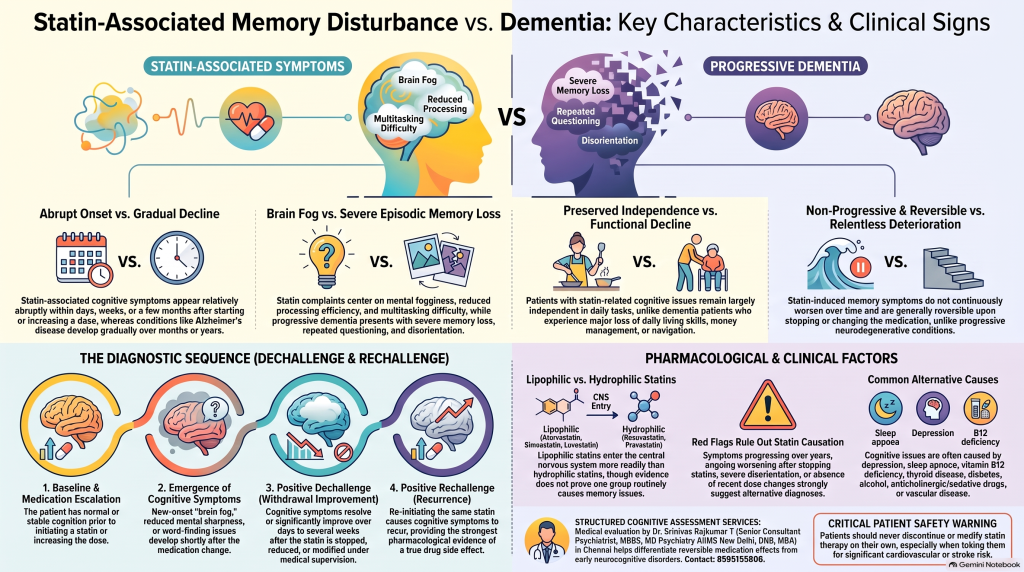 Statins are widely prescribed to reduce cholesterol and prevent cardiovascular disease. For most people, they are well tolerated and there is no convincing evidence that statins commonly cause dementia.
However, a small number of patients report new-onset memory or concentration problems after starting a statin or increasing the dose.
When this occurs, the clinical pattern is usually quite different from Alzheimer’s disease or another progressive neurodegenerative disorder.
1. There Is Usually a Temporal Relationship
The most important clue is timing.
A typical history may be:
Normal or stable cognition → statin started or dose increased → memory or concentration symptoms develop
Symptoms have been reported within days, weeks or a few months after treatment begins.
A cognitive complaint arising shortly after a medication change is therefore more suggestive than memory impairment appearing after many years on an unchanged dose.
2. “Brain Fog” Is Commonly Described
Patients may not necessarily describe severe memory loss.
Instead, they may report:
- mental fogginess
- difficulty concentrating
- reduced mental sharpness
- slower thinking
- difficulty multitasking
- problems recalling words or names
- increased forgetfulness
- difficulty retaining recently presented information
The complaint may therefore involve attention, working memory and processing efficiency, rather than isolated episodic memory impairment.
3. The Onset Is Often Relatively Abrupt
Neurodegenerative conditions such as Alzheimer’s disease typically develop gradually over months or years.
Medication-related cognitive symptoms are more likely to appear over a much shorter period.
A patient or family member may say:
“He was functioning normally, but a few weeks after the cholesterol medicine was increased, he became noticeably forgetful.”
This relatively abrupt change should prompt a medication review.
4. Severe Functional Decline Is Unusual
Patients with suspected statin-associated cognitive symptoms may remain largely independent.
They may complain of reduced efficiency at work, forgetting appointments, losing track of conversations or having difficulty finding words.
In contrast, more advanced neurocognitive disorders may produce:
- repeated questioning
- getting lost
- difficulty handling money
- medication errors
- inability to manage household tasks
- significant occupational decline
Major loss of independence should therefore trigger a broader evaluation.
5. The Symptoms Are Usually Non-Progressive
True medication-related cognitive effects would generally not be expected to produce relentless deterioration.
If cognition continues to worsen steadily despite no further statin dose change—or continues to worsen after the medication is withdrawn—another diagnosis should be considered.
Progressive decline raises possibilities such as:
- mild cognitive impairment
- Alzheimer’s disease
- vascular cognitive impairment
- Lewy body disease
- depression
- sleep disorders
- metabolic or endocrine causes
6. Improvement After Withdrawal Is an Important Clue
One of the strongest features supporting a statin-related effect is improvement after modifying treatment.
This is known as a positive dechallenge.
The sequence may be:
Statin started → cognitive symptoms appear → statin withdrawn or changed → cognition improves
Improvement may occur over days to several weeks.
Not every patient will recover immediately, and the time course may vary.
7. Recurrence on Rechallenge Strengthens the Diagnosis
If the same statin is restarted and similar cognitive symptoms recur, the likelihood of a true medication-related effect becomes considerably stronger.
This is called a positive rechallenge.
From a pharmacological perspective, the combination of:
temporal association + improvement on withdrawal + recurrence on rechallenge
provides much stronger evidence of causality than simply observing that somebody with memory complaints happens to be taking a statin.
8. Dose Changes May Be Relevant
Sometimes the patient has tolerated a statin for months or years but develops symptoms after the dose is increased.
Therefore, the history should include:
- exact statin
- dose
- date treatment started
- date of dose escalation
- date cognitive symptoms appeared
- any simultaneous medication changes
This timeline is often more useful than simply asking whether the patient is “on a statin.”
9. Lipophilic Statins Are Sometimes Implicated
Statins differ in their ability to enter tissues.
Relatively lipophilic statins include:
Atorvastatin, simvastatin and lovastatin
Relatively hydrophilic statins include:
Rosuvastatin and pravastatin
Because lipophilic drugs may enter the central nervous system more readily, it has been proposed that they may be more likely to produce cognitive symptoms in susceptible individuals.
However, the evidence is not strong enough to state that one group routinely causes memory problems.
In selected cases, clinicians may consider switching from one statin to another rather than abandoning cholesterol treatment altogether.
10. There Is Usually No Characteristic Neurological Syndrome
Statin-associated cognitive complaints generally do not produce a distinctive neurological examination.
The presence of additional symptoms such as:
- focal weakness
- speech disturbance
- marked visuospatial impairment
- gait disturbance
- tremor or parkinsonism
- seizures
- rapidly progressive confusion
should prompt evaluation for other neurological or medical conditions.
11. Statin-Associated Memory Problems Are Usually Reversible
This is an important distinction from dementia.
Reported cognitive symptoms associated with statins have generally been reversible after treatment modification.
This is one reason clinicians should distinguish between:
a reversible adverse drug effect
and
a progressive neurodegenerative process.
The two should not be treated as equivalent.
12. Statins Should Not Automatically Be Blamed
Memory impairment is extremely common, particularly in middle-aged and older adults.
Other explanations frequently include:
- depression
- anxiety
- chronic stress
- poor sleep
- obstructive sleep apnoea
- vitamin B12 deficiency
- thyroid disease
- diabetes
- alcohol use
- anticholinergic medications
- sedative medications
- polypharmacy
- vascular disease
- mild cognitive impairment
- dementia
Therefore, simply finding that a patient with memory complaints is taking atorvastatin or rosuvastatin does not prove causation.
The Most Characteristic Pattern
The pattern most suggestive of statin-associated cognitive disturbance is:
Previously stable cognition
↓
Statin initiated or dose increased
↓
New brain fog, forgetfulness or concentration problems
↓
Symptoms remain relatively non-progressive
↓
Statin reduced, stopped or changed under medical supervision
↓
Cognition improves over the following days or weeks
A recurrence after rechallenge makes the association even stronger.
When Is a Statin Less Likely to Be the Cause?
A statin is less likely to explain the problem when:
- cognitive decline has been progressing for several years
- symptoms began long after treatment was established
- there has been no recent dose change
- everyday functioning is progressively deteriorating
- there is significant disorientation
- symptoms continue worsening after the statin is withdrawn
- neurological abnormalities are present
In these situations, a formal cognitive evaluation becomes particularly important.
Clinical Assessment
When statin-associated memory disturbance is suspected, a structured assessment should include:
- detailed medication timeline
- review of all other drugs
- assessment of sleep
- evaluation for depression and anxiety
- thyroid and vitamin B12 assessment where indicated
- metabolic and vascular risk assessment
- cognitive screening such as the MoCA
- reassessment after any supervised medication change
Repeated cognitive testing can sometimes help determine whether symptoms objectively improve.
Take-Home Message
Statin-associated memory disturbance appears to be uncommon, usually reversible and typically non-progressive.
The strongest clues are:
temporal association, relatively abrupt onset, brain-fog-type symptoms, improvement after withdrawal and recurrence after rechallenge.
Progressive cognitive decline over months or years should not automatically be attributed to cholesterol medication and deserves a broader evaluation.
Patients should not discontinue statins on their own, particularly when they have significant cardiovascular or stroke risk.
Memory and Cognitive Assessment in Chennai
New-onset forgetfulness does not always mean dementia. Medication effects, sleep disorders, mood disorders, metabolic problems and early neurocognitive disorders can produce very similar symptoms.
A structured cognitive assessment can help identify whether the problem is reversible or requires further neurological or psychiatric evaluation.
Dr. Srinivas Rajkumar T
Senior Consultant Psychiatrist
MBBS, MD Psychiatry (AIIMS New Delhi), DNB Psychiatry, MBA
Assessment includes evaluation of memory, attention, executive function, mood, sleep, medication effects and potentially reversible causes of cognitive decline.
Appointments: 8595155808
Patients taking statins should not stop or alter treatment without discussing it with their treating physician.