Can Statins Cause Memory Problems?
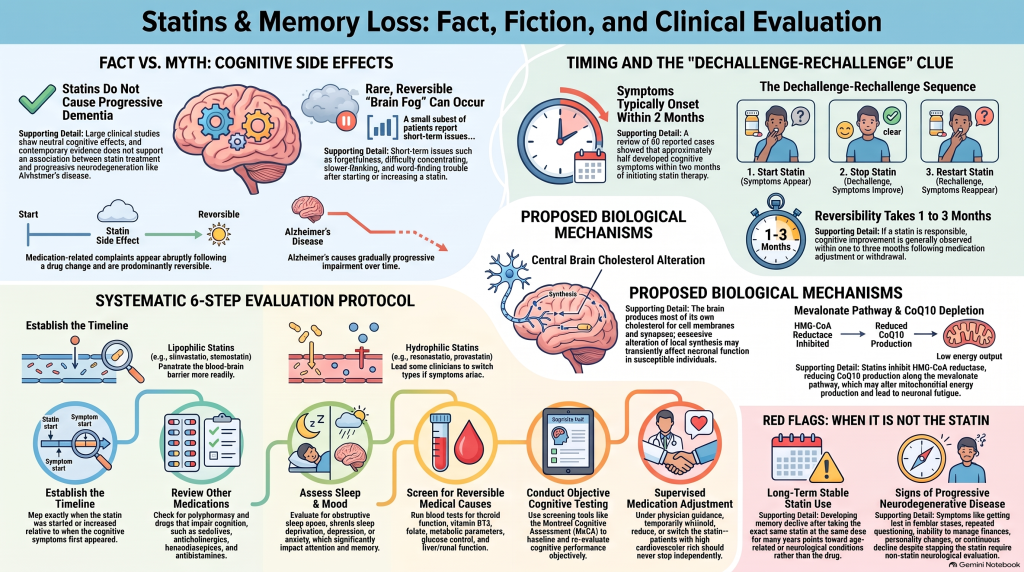 Statins such as atorvastatin, rosuvastatin and simvastatin are widely used to reduce cholesterol and prevent heart attack and stroke. A common concern, especially among older adults, is whether statins can affect memory.
The short answer is:
Statins do not appear to commonly cause dementia or permanent cognitive decline. However, a small number of patients may experience reversible memory or concentration problems that are temporally related to starting or increasing a statin.
What Do Statin-Related Cognitive Symptoms Look Like?
Reported symptoms may include:
- forgetfulness
- reduced concentration
- word-finding difficulty
- slower thinking
- difficulty multitasking
- a subjective sense of “brain fog”
This pattern is usually different from the slowly progressive memory decline seen in Alzheimer’s disease.
Timing Is Important
When a statin is genuinely contributing to cognitive symptoms, the relationship often follows a recognizable sequence:
Statin started or dose increased → cognitive symptoms appear → statin reduced or stopped → symptoms improve
Symptoms may begin within days or weeks, although later onset is also possible.
In published case reports, many patients developed symptoms within the first few months of treatment.
Are the Symptoms Reversible?
In reported cases, cognitive symptoms have generally been reversible.
Improvement may begin within days to weeks after the medication is changed, although complete recovery may sometimes take several weeks.
A practical observation period is often around 2–8 weeks, and occasionally longer depending on the clinical situation.
The fact that symptoms improve after stopping the suspected medication is called a dechallenge response.
If the same symptoms recur when the statin is restarted, this strengthens the likelihood of a genuine medication-related effect.
Why Might Statins Affect Memory?
There is no single proven mechanism, but several explanations have been proposed.
1. Cholesterol and Brain Function
Cholesterol is important for neuronal membranes, synapses and myelin.
Because statins reduce cholesterol synthesis, it has been suggested that excessive reduction in cholesterol-related pathways within the brain may temporarily affect neuronal function in susceptible individuals.
This remains a proposed mechanism rather than a proven explanation.
2. Coenzyme Q10 and Mitochondria
Statins inhibit the mevalonate pathway.
This pathway is involved not only in cholesterol production but also in the synthesis of compounds such as Coenzyme Q10, which is important for mitochondrial energy production.
A theoretical mechanism is:
Statin → reduced CoQ10 availability → altered mitochondrial energy production → cognitive symptoms
The mechanism is biologically plausible, but evidence is not strong enough to establish it as the main cause.
3. Blood-Brain Barrier Penetration
Some statins are more lipophilic and may enter the central nervous system more readily.
Examples include:
More lipophilic: atorvastatin, simvastatin, lovastatin
More hydrophilic: rosuvastatin, pravastatin
In selected patients with a convincing temporal relationship, clinicians may consider switching to a different statin rather than abandoning lipid-lowering treatment altogether.
Do Statins Cause Alzheimer’s Disease?
Current evidence does not support the idea that statins commonly cause Alzheimer’s disease.
Large studies have generally not shown an increased risk of dementia with statin use.
Some observational studies have even found lower rates of dementia among statin users, although this does not prove that statins themselves prevent dementia.
It is therefore important to distinguish:
Rare reversible cognitive symptoms
from
progressive neurodegenerative disease
They are not the same clinical problem.
When Should a Statin Be Suspected?
The possibility becomes more convincing when:
- symptoms begin soon after starting treatment
- symptoms appear after a dose increase
- there was no previous cognitive decline
- symptoms improve after dose reduction or withdrawal
- symptoms recur after rechallenge
The association is much weaker when a patient has taken the same statin for many years and develops slowly progressive memory decline.
In such situations, other causes need to be considered.
Other Causes of Memory Problems Should Be Checked
Memory complaints can arise from many conditions, including:
- depression
- anxiety
- poor sleep
- obstructive sleep apnoea
- thyroid disorders
- vitamin B12 deficiency
- diabetes
- medication interactions
- anticholinergic medicines
- vascular disease
- mild cognitive impairment
- dementia
This is why memory problems should not automatically be attributed to a statin.
What Should Patients Do?
Patients should not stop statins on their own, particularly if the medication has been prescribed after a heart attack, stroke or because of significant cardiovascular risk.
Instead, the doctor may consider:
- reviewing the timeline
- checking for other causes of cognitive symptoms
- reducing the dose
- switching to another statin
- temporarily withholding the drug under supervision
- repeating cognitive assessment after a few weeks
When necessary, structured cognitive screening or more detailed neuropsychological assessment can help distinguish a medication-related problem from early cognitive impairment or dementia.
Take-Home Message
Statin-related memory complaints appear to be uncommon, usually reversible and very different from progressive dementia.
The most useful clue is the timeline.
Did the memory problem begin after starting or increasing the statin, and did it improve when the treatment was modified?
A careful medication history and cognitive assessment can often provide the answer.
Memory and Cognitive Assessment in Chennai
If you or a family member has developed new forgetfulness, concentration problems or cognitive changes, a structured assessment can help identify whether the problem is related to medication, mood, sleep, medical illness, mild cognitive impairment or dementia.
Dr. Srinivas Rajkumar T
Senior Consultant Psychiatrist
MBBS, MD Psychiatry (AIIMS New Delhi), DNB Psychiatry, MBA
Mob: 8595155808
Clinical assessment includes evaluation of memory, attention, executive function, mood, sleep, medications and potentially reversible causes of cognitive decline.
Appointments: 8595155808
Do not discontinue a prescribed statin without discussing it with your treating physician.