Bessel van der Kolk on Neurofeedback: Can the Traumatized Brain Learn to Regulate Itself?
 Bessel van der Kolk, psychiatrist, researcher and author of The Body Keeps the Score, has been one of the most influential voices in changing the way clinicians understand psychological trauma.
One of the central ideas running through his work is deceptively simple:
Trauma is not only something that happened in the past. It may continue to be expressed through the way the brain and body respond in the present.
A person may intellectually understand that a traumatic event is over, yet continue to experience hypervigilance, exaggerated startle, insomnia, emotional flooding, dissociation or a persistent inability to feel safe.
This observation led van der Kolk to become interested in interventions that go beyond simply talking about traumatic experiences.
Among them is neurofeedback.
Trauma Is More Than a Memory
Traditional psychological approaches often focus on memories, beliefs and interpretations.
For example:
Traumatic event → maladaptive thoughts → distress → behavioural and emotional symptoms
This model remains enormously useful and underlies several effective trauma-focused psychotherapies.
Van der Kolk, however, argues that another dimension must also be considered.
Trauma can affect the systems responsible for:
- autonomic regulation
- attention
- emotional control
- threat detection
- sleep
- bodily awareness
- executive functioning
- interpersonal engagement.
The problem therefore may not simply be that the patient remembers something frightening.
The nervous system itself may have become unusually sensitive to threat.
A relatively minor stimulus — a sound, facial expression, sensation, smell or interpersonal disagreement — may activate a disproportionately powerful physiological response.
The patient may understand:
“I am safe.”
But the body responds:
“Danger.”
This distinction is crucial.
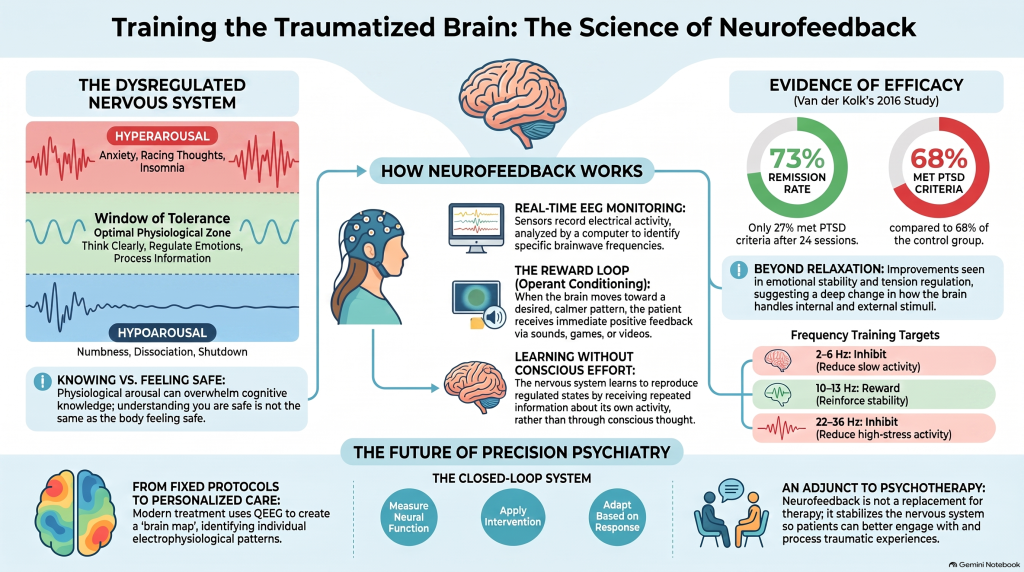
The Dysregulated Brain
Severe or chronic trauma can be associated with difficulties regulating arousal.
Patients may oscillate between two extremes.
Hyperarousal
The individual may experience:
- anxiety
- hypervigilance
- irritability
- anger
- racing thoughts
- exaggerated startle
- insomnia
- autonomic activation
- difficulty concentrating.
At the other extreme is:
Hypoarousal
This may manifest as:
- emotional numbness
- withdrawal
- shutdown
- dissociation
- derealisation
- depersonalisation
- reduced motivation
- feeling disconnected from one’s body.
Between these states lies what trauma clinicians often call the:
Window of Tolerance
Within this range, the person can remain sufficiently calm while still being alert.
This is the physiological state in which people are generally better able to:
- think clearly
- regulate emotions
- communicate
- process memories
- participate in psychotherapy
- tolerate distress.
One way of understanding van der Kolk’s interest in neurofeedback is therefore:
Can we train the nervous system to remain within this regulatory window more consistently?
What Is Neurofeedback?
Neurofeedback is a form of brain-computer biofeedback.
Brain electrical activity is recorded using EEG sensors placed on the scalp.
The computer continuously analyses selected characteristics of the EEG signal.
The person then receives immediate feedback — commonly through:
- sounds
- animations
- games
- videos
- visual rewards.
When the brain moves toward a desired activity pattern, the computer provides positive feedback.
Over repeated sessions, the brain may gradually learn to reproduce these states more consistently.
The underlying mechanism is broadly based on:
Operant conditioning
In simplified form:
Brain activity
↓
Real-time EEG measurement
↓
Computer detects target pattern
↓
Immediate reward
↓
Brain learns which activity produces reward
↓
Repeated training
↓
Potential improvement in self-regulation
The important distinction is that the patient is not necessarily consciously trying to produce a specific brainwave.
Instead, the nervous system receives repeated information about its own activity and gradually learns from that feedback.
Why Did Neurofeedback Interest Van der Kolk?
Consider a patient with severe trauma.
The therapist may explain:
“You are safe now.”
The patient may completely understand the statement.
Yet during a trigger:
- heart rate rises
- muscles tense
- breathing changes
- attention narrows
- threat perception increases
- emotional control deteriorates.
At this point, cognitive knowledge may become temporarily overwhelmed by physiological arousal.
This leads to an important therapeutic insight:
Knowing that you are safe is not necessarily the same as feeling safe.
Van der Kolk therefore became interested in treatments that might help patients develop greater physiological self-regulation.
Neurofeedback fits naturally into this framework.
Instead of attempting to regulate the nervous system entirely through conscious thought, neurofeedback attempts to train the regulatory process itself.
The Landmark Van der Kolk Neurofeedback Study
One of the most frequently cited studies in this area was published by van der Kolk and colleagues in 2016:
A Randomized Controlled Study of Neurofeedback for Chronic PTSD
The study included adults with chronic post-traumatic stress disorder.
Participants were assigned either to neurofeedback treatment or to a control condition.
The neurofeedback group received approximately:
24 sessions
delivered twice weekly over approximately 12 weeks.
Each session lasted around 30 minutes.
What Exactly Did They Train?
The study used an EEG electrode configuration involving the right temporoparietal region.
The primary montage was:
T4–P4
with EEG frequency training designed broadly to:
reduce slower activity
while
reinforcing approximately 10–13 Hz activity
and
reducing excessive higher-frequency activity.
The investigators initially trained approximately:
| EEG Frequency | Training Direction |
|---|---|
| 2–6 Hz | Inhibit |
| 10–13 Hz | Reward |
| 22–36 Hz | Inhibit |
It is important to understand this historically.
This was primarily traditional EEG amplitude neurofeedback.
It was not the same as many contemporary approaches such as:
- QEEG-guided neurofeedback
- Z-score neurofeedback
- connectivity-based training
- source-localised neurofeedback
- LORETA neurofeedback
- fMRI neurofeedback.
Nevertheless, the study became an important demonstration that deliberately training electrophysiological regulation could potentially affect clinically meaningful trauma symptoms.
What Happened?
The results attracted considerable attention.
Among treatment completers, approximately:
27% of the neurofeedback group
continued to meet PTSD diagnostic criteria after treatment,
compared with approximately:
68% of the control group.
Clinician-rated PTSD symptoms improved substantially.
Importantly, the improvements were not confined to a single symptom.
Changes were reported in areas involving:
- emotional regulation
- affective instability
- tension
- overall PTSD symptoms.
This suggested something potentially deeper than simply teaching patients to relax during the neurofeedback session.
What Might Neurofeedback Actually Be Changing?
The most interesting interpretation is not:
“Neurofeedback removes traumatic memories.”
Traumatic memories are not simply deleted.
A better conceptualisation is:
Neurofeedback may improve the brain’s ability to regulate its response to internal and external stimuli.
The traumatic memory may remain.
But the nervous system’s reaction to it may become less overwhelming.
This distinction is clinically important.
Imagine two patients remembering exactly the same traumatic event.
Patient A
Memory appears.
↓
Massive autonomic activation.
↓
Panic.
↓
Emotional flooding.
↓
Loss of cognitive control.
↓
Avoidance.
Patient B
Memory appears.
↓
Moderate emotional response.
↓
Arousal remains tolerable.
↓
Reflection remains possible.
↓
Emotion gradually settles.
The memory itself may not have changed dramatically.
What has changed is the individual’s capacity to regulate their response to it.
That is one of the most compelling theoretical reasons neurofeedback has attracted attention in trauma treatment.
Neurofeedback and Psychotherapy Are Not Opponents
An important misconception is that neurofeedback is intended to replace psychotherapy.
It need not.
A more useful model may be:
Neurofeedback
↓
Improved physiological regulation
↓
Greater emotional stability
↓
Improved ability to tolerate distress
↓
Better engagement with psychotherapy
↓
Improved processing of traumatic experiences.
This may be particularly relevant for patients who say:
“I understand everything my therapist tells me, but when I get triggered I cannot use any of it.”
The difficulty may not necessarily be a lack of insight.
The difficulty may be that high physiological arousal temporarily compromises the ability to apply that insight.
From Trauma to Developmental Trauma
Van der Kolk and colleagues subsequently explored neurofeedback in children with histories of severe developmental trauma.
This is particularly interesting because childhood trauma can affect developing systems involved in:
- impulse control
- attachment
- emotional regulation
- attention
- executive function
- threat processing.
Later research used more individualised neurofeedback approaches, including adjustment of reward frequencies according to physiological characteristics such as the child’s posterior dominant rhythm.
This represented an important conceptual shift.
Instead of asking:
“Which neurofeedback protocol treats this diagnosis?”
the emerging question became:
“What electrophysiological pattern does this particular brain show, and what should we train?”
That distinction brings us directly into the modern era of QEEG-informed neurofeedback.
From Fixed Protocols to Personalised Neurofeedback
Earlier neurofeedback frequently relied on relatively standardised protocols.
For example:
Diagnosis
↓
Predetermined electrode location
↓
Predetermined frequency training
Modern neurofeedback increasingly attempts to move toward:
Clinical assessment
↓
EEG/QEEG recording
↓
Identification of individual electrophysiological patterns
↓
Clinical correlation
↓
Individualised training targets
↓
Repeated reassessment.
This is conceptually much closer to precision medicine.
Two patients can both have:
- PTSD
- ADHD
- anxiety
- depression
yet potentially demonstrate quite different electrophysiological patterns.
Similarly, two individuals with apparently similar EEG abnormalities may have completely different clinical presentations.
Therefore EEG findings should never be interpreted in isolation.
Where Does QEEG Fit?
A conventional EEG is primarily designed to identify clinically significant electrophysiological abnormalities such as epileptiform activity.
Quantitative EEG — QEEG — applies mathematical analysis to EEG recordings.
Depending upon the system being used, QEEG may examine parameters such as:
- absolute power
- relative power
- dominant frequency
- asymmetry
- coherence
- phase relationships
- frequency distribution
- regional differences
- comparison with normative databases.
Some systems additionally generate:
- Z-scores
- connectivity measurements
- source estimates
- three-dimensional representations.
These findings can potentially help clinicians generate hypotheses about brain regulation.
But there is a crucial principle:
A QEEG pattern is not automatically a psychiatric diagnosis.
There is no single brain map that proves:
“this patient has depression”
or
“this patient has ADHD”
or
“this patient has PTSD.”
Diagnosis remains fundamentally clinical.
QEEG is better considered an adjunctive physiological investigation that can sometimes provide additional information about brain activity.
The Future: Closed-Loop Psychiatry?
Neurofeedback belongs to a much larger transformation occurring in neuroscience.
Traditional psychiatric treatment often works in an open-loop manner:
Assess patient
↓
Choose intervention
↓
Wait
↓
Ask whether patient improved
↓
Modify treatment.
Emerging technologies increasingly allow more objective measurement.
Potentially:
Measure neural function
↓
Apply intervention
↓
Measure again
↓
Identify physiological response
↓
Adapt intervention
↓
Repeat.
This is the basic principle of a:
Closed-loop system.
Modern research is exploring this concept through:
- EEG neurofeedback
- QEEG
- functional near-infrared spectroscopy
- fMRI neurofeedback
- brain-computer interfaces
- digital cognitive testing
- neuromodulation
- wearable physiological monitoring.
Psychiatry is therefore gradually moving toward a world where the clinical interview remains central, but increasingly sophisticated physiological measurements may complement it.
What Does the Current Evidence Say?
Scientific enthusiasm needs to be balanced with scientific caution.
Neurofeedback research in PTSD has expanded considerably since van der Kolk’s early work.
Systematic reviews and meta-analyses have reported promising reductions in PTSD symptoms across several studies.
However, major limitations remain.
Different studies use different:
- electrode montages
- frequencies
- treatment durations
- neurofeedback technologies
- control conditions
- outcome measures
- patient populations.
Sample sizes are frequently modest.
Blinding neurofeedback studies is also methodologically difficult.
Therefore, neurofeedback should not currently be presented as a universally established first-line treatment for PTSD.
Evidence-based trauma-focused psychotherapies continue to have substantially stronger guideline support.
The most scientifically responsible conclusion is therefore:
Neurofeedback is promising, but promising is not the same as proven.
That distinction protects patients while allowing legitimate innovation to continue.
Van der Kolk’s Larger Contribution
Perhaps Bessel van der Kolk’s most important contribution to this field is not proving that one particular EEG protocol treats trauma.
His larger contribution has been helping psychiatry reconsider the therapeutic target.
Instead of asking only:
“What happened to this patient?”
we can also ask:
“What happens inside this patient’s nervous system when they encounter stress?”
And beyond that:
“Can that nervous system learn to regulate itself more effectively?”
That is where neurofeedback becomes fascinating.
It transforms the brain from something clinicians merely observe into something the patient may potentially learn to regulate.
From Symptom-Based Psychiatry to Objective Brain Assessment
Psychiatry will always require a careful clinical interview.
No brain scan, questionnaire or computer test can replace understanding:
- the person’s life
- developmental history
- relationships
- emotions
- behaviour
- environment
- medical conditions
- medications.
But subjective symptoms can increasingly be complemented by objective measurements.
That is particularly useful when symptoms overlap.
Difficulty concentrating, for example, can occur in:
- ADHD
- anxiety
- depression
- PTSD
- sleep deprivation
- substance use
- medication effects
- cognitive disorders
- several medical conditions.
Instead of assuming that every attention complaint represents ADHD, a comprehensive evaluation asks:
Why is this particular person having difficulty with attention?
That is a much more clinically meaningful question.
ATTN Clinic: Moving Toward Objective, Personalised Psychiatry
At ATTN Clinic, Chennai, we are developing this same broader philosophy of assessment.
The clinical interview remains the foundation of diagnosis.
However, where clinically appropriate, assessment can be supplemented with objective tools including:
QEEG brain mapping
Computerised attention and cognitive assessment
Structured psychiatric evaluation
Standardised clinical rating scales
Neurofeedback and brain-training approaches
The objective is not to diagnose psychiatric disorders from a colourful brain map.
It is to develop a more complete understanding of the individual.
For patients presenting with problems such as:
- poor attention
- ADHD symptoms
- anxiety
- depression
- emotional dysregulation
- cognitive difficulties
- memory concerns
we attempt to understand both the clinical symptom profile and, where relevant, measurable aspects of cognitive and brain function.
This can be especially valuable when several possible explanations for the same symptom coexist.
Attention. Understood.
The philosophy behind ATTN Clinic can be summarised simply:
Do not treat an attention symptom until you understand why the attention problem is occurring.
Clinical evaluation comes first.
Objective assessments can then provide additional pieces of the puzzle.
Where appropriate, treatment may incorporate:
- medication optimisation
- psychological interventions
- behavioural strategies
- cognitive training
- neurofeedback
- neuromodulation approaches.
The broader goal is a transition from purely symptom-based treatment toward increasingly measurable, individualised and neuroscience-informed psychiatric care.
ATTN Clinic
Attention. Understood.
Currently functioning from:
Apollo Clinic, opposite Phoenix Market City, Velachery, Chennai
Appointments: +91 85951 55808
Email: srinivasaiims@gmail.com