Understanding Relationships in Autism
 When parents first worry about autism, the concern often begins with relationships.
“He does not respond when I call him.”
“She plays alone most of the time.”
“He does not look at me the way other children do.”
“She comes to me only when she needs something.”
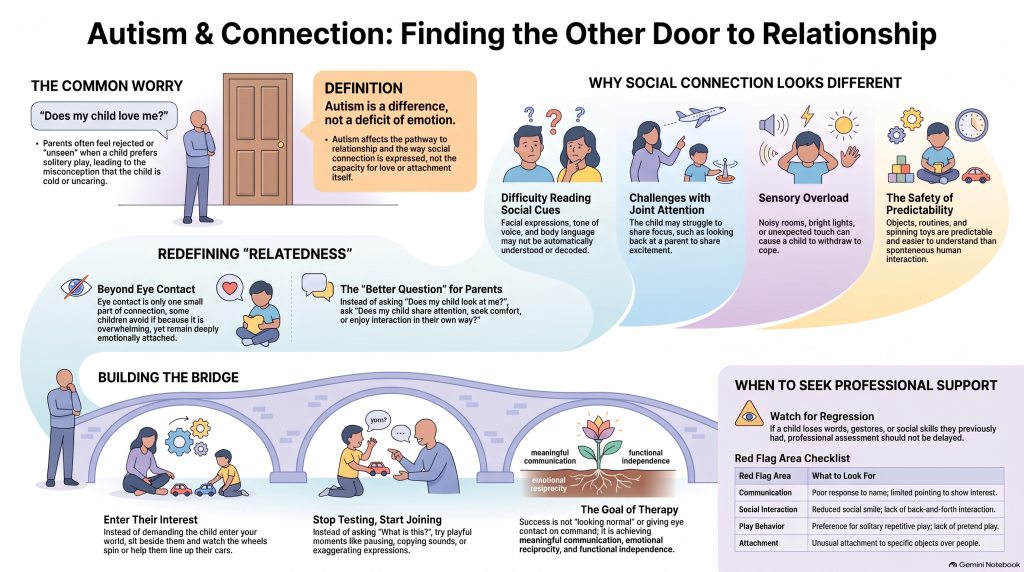
These observations can be emotionally painful for families. Many parents silently wonder, “Does my child love me?” or “Is my child not attached to us?” This is where autism is often misunderstood.
Autism does not mean the absence of love. It does not mean the child is cold, uncaring, or emotionally disconnected. More accurately, autism affects the way a child understands, expresses, receives, and responds to social connection.
The First Area to Understand: Relating to People
One of the important clinical areas assessed in autism rating scales is how the child relates to people. This includes the child’s response to parents, siblings, teachers, peers, relatives, and unfamiliar adults.
A typically developing child naturally turns toward people for comfort, sharing, play, imitation, approval, and emotional exchange. In autism, this social instinct may look different. The child may not automatically seek shared attention, may not respond consistently to social cues, or may not show interest in others in expected ways.
This does not always mean the child is avoiding people intentionally. Often, the child’s brain is processing the social world differently.
What Parents May Notice
Some children with autism may seem aloof. They may appear unaware when others enter or leave the room. They may not respond to their name consistently. They may not bring toys to show parents. They may not point to share interest. They may not look back to check whether the parent is watching.
Some children may interact, but only in a limited or unusual way. For example, they may pull the parent’s hand to get what they want, but may not look at the parent’s face. They may enjoy physical play like tickling or chasing, but may not engage in back-and-forth conversation or pretend play.
Some children may be socially interested but awkward. They may come very close to others, ask repetitive questions, speak only about their favourite topic, or struggle to understand personal space. These children are not antisocial; they are socially motivated but may lack the intuitive social map that other children pick up naturally.
Relationship Is Not Only Eye Contact
A common mistake is to reduce social relatedness to eye contact alone.
Eye contact is important, but it is not the whole story. Some autistic children may make eye contact briefly but still struggle with social reciprocity. Others may avoid eye contact because it feels overwhelming, distracting, or uncomfortable, yet they may still be emotionally attached to caregivers.
A better question is not simply, “Does the child look at me?”
The better question is: “Does the child share attention, respond to people, seek comfort, enjoy interaction, and engage in back-and-forth communication in a developmentally appropriate way?”
Why Social Connection May Look Different
Autism affects several building blocks of social connection.
First, the child may have difficulty reading social cues. Facial expressions, tone of voice, gestures, and body language may not be automatically understood.
Second, the child may have difficulty with joint attention. Joint attention means sharing focus with another person — for example, pointing at an airplane and looking back at the parent to share excitement.
Third, sensory overload may interfere with social engagement. A noisy room, bright lights, multiple people talking, or unexpected touch may make the child withdraw.
Fourth, language delay or communication differences may reduce social interaction. A child who cannot express needs easily may use pulling, crying, or repetitive behaviours instead of words.
Fifth, predictability may feel safer than social spontaneity. Objects, routines, numbers, letters, screens, or spinning toys may be easier to understand than unpredictable human interaction.
The Parent’s Emotional Experience
Parents often feel rejected when the child does not respond in expected ways. This is understandable.
A mother may feel hurt when the child does not run to her after school. A father may feel helpless when his child does not enjoy the games he planned. Grandparents may compare the child with cousins and say, “He is in his own world.”
But the child is not rejecting the family. The child may be struggling to decode the social world. The parent’s task is not to force normal-looking behaviour, but to build a bridge into the child’s world and slowly expand it.
How to Build Connection
The first step is to enter the child’s interest rather than immediately demanding the child enter ours.
If the child likes spinning wheels, sit beside the child and watch the wheels together. If the child likes lining up cars, join the pattern gently. If the child likes letters, use letters to create interaction. If the child likes music, use rhythm and pauses to invite response.
Connection often begins when the adult stops testing the child and starts joining the child.
Instead of repeatedly asking, “What is this? Say car. Look at me,” try creating playful moments: pause before giving a favourite toy, exaggerate facial expressions, copy the child’s sound, take turns with an object, and celebrate even small social responses.
Red Flags That Need Professional Assessment
A child should be assessed if there is poor response to name, limited eye contact, lack of pointing to show interest, reduced social smile, limited back-and-forth interaction, preference for solitary repetitive play, lack of pretend play, unusual attachment to objects, or difficulty interacting with peers.
Regression is especially important. If a child had words, gestures, or social interaction and then lost them, assessment should not be delayed.
Early assessment does not label the child negatively. It opens the door for early support.
What Therapy Should Aim For
Good therapy should not aim to make the child mechanically “look normal.” It should aim to improve meaningful communication, emotional connection, social understanding, flexibility, and functional independence.
A child should not merely be trained to give eye contact on command. The deeper goal is shared attention, emotional reciprocity, and communication that helps the child connect with others.
Progress may look small at first: turning when called, looking briefly to share joy, bringing a toy to show, waiting for a turn, copying an action, using a gesture, or tolerating another child nearby. These small steps are major developmental gains.
A More Compassionate Way to Understand Autism
Children with autism do form relationships. They may love deeply, attach strongly, and feel distress when separated from caregivers. But their way of showing connection may be different.
Some children show love by sitting near a parent, bringing a favourite object, accepting touch only from trusted people, smiling during a familiar routine, or becoming calm in the parent’s presence.
When we understand this, we stop asking, “Why is this child not like others?”
We begin asking, “How does this child connect, and how can we help that connection grow?”
That shift changes everything.
Final Message for Parents
Autism is not the absence of relationship. It is a difference in the pathway to relationship.
The child may not enter the social world through the usual door. But with patience, structure, warmth, and the right intervention, we can often find another door — and sometimes, the relationship that emerges is deeply meaningful in its own unique way.
Dr. Srinivas Rajkumar T
MD, DNB, MBA
Senior Consultant Psychiatrist
Mind & Memory Clinic, Apollo Clinic Velachery, Chennai
Opp. Phoenix Mall
Email: srinivasaiims@gmail.com
Phone: +91-8595155808