When, How, and What Exercise Improves Sleep A Science-Based Guide to Sleeping Better
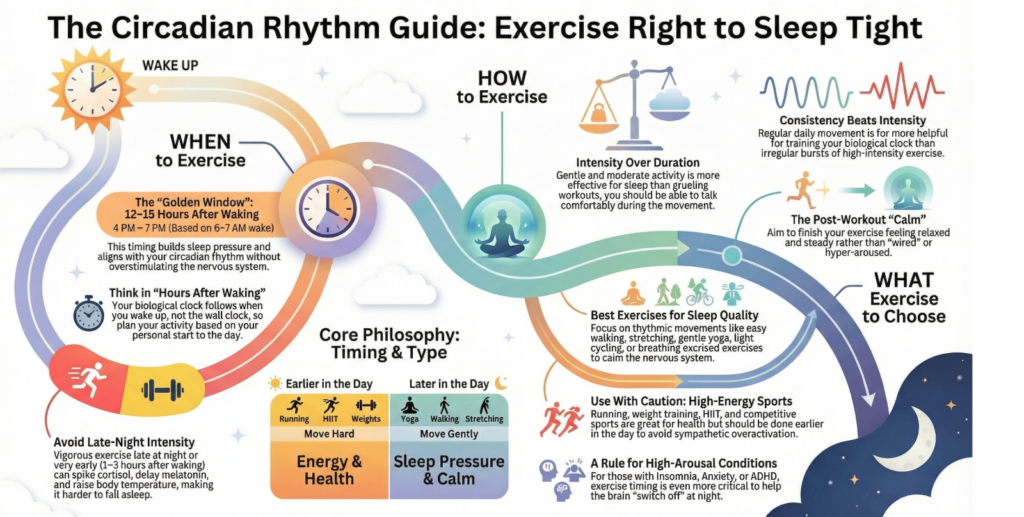 Exercise is often recommended as a natural remedy for poor sleep. Yet many people who exercise regularly still struggle with insomnia, fragmented sleep, or delayed sleep onset. This leads to an important question:
When should you exercise, how should you exercise, and what kind of exercise actually improves sleep?
Recent research and clinical understanding show that exercise helps sleep only when its timing, intensity, and type are aligned with your biological clock.
WHEN to Exercise for Better Sleep
✅ Best Time: Late Afternoon to Early Evening
The strongest evidence suggests that low-intensity exercise performed 12–15 hours after waking is most beneficial for sleep quality.
For most people who wake between 6–7 am, this corresponds to:
-
4 pm to 7 pm
This timing:
-
Builds sleep pressure naturally
-
Supports circadian rhythm alignment
-
Does not overstimulate the nervous system
❌ Times That Can Worsen Sleep
-
Very intense exercise late at night
-
Moderate to vigorous exercise very early in the morning (1–3 hours after waking)
These can:
-
Increase cortisol
-
Delay melatonin release
-
Raise body temperature
-
Increase mental arousal
⏰ Think in “Hours After Waking”
Your circadian rhythm follows your wake-up time, not the wall clock. Thinking in terms of hours after waking leads to better sleep-friendly exercise planning.
HOW to Exercise for Better Sleep
🔹 Intensity Matters More Than Duration
For sleep, gentle and moderate activity works better than hard workouts.
Best approach:
-
Low-intensity, rhythmic movement
-
You should be able to talk comfortably while exercising
-
Finish feeling calm, not wired
Avoid:
-
High-intensity interval training close to bedtime
-
Competitive or adrenaline-driven workouts late in the day
🔹 Consistency Beats Intensity
Regular daily movement trains:
-
Sleep pressure (homeostatic drive)
-
Circadian rhythm (biological clock)
Irregular bursts of intense exercise are far less helpful for sleep.
WHAT Exercise Is Best for Sleep?
✅ Best Exercises for Sleep
These exercises consistently support better sleep quality:
-
Easy walking
-
Stretching or mobility routines
-
Gentle yoga
-
Light cycling
-
Calm household movement
-
Breathing-focused exercises
These activities:
-
Calm the nervous system
-
Increase sleep pressure
-
Avoid sympathetic overactivation
⚠️ Use With Caution (Timing Matters)
-
Running
-
Weight training
-
HIIT
-
Competitive sports
Excellent for overall health, but best done earlier in the day, not close to bedtime.
Exercise and Sleep in Insomnia, Anxiety, and ADHD
People with insomnia, anxiety disorders, or ADHD often have:
-
Higher baseline arousal
-
Circadian rhythm sensitivity
-
Difficulty “switching off” at night
For them, timing and intensity matter even more.
A useful principle:
Exercise should be treated like medication—right dose, right time, right person.
A Simple Rule to Remember
Move hard earlier.
Move gently later.
Sleep better at night.
Bottom Line
Better sleep does not come from exercising more.
It comes from exercising at the right time, with the right intensity, and in the right way for your biology.
Sleep is not passive rest—it is an actively regulated process. When exercise works with that system, sleep improves naturally.
About the Author
Dr. Srinivas Rajkumar T, MD (AIIMS), DNB, MBA (BITS Pilani)
Consultant Psychiatrist & Neurofeedback Specialist
Mind & Memory Clinic, Apollo Clinic Velachery
(Opp. Phoenix Mall)
Velachery, Chennai – 600022
✉ srinivasaiims@gmail.com
📞 +91-8595155808