How Age of Onset Determines Symptoms in Alzheimer’s Disease
 Alzheimer’s disease is commonly understood as a disorder that begins with memory loss. Forgetting names, repeating questions, misplacing objects—these are the images most people associate with the illness. While this description fits many older adults, it does not capture the full clinical reality.
Growing evidence shows that the age at which Alzheimer’s disease begins plays a crucial role in determining its earliest symptoms. In younger individuals, Alzheimer’s often starts without prominent memory complaints, leading to frequent misdiagnosis and delayed care.
Understanding how age of onset determines symptoms in Alzheimer’s disease is essential for clinicians, patients, and families alike.
Is Alzheimer’s Disease the Same at Every Age?
Alzheimer’s disease is not a single, uniform condition. Instead, it is increasingly recognised as a disorder with multiple clinical phenotypes, shaped in part by age of onset.
A large multi-centre study analysing data from over 7,800 individuals with Alzheimer’s disease demonstrated that the first cognitive and behavioural symptoms vary systematically with age
Rather than a sharp divide between “early-onset” and “late-onset” Alzheimer’s, symptoms shift gradually across the lifespan.
Early-Onset Alzheimer’s Disease: When Memory Is Not the First Symptom
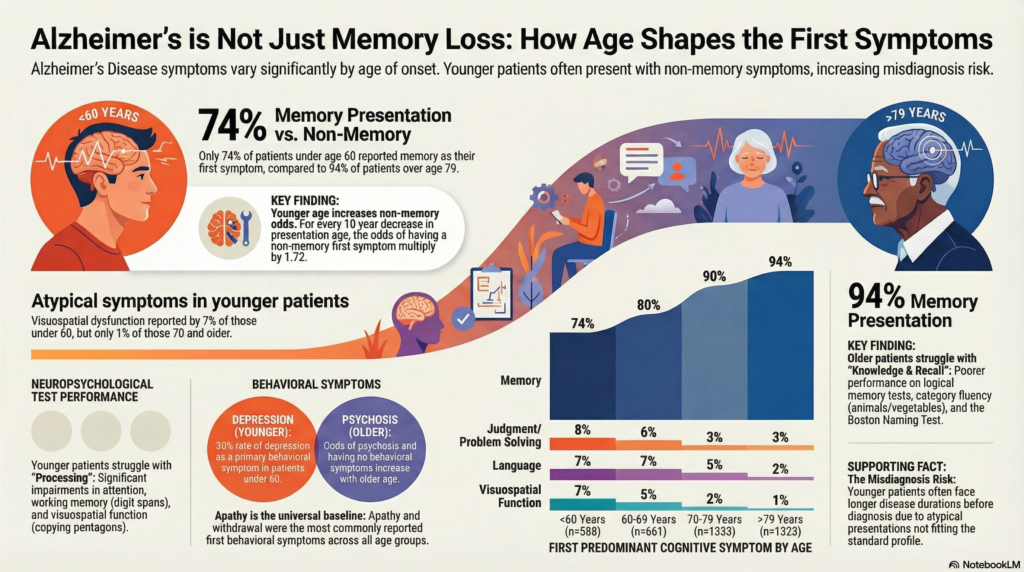
In people who develop Alzheimer’s disease before the age of 60, memory loss is often not the earliest or most prominent symptom.
Instead, early-onset Alzheimer’s disease frequently begins with non-memory cognitive difficulties, such as:
-
Language problems (word-finding difficulty, reduced fluency, naming errors)
-
Visuospatial impairment (difficulty navigating familiar places, judging distances)
-
Executive dysfunction (poor planning, judgment, or decision-making)
-
Declining work performance despite apparently intact memory
Research shows that nearly one in four younger patients present with a non-memory symptom as the first sign of Alzheimer’s disease. With every 10-year decrease in age, the likelihood of a non-memory presentation increases significantly.
Why early-onset Alzheimer’s is often missed
Because memory appears relatively preserved, these individuals are frequently diagnosed with:
-
Depression
-
Anxiety disorders
-
Adult ADHD
-
Stress- or burnout-related cognitive complaints
As a result, diagnosis is delayed—sometimes by several years—during which patients may experience worsening symptoms, occupational difficulties, and emotional distress.
Late-Onset Alzheimer’s Disease: The Classic Memory-Led Pattern
In contrast, Alzheimer’s disease beginning after the age of 70 most often follows the traditional pattern taught in textbooks:
-
Early impairment in episodic memory
-
Repetition of questions or conversations
-
Forgetting recent events
More than 90% of older adults with Alzheimer’s report memory impairment as their first cognitive symptom.
This explains why Alzheimer’s disease is widely equated with forgetfulness—but also highlights why younger presentations are frequently overlooked.
Behavioural and Emotional Symptoms: An Overlooked Beginning
Alzheimer’s disease affects behaviour and emotional regulation as much as cognition.
Across all age groups, apathy and social withdrawal are among the most common early behavioural changes. However, age again shapes the pattern:
-
Younger patients are more likely to present with depressive symptoms and emotional distress
-
Older patients are more likely to develop psychotic symptoms or show minimal behavioural change early on
Depression in a younger adult is rarely viewed through a neurodegenerative lens, even when cognitive complaints coexist—contributing further to diagnostic delay.
What Neuropsychological Testing Reveals
Objective cognitive testing supports these clinical observations:
-
Younger-onset Alzheimer’s disease shows greater impairment in:
-
Visuospatial skills
-
Attention and working memory
-
-
Later-onset Alzheimer’s disease shows greater impairment in:
-
Episodic memory
-
Language naming
-
Processing speed and executive sequencing
-
These findings suggest that different brain networks are affected first at different ages, rather than Alzheimer’s following a single fixed pathway.
Why Does Age of Onset Change Alzheimer’s Symptoms?
Several factors likely contribute to age-dependent symptom patterns:
-
Age-related vulnerability of specific brain networks
-
Genetic influences such as APOE-ε4, more strongly linked to memory-predominant disease
-
Cognitive reserve masking memory deficits in younger individuals
-
Distinct biological subtypes of Alzheimer’s disease
In essence, Alzheimer’s disease does not have a universal starting point.
When Should Alzheimer’s Be Considered Without Memory Loss?
Alzheimer’s disease should be considered—even in the absence of obvious memory impairment—when a person, especially under 60, develops progressive and unexplained:
-
Language difficulties
-
Visuospatial problems
-
Executive dysfunction
-
Personality or motivational changes
Early recognition allows for appropriate investigations, timely counselling, and better long-term planning.
Key Takeaway
Memory loss is a common early symptom of Alzheimer’s disease.
It is not a mandatory one.
The age at which Alzheimer’s disease begins strongly determines how it first presents—and recognising this can prevent years of confusion and misdiagnosis.
Final Thoughts
Alzheimer’s disease is not simply a disorder of forgetting. It is a disorder of brain network failure, and the network that fails first depends, in part, on age.
Expanding our understanding of age-dependent Alzheimer’s symptoms leads to earlier diagnosis, reduced stigma, and better care for patients and families.
About the Author
Dr. Srinivas Rajkumar T, MD (AIIMS, New Delhi)
Consultant Psychiatrist
Apollo Clinic Velachery (Opp. Phoenix Mall)
Chennai, Tamil Nadu
✉ srinivasaiims@gmail.com
📞 +91-8595155808