Emotionally Unstable Personality Disorder (EUPD): Understanding What Lies Beneath the Pain
Emotionally Unstable Personality Disorder (EUPD), also commonly known as Borderline Personality Disorder (BPD), is one of the most misunderstood diagnoses in mental health. At its core, it is not about being “difficult” or “manipulative.” It is about feeling everything more intensely, more deeply, and more painfully than most people can imagine.
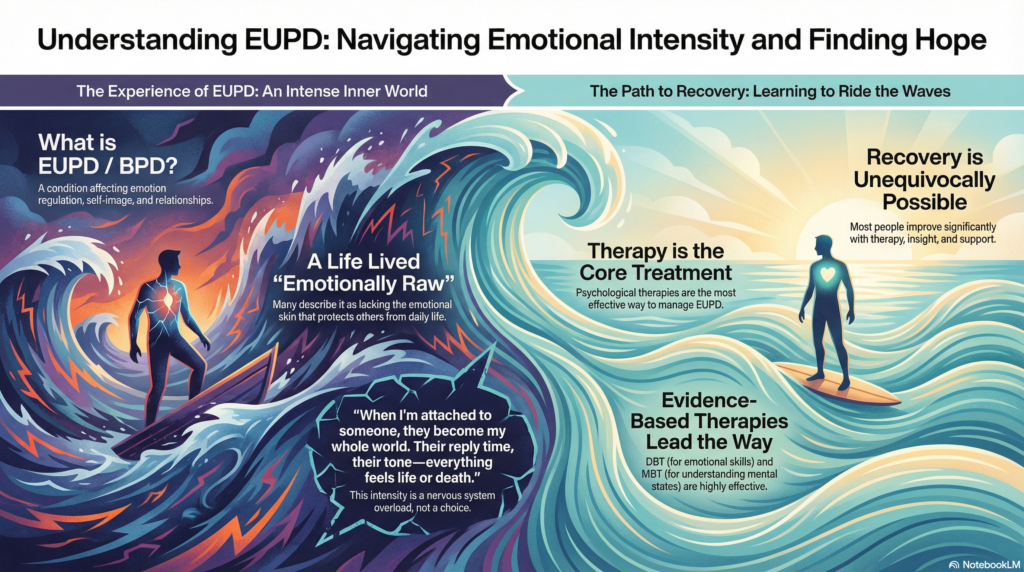
Many people living with EUPD describe life as emotionally raw—as if the skin that protects others from everyday emotional bumps simply isn’t there.
What Is EUPD / BPD?
EUPD is a mental health condition that affects:
-
How a person experiences and regulates emotions
-
How they see themselves
-
How they relate to other people
These difficulties are long-standing, deeply ingrained, and significantly interfere with daily life, relationships, and self-stability.
The term borderline is historical and often misleading. Today, many clinicians and individuals prefer Emotionally Unstable Personality Disorder, or even non-diagnostic language that focuses on emotional intensity and trauma responses.
Importantly, it’s your choice which term—if any—you use. Some find the diagnosis validating. Others experience it as stigmatising. Both responses are valid.
How Does EUPD Feel on the Inside?
People with EUPD often describe experiences such as:
-
Emotions that rise suddenly and powerfully, lasting hours or days
-
Rapid shifts from confidence to despair
-
An unstable or fragile sense of identity
-
A deep fear of abandonment
-
Intense, consuming attachments
-
Feeling chronically empty
-
Anger that feels overwhelming and hard to control
-
Dissociation or paranoia during extreme stress
One person described it simply:
“When I’m attached to someone, they become my whole world. Their reply time, their tone—everything feels life or death.”
This isn’t drama. It’s nervous system overload.
When Is EUPD Diagnosed?
A diagnosis is usually considered when a person experiences at least five of the following patterns persistently and across situations:
-
Fear of abandonment and desperate efforts to avoid it
-
Intense, rapidly shifting emotions
-
Unstable sense of self
-
Unstable and intense relationships (idealising → devaluing)
-
Chronic feelings of emptiness
-
Impulsive, self-damaging behaviours
-
Self-harm or suicidal thoughts
-
Intense, inappropriate anger
-
Stress-related paranoia or dissociation
Because only five criteria are needed, EUPD is a broad and heterogeneous diagnosis. Two people with the same label may have very different lives and struggles.
The Diagnosis Debate: Helpful or Harmful?
There is ongoing debate about whether personality disorder diagnoses are useful.
Many people find the diagnosis helpful because it:
-
Validates long-standing suffering
-
Helps explain confusing emotional patterns
-
Allows access to specialised therapies
-
Reduces self-blame
Others find it harmful because it:
-
Feels stigmatising
-
Suggests something is “wrong” with who they are
-
Can limit access to care in some systems
-
Ignores trauma and social context
Some reject the diagnosis entirely, viewing their experiences as understandable responses to trauma, neglect, or chronic invalidation rather than a disorder.
There is no single “correct” framework. What matters most is whether the explanation helps you heal.
What Treatments Actually Help?
Talking Therapies (Core Treatment)
Psychological therapy is the mainstay of treatment for EUPD.
Evidence-supported approaches include:
Dialectical Behaviour Therapy (DBT)
Focuses on emotion regulation, distress tolerance, interpersonal effectiveness, and mindfulness. Particularly helpful for self-harm and emotional dysregulation.
Mentalisation-Based Therapy (MBT)
Helps people understand their own mental states and those of others—especially valuable when emotions overwhelm thinking.
Other helpful approaches may include:
-
Cognitive Behavioural Therapy (CBT)
-
Cognitive Analytic Therapy (CAT)
-
Schema Therapy
-
Psychodynamic psychotherapy
-
Trauma-informed therapies
-
Arts and expressive therapies
Recovery is not about becoming emotionally numb. It’s about learning to ride emotional waves without drowning in them.
Therapeutic Communities
Some people benefit from structured group-based therapeutic communities, where healing occurs through relationships, shared responsibility, and consistency.
Medication: A Support, Not a Cure
There is no medication that treats EUPD itself.
Medication may help with:
-
Co-occurring depression or anxiety
-
Severe mood instability
-
Sleep disturbances
-
Short-term crisis management
Medication should be symptom-targeted, time-limited, and regularly reviewed.
Crisis Care: A Reality Check
Many people with EUPD struggle to access timely crisis support. This is a systemic failure—not a personal one.
If services fall short, peer support, advocacy, and trauma-informed clinicians can make a meaningful difference. Hope often begins when someone finally says:
“There is a way forward. You are not broken.”
Is Recovery Possible?
Yes. Unequivocally.
Long-term studies consistently show that most people with EUPD improve significantly over time, especially with therapy, insight, and support.
Recovery does not mean the absence of emotion.
It means emotions no longer control your life.
One person reflected:
“There was no magic wand. But when I realised change was possible, something clicked.”
That moment—quiet, internal, deeply personal—is where healing begins.
A Final Word
If you live with EUPD—or think you might—you deserve understanding, not judgment. Your emotions are intense because your nervous system learned to survive in difficult conditions. With the right support, those same emotional depths can become a source of strength, creativity, and connection.
About the Author
Dr. Srinivas Rajkumar T, MD (AIIMS, New Delhi)
Consultant Psychiatrist & Neurofeedback Specialist
Mind & Memory Clinic, Apollo Clinic Velachery (Opp. Phoenix Mall)
Dr. Srinivas works with trauma-informed, evidence-based approaches to emotional dysregulation, personality patterns, and complex mood disorders, integrating psychotherapy, neuroscience, and compassionate clinical care.
📞 +91-8595155808
✉️ srinivasaiims@gmail.com