How Autism, ADHD, and AuDHD Shape the Transition From Working Life to Later Life
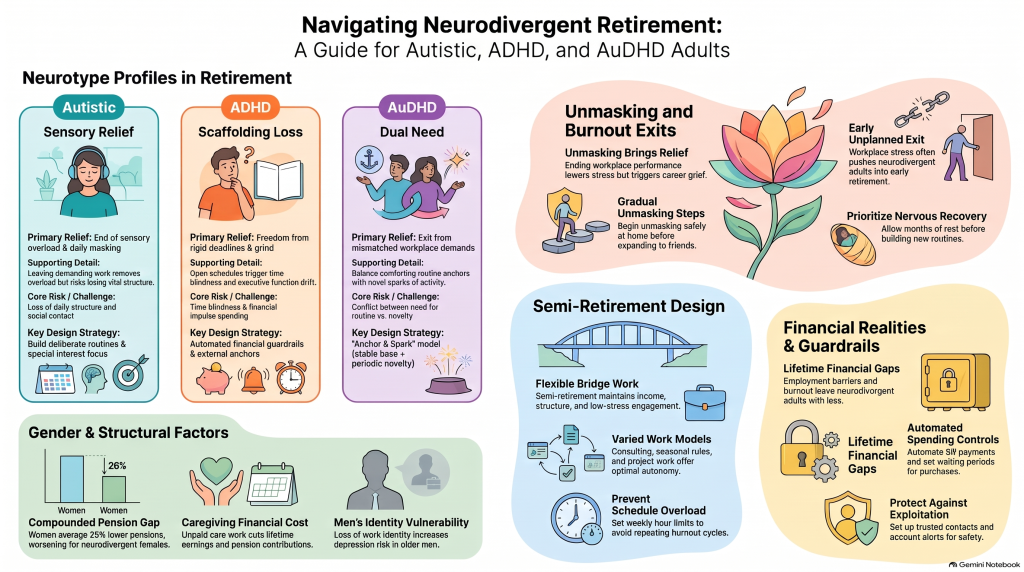 An evidence-based perspective on retirement, executive functioning, identity, mental health, and healthy ageing.
Retirement is often imagined as a reward for decades of work: freedom from deadlines, professional responsibilities, workplace politics, and the demands of everyday employment. Yet retirement is not simply the disappearance of work. It is also the disappearance of a structure around which much of adult life has been organised.
For people with attention-deficit/hyperactivity disorder (ADHD), autism spectrum disorder (ASD), or co-occurring autism and ADHD (AuDHD), this transition may carry additional challenges. Employment can be exhausting, but it may also provide external organisation, predictable routines, social relationships, financial stability, and a sense of identity.
The freedom that follows retirement can therefore be accompanied by unexpected difficulties. A person may welcome the end of workplace demands while struggling to organise an unstructured day. Another may experience enormous relief from sensory overload and social expectations but feel distressed when familiar routines disappear.
These possibilities are clinically relevant, but they should not be treated as universal characteristics of neurodivergent people.
Research on neurodivergence in older adults has historically been limited, and direct studies of retirement have only recently emerged. Nevertheless, findings from autism research, older-adult ADHD studies, retirement psychology, and geriatric psychiatry provide an increasingly useful framework for understanding this life transition.
1. Retirement Is a Psychological Transition, Not Merely an Occupational Event
Retirement changes several interconnected dimensions of life: time, identity, social relationships, finances, autonomy, and physical and mental health.
Its psychological effects are not uniformly positive or negative.
A meta-analysis of retirement adjustment involving 139 studies and 78,632 participants found that social participation and physical health were among the strongest correlates of successful adjustment, followed by marital relationships, finances, and the circumstances surrounding retirement. [1]
These findings suggest that the ability to adapt to retirement depends on much more than the amount of money accumulated during working life.
The relationship between retirement and depression is particularly complex.
One systematic review covering more than half a million participants found that retirement was associated with a modest reduction in depression risk. However, the studies were highly heterogeneous. Another longitudinal meta-analysis found a small overall increase in depressive symptoms, particularly following involuntary retirement. [2,3]
These apparently conflicting findings illustrate an important principle: retirement is not a single exposure with a predictable psychological outcome.
Leaving an exhausting occupation voluntarily, with adequate financial resources and meaningful plans, is very different from being forced to stop working because of illness, disability, unemployment, or burnout.
For neurodivergent adults, the distinction between voluntary and involuntary retirement may be especially relevant because workplace accommodations, occupational demands, and access to long-term employment can differ substantially.
2. What Research Tells Us About Autistic Retirement
For many years, autism research concentrated predominantly on childhood and adolescence. Consequently, relatively little was known about the experiences of autistic adults approaching old age.
This has started to change.
The first qualitative evidence
In a study published online in 2024, Davies and colleagues interviewed 12 autistic adults, including eight who had retired or semi-retired and four preparing for retirement.
The participants described varied experiences. Some considered retirement a welcome escape from demanding work environments. Others found retirement planning difficult or struggled with changes in routine and everyday structure.
Participants also raised concerns about ageing, declining health, the availability of appropriate support, and the possibility of entering residential care. [4]
Although the study was small and cannot establish how common these experiences are, it provided valuable first-person evidence that autistic retirement involves distinctive practical and psychological considerations.
A larger comparative study in 2026
A more substantial contribution appeared in March 2026, when Kowalczyk and colleagues published A New Pace of Life in the journal Autism.
The investigators surveyed 517 adults aged 40–90 years in the United Kingdom, including 395 autistic participants.
The study found that autistic and non-autistic adults reported broadly similar expected or actual retirement ages. However, autistic participants were less likely to have made retirement plans and more likely to report disrupted planning, lower pre-retirement income, reduced pension resources, and difficulties related to employment and health.
Some anticipated greater autonomy, less environmental stress, and more time for personal interests. Others worried about finances, isolation, and the loss of occupational identity and routine. [5]
This is an important finding. It suggests that retirement difficulties among autistic adults cannot be understood solely in terms of autism-related traits.
Employment history, economic disadvantage, access to support, and the cumulative effects of occupational environments also matter.
The study was observational, relied substantially on self-report, and involved UK participants. Its findings should not automatically be generalised to all autistic populations or other countries.
3. Autism, Predictability, and the Loss of Routine
Many autistic adults value predictability, familiar environments, and opportunities to regulate sensory and social demands. These preferences differ considerably between individuals.
During employment, the workplace may provide a relatively stable timetable: waking at a particular hour, travelling to the same location, working through familiar responsibilities, and returning home at a predictable time.
When employment ends, this structure may suddenly disappear.
The challenge is not necessarily an inability to tolerate leisure. Rather, an established pattern that previously supported daily functioning may need to be replaced.
Some individuals may benefit from developing a weekly routine before retirement. Others may enjoy substantially more flexibility than they experienced during their working lives.
Retirement may also reduce exposure to sensory demands such as crowded commuting, workplace noise, fluorescent lighting, unpredictable meetings, and socially demanding environments.
For someone who has spent decades managing these demands, retirement may produce meaningful improvements in well-being.
The clinical task is therefore not simply to encourage more activity. It is to identify which aspects of the previous environment were supportive, which were harmful, and which should be retained or replaced.
4. Masking, Occupational Identity, and Autistic Burnout
A substantial body of autism research describes camouflaging or masking: efforts to conceal autistic characteristics or modify behaviour to meet social expectations.
Such strategies can sometimes help individuals navigate difficult environments, but sustained camouflaging may also be psychologically costly.
Raymaker and colleagues’ influential 2020 research described autistic burnout as a state associated with prolonged stress and inadequate support, characterised by exhaustion, reduced functioning, and diminished tolerance of stimulation. [6]
Autistic burnout is an emerging clinical and research construct rather than a formally established DSM or ICD diagnosis. Its symptoms can overlap with depression, anxiety, sleep disorders, and physical illness.
Retirement may reduce some of the occupational demands contributing to exhaustion. However, leaving employment does not automatically resolve years of accumulated stress, financial insecurity, or psychiatric comorbidity.
Another psychological issue concerns identity.
A person who has spent decades being recognised primarily as a teacher, engineer, administrator, doctor, or academic may find that professional identity has become inseparable from self-worth.
Retirement can then create a difficult question: who am I when I no longer perform the role through which others have known me?
For some autistic adults, this question may intersect with a later-life diagnosis and a reassessment of earlier experiences.
Psychological support may be useful when retirement brings unresolved grief, shame, loss of identity, or persistent emotional distress. However, unmasking should not be treated as an obligatory therapeutic goal; individual safety, choice, and context remain important.
5. ADHD in Retirement: What Happens When External Structure Disappears?
ADHD is a neurodevelopmental condition characterised by persistent difficulties involving attention regulation, impulsivity, and, in some individuals, hyperactivity.
The manifestations of ADHD may change across the lifespan. Overt motor hyperactivity may become less prominent, while difficulties with organisation, time management, emotional regulation, and completing tasks remain important.
A 2024 scoping review of ADHD in older adults identified continuing symptoms, psychiatric comorbidity, relationship difficulties, and social isolation among relevant clinical concerns. [7]
Qualitative studies have also described lifelong experiences of mental restlessness, low self-esteem, difficulties with personal resources, and efforts to adapt to social expectations.
Retirement may expose previously compensated difficulties
Consider a hypothetical individual who has spent several decades in a structured occupation.
The workplace provides a reporting time, regular appointments, deadlines, colleagues who expect responses, and consequences when responsibilities are neglected.
These external structures may help compensate for difficulties with planning and time management.
After retirement, the person may find it harder to begin activities, maintain household organisation, complete financial paperwork, or manage an entire day without external deadlines.
Such an experience would not mean that retirement had caused ADHD.
Rather, it might indicate that previously effective compensatory strategies were no longer available.
This is a clinically plausible formulation supported indirectly by what is known about ADHD and executive functioning. However, direct longitudinal evidence demonstrating that retirement itself causes worsening ADHD symptoms remains limited.
Financial organisation and impulsivity
Executive-function difficulties may complicate financial tasks such as paying bills, monitoring investments, maintaining records, and planning future expenditure.
Impulsive spending may create additional problems for some individuals, although it would be inappropriate to assume that all adults with ADHD are financially impulsive.
Useful compensatory measures include automated recurring payments, simplified accounts, scheduled financial reviews, and appropriately chosen decision-making supports.
These strategies are practical applications of established ADHD management principles rather than interventions specifically proven in retirement trials.
6. The Emerging Connection Between ADHD and Cognitive Ageing
One of the most clinically important developments in recent research concerns the relationship between ADHD and late-life cognitive impairment.
Older adults with ADHD may report memory lapses, distractibility, difficulties retrieving information, and inefficient organisation.
Some of these complaints overlap with mild cognitive impairment (MCI), depression-related cognitive difficulties, and early dementia.
Evidence from longitudinal studies
A 2023 study published in JAMA Network Open followed 109,218 Israeli adults over a period of up to 17.2 years.
Individuals diagnosed with adult ADHD showed a higher subsequent rate of dementia. The adjusted hazard ratio in the primary analysis was 2.77. [8]
More recently, an October 2026 study published in JAMA Psychiatry examined 187,341 participants aged 50 years and older from the US All of Us Research Program.
The investigators found that an ADHD diagnosis was associated with increased subsequent diagnoses of MCI or dementia.
The association persisted after adjustment for multiple potential confounders, although its magnitude decreased with more extensive adjustment. The study also found an association between higher ADHD polygenic risk and later cognitive impairment. [9]
These findings are clinically significant, but they require careful interpretation.
Neither study establishes that ADHD directly causes neurodegeneration. Diagnostic overlap, residual confounding, healthcare utilisation, comorbid psychiatric illness, and possible reverse causation remain relevant. Furthermore, an increased relative hazard does not mean that every individual with ADHD will develop dementia.
ADHD and dementia are not interchangeable
The most useful clinical distinction is often the trajectory of symptoms.
A person with ADHD may describe attention and organisational difficulties extending back to childhood or early adult life.
By contrast, progressive deterioration in previously established abilities raises concern for an acquired cognitive disorder.
Nevertheless, the distinction is not always straightforward. ADHD and neurodegenerative conditions can coexist, and an individual’s longstanding ADHD symptoms should not be used to dismiss genuinely progressive cognitive impairment.
Clinical assessment should consider developmental history, collateral information, longitudinal functional change, sleep quality, mood symptoms, medication effects, sensory impairment, and appropriate cognitive testing.
In particular, a single low score on a cognitive screening instrument cannot reliably distinguish ADHD from MCI or dementia.
A 2025 systematic review of cognition in older adults with ADHD reported difficulties particularly involving attention and episodic memory, with more mixed evidence regarding executive functioning. The authors emphasised the need for better standardised assessment methods and clearer differentiation from age-related cognitive disorders. [10]
This is an important area for future geriatric psychiatry research.
7. Does Autism Lead to Accelerated Cognitive Ageing?
Autism and cognitive ageing represent another developing field.
A systematic review published in 2026 in Neuroscience & Biobehavioral Reviews examined 56 studies involving cognitive, neurological, and physical health outcomes in autistic adults.
The review did not find evidence supporting globally accelerated cognitive ageing in autism. Objective cognitive findings were variable, while subjective cognitive complaints were more consistently elevated. Some physical health and neurological outcomes suggested areas of increased vulnerability. [11]
This challenges overly simplistic claims that autistic adults necessarily experience earlier or faster cognitive decline.
Autism is a lifelong neurodevelopmental condition, not itself a progressive neurodegenerative disorder.
Nevertheless, ageing-related neurological and medical conditions may occur alongside autism and require appropriate assessment.
The challenge for clinicians is to recognise new changes without misattributing longstanding differences to dementia or, conversely, dismissing progressive decline as simply part of autism.
8. AuDHD and Retirement: A Research Gap
Co-occurring autism and ADHD is increasingly recognised in clinical practice, but research specifically examining retirement in this population remains exceptionally limited.
The clinical formulation is therefore largely extrapolated from separate autism and ADHD research.
Some individuals with both conditions may experience competing preferences. Predictability may feel reassuring, while novelty and stimulation may also be important.
Retirement planning might therefore benefit from retaining a dependable daily routine while allowing flexibility for changing interests, activities, and energy levels.
For example, a person might maintain consistent waking, exercise, and meal times while keeping afternoons available for learning, hobbies, or social activities.
This is a reasonable individualised strategy, but it should not be presented as a scientifically validated AuDHD retirement protocol.
There is no single neurodivergent retirement personality. Some people prefer solitude; others seek social engagement. Some thrive on routine; others find it restrictive.
Planning should follow the individual’s functioning, needs, and preferences rather than assumptions derived from a diagnostic label.
9. Mental Health Risks During Retirement
Retirement can coincide with several psychologically significant changes: reduced social interaction, financial uncertainty, bereavement, physical illness, and altered family responsibilities.
These changes may contribute to depression, anxiety, adjustment difficulties, or loneliness.
For neurodivergent adults, additional issues may include reduced access to familiar social environments, difficulty initiating new activities, and longstanding experiences of stigma or exclusion.
However, retirement may also remove major sources of distress and improve mental health.
A 2025 overview of systematic reviews examining retirement and health found that outcomes varied substantially and that socioeconomic circumstances were particularly relevant. [12]
The evidence therefore does not justify describing retirement as inherently dangerous for neurodivergent individuals.
Instead, mental health assessment should focus on the person’s actual experience.
Persistent sadness, loss of pleasure, hopelessness, significant sleep or appetite disturbance, increasing social withdrawal, or thoughts of suicide warrant clinical assessment rather than being dismissed as normal features of retirement.
Equally, a person who prefers a quiet and socially limited retirement should not automatically be considered depressed or maladjusted.
10. Is Semi-Retirement a Better Alternative?
The conventional retirement model assumes a relatively abrupt transition from full-time employment to no employment.
However, many people increasingly follow alternative pathways involving part-time employment, consultancy, self-employment, mentoring, or gradual reduction in responsibilities.
For some neurodivergent adults, such arrangements may offer a useful balance.
Part-time employment can preserve income, social contact, occupational identity, and daily structure while reducing the demands of full-time work.
An academic might gradually reduce teaching responsibilities while continuing selected research projects. A clinician might decrease consultation hours while retaining supervision or mentoring. Someone with a specialised technical skill may prefer occasional project-based employment.
Nevertheless, there is insufficient direct evidence to recommend semi-retirement as universally superior for autistic adults or those with ADHD.
Its suitability depends on health, finances, personal preferences, workplace conditions, family responsibilities, and the capacity to negotiate reasonable arrangements.
For some individuals, complete retirement may offer the greatest improvement in quality of life.
For others, continuing meaningful work at a reduced intensity may be preferable.
The essential principle is flexibility.
11. A Practical Neurodivergent Retirement Framework
Although controlled trials of retirement interventions specifically designed for neurodivergent adults are lacking, several practical recommendations can be derived from retirement-adjustment research and established clinical principles.
Plan before leaving employment. Explore the emotional, financial, occupational, and social consequences of retirement, ideally while there is sufficient time to make gradual changes.
Preserve useful structure. Identify the routines and external supports that currently help with functioning. These might include calendars, fixed appointments, financial automation, or scheduled exercise.
Protect social relationships. Retirement may reduce everyday contact with colleagues. Maintaining existing friendships and developing opportunities for meaningful social engagement can support adjustment.
Review financial vulnerability. Executive-function difficulties, interrupted employment histories, or limited pension resources may require specialised advice and simpler financial systems.
Attend to physical and cognitive health. Exercise, sleep, cardiovascular risk management, hearing care, and appropriate evaluation of cognitive complaints remain important components of healthy ageing.
Retain meaningful activities. Interests, volunteering, mentoring, family relationships, community activities, and creative pursuits may provide purpose outside formal employment.
Allow retirement to evolve. A successful retirement plan at 60 may be unsuitable at 70. Periodic reassessment allows arrangements to change with health, priorities, and circumstances.
These recommendations should be understood as an evidence-informed framework, not a validated clinical intervention.
12. The Indian Context: Retirement Beyond Western Models
Much of the research on neurodivergent retirement comes from Europe, North America, and other high-income settings.
Its direct applicability to India remains uncertain.
Retirement in India is shaped by substantial variation in employment type, family structure, pension access, healthcare resources, and expectations surrounding intergenerational support.
For an individual employed in the formal sector, retirement may involve a predictable end to salaried work. For someone who is self-employed or works in the informal economy, occupational withdrawal may be gradual, inconsistent, or financially constrained.
Family expectations may also differ. Retirement can increase caregiving responsibilities for grandchildren, ageing parents, or an unwell spouse rather than producing an uncomplicated period of leisure.
These considerations are particularly relevant when evaluating the needs of older adults with ADHD or autism.
An effective retirement plan must account for both neurodevelopmental characteristics and the social environment in which the person lives.
At present, India-specific longitudinal evidence on retirement outcomes among autistic adults and older adults with ADHD is extremely limited.
This represents a meaningful opportunity for research involving psychiatry, geriatric medicine, clinical psychology, occupational health, and public health.
13. Implications for Clinical Practice
Retirement deserves greater attention during psychiatric assessments of middle-aged and older neurodivergent adults.
Clinicians should explore the individual’s current functional supports, anticipated occupational changes, social relationships, financial concerns, and expectations regarding retirement.
When a previously stable adult develops new functional difficulties after leaving employment, the assessment should consider several possibilities.
The loss of external structure may have exposed previously compensated executive-function difficulties. Retirement-related psychological distress or depression may be contributing. Sleep disturbances, medication effects, medical illness, or emerging cognitive impairment may also be relevant.
These possibilities are not mutually exclusive.
Management should be individualised and may involve psychological interventions, executive-function strategies, family involvement with consent, occupational adjustments, or treatment of coexisting psychiatric conditions.
For older adults with ADHD, medication decisions require particular attention to cardiovascular health, sleep, polypharmacy, and individual risks.
A population-based study of stimulant initiation among adults aged 66 years and older identified an increased rate of cardiovascular events during the first 30 days after initiation, although an increased long-term association was not observed. [13]
This finding supports careful clinical evaluation and monitoring rather than automatic avoidance of stimulant treatment in every older patient.
14. What Research Still Needs to Answer
Despite recent progress, several important questions remain unresolved.
We do not yet know whether retirement directly worsens ADHD symptoms, whether retirement-related loss of routine contributes to sustained functional deterioration in autistic adults, or whether tailored pre-retirement interventions improve long-term outcomes.
There is also insufficient evidence regarding the retirement experiences of people with co-occurring autism and ADHD.
Future studies should examine neurodivergent adults longitudinally before and after retirement, assess functional and psychological outcomes, and distinguish the effects of retirement from ageing, comorbid illness, socioeconomic disadvantage, and occupational conditions.
Studies should also involve populations beyond Western countries and include people with different levels of support needs, employment histories, and communication abilities.
An especially valuable direction would be to investigate whether structured retirement preparation, occupational flexibility, and individually tailored executive-function supports improve adjustment.
Such research could inform practical interventions rather than relying exclusively on general recommendations.
Conclusion: Retirement Should Be Designed Around the Person
Retirement is one of adulthood’s major developmental transitions. For neurodivergent individuals, its significance extends beyond employment and financial security.
It may remove environments that have been exhausting, inaccessible, or psychologically harmful. At the same time, it may eliminate routines, responsibilities, relationships, and compensatory structures that have supported functioning for decades.
The evidence emerging in 2024–2026 suggests that autistic adults may encounter particular difficulties with retirement planning, financial security, and changes in routine, although experiences are highly variable.
For adults with ADHD, continued research into later-life functioning and cognitive health highlights the importance of longitudinal assessment and individualised support.
For people with co-occurring autism and ADHD, the evidence remains insufficient to establish specific retirement outcomes or interventions.
Ultimately, neurodivergent retirement should not be approached as a problem to be corrected, nor should it be romanticised as an automatic escape from occupational stress.
It is a transition that deserves preparation, flexibility, appropriate support, and respect for individual differences.
The goal of retirement is not simply to stop working. It is to create a life in which structure, autonomy, health, relationships, and meaning can coexist without depending entirely on employment.
References
- A meta-analysis of retirement adjustment predictors. Journal of Vocational Behavior. 2022. https://doi.org/10.1016/j.jvb.2022.103723
- Does retirement trigger depressive symptoms? A systematic review and meta-analysis. 2021. https://pmc.ncbi.nlm.nih.gov/articles/PMC8679838/
- The Longitudinal Association Between Retirement and Depression: A Systematic Review and Meta-Analysis. 2021. https://pubmed.ncbi.nlm.nih.gov/33913467/
- Davies J, Matthews R, Romualdez AM, Pellicano E, Remington A. “Retirement Is One Hell of a Change”: Autistic People’s Experiences of Retiring. Autism in Adulthood. First published online 2024. https://doi.org/10.1089/aut.2023.0155
- Kowalczyk Z, Fadzil AHA, Ward I, Happé F, Stewart GR. ‘A New Pace of Life’: A Mixed-Methods Exploration of Retirement Plans, Preparations and Experiences in Middle-Aged and Older Autistic and Non-Autistic Adults. Autism. 2026;30(5):1330–1343. https://doi.org/10.1177/13623613261431925
- Raymaker DM, et al. “Having All of Your Internal Resources Exhausted Beyond Measure and Being Left with No Clean-Up Crew”: Defining Autistic Burnout. Autism in Adulthood. 2020. https://doi.org/10.1089/aut.2019.0079
- ADHD in older adults – a scoping review. 2024. https://pubmed.ncbi.nlm.nih.gov/38622905/
- Levine SZ, Rotstein A, Kodesh A, et al. Adult Attention-Deficit/Hyperactivity Disorder and the Risk of Dementia. JAMA Network Open. 2023;6(10). https://doi.org/10.1001/jamanetworkopen.2023.38088
- Bauer-Negrini G, Leffa DT, Ferreira PCL, et al. Attention-Deficit/Hyperactivity Disorder and Late-Life Cognitive Impairment. JAMA Psychiatry. Published online October 7, 2026. https://doi.org/10.1001/jamapsychiatry.2026.3165
- Cognitive Profile of ADHD in Older Adults: A Systematic Review. 2025. https://doi.org/10.1177/10870547251385758
- Dickinson A, Ryan D, Carroll JE, Lord C. Aging in autism: A systematic review of cognitive, neural, and physical health findings. Neuroscience & Biobehavioral Reviews. 2026;188:106820. https://doi.org/10.1016/j.neubiorev.2026.106820
- Impact of retirement transition on health, well-being and health behaviours: Critical insights from an overview of reviews. Social Science & Medicine. 2025. https://doi.org/10.1016/j.socscimed.2025.118049
- Tadrous M, Shakeri A, Chu C, et al. Assessment of Stimulant Use and Cardiovascular Event Risks Among Older Adults. JAMA Network Open. 2021;4(10). https://doi.org/10.1001/jamanetworkopen.2021.30795