ADHD in Middle Age: Why It Often Goes Unrecognised Until Your 40s and 50s
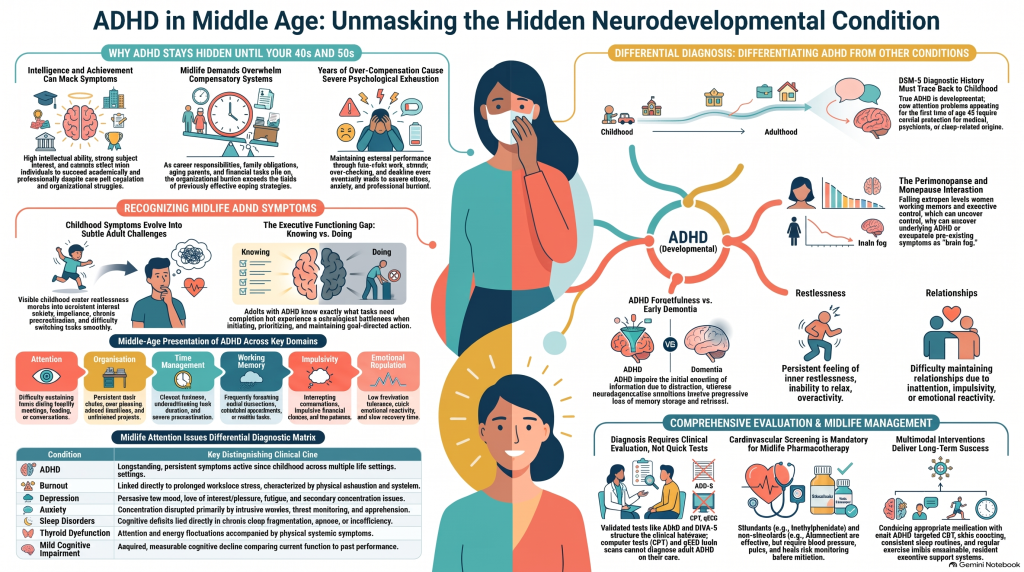 You have managed your life for forty years. You have a career, responsibilities, perhaps a family. So why does everything suddenly feel more difficult? Could it be ADHD?
By Dr. T. Srinivas Rajkumar, MD Psychiatry (AIIMS, New Delhi)
Imagine a 45-year-old professional.
He has a successful career, a reasonable income and a reputation for being intelligent and capable. But behind this apparently successful life is a different story.
He struggles to complete projects on time. His desk is filled with unfinished work. He regularly forgets appointments, misplaces important documents and postpones even relatively simple administrative tasks.
At home, his partner complains that he does not listen, forgets commitments and seems mentally absent during conversations.
He has always been this way, although somehow things seemed manageable earlier.
Now, with increasing professional responsibilities, family commitments and financial obligations, everything feels overwhelming.
He wonders whether he is experiencing burnout, anxiety, depression or simply the consequences of getting older.
But what if the underlying difficulty is Attention-Deficit/Hyperactivity Disorder (ADHD), a condition that has remained unrecognised for decades?
This hypothetical situation illustrates an increasingly recognised clinical phenomenon: ADHD being identified for the first time during middle adulthood.
Importantly, ADHD diagnosed in middle age is usually not a disorder that suddenly developed at forty. It is more often a longstanding neurodevelopmental condition that was overlooked, compensated for, or attributed to other causes.
1. ADHD Does Not Disappear When Childhood Ends
ADHD is commonly associated with children who are restless, inattentive or disruptive in classrooms.
However, ADHD is a neurodevelopmental disorder that can persist throughout adult life.
The outward expression of symptoms may change considerably with age.
A hyperactive child who constantly runs around may grow into an adult who experiences persistent inner restlessness, impatience or difficulty relaxing.
A child who frequently forgets homework may become a professional who misses deadlines, postpones important decisions or struggles with administrative responsibilities.
Similarly, impulsive behaviour may become evident through poorly considered financial decisions, emotional reactions, interruptions during conversations or difficulties managing relationships.
The symptoms may evolve, but difficulties with attention regulation, inhibition and executive functioning can remain significant.
A 2024 longitudinal study examining ADHD symptoms from emerging adulthood into early middle adulthood found considerable stability in symptoms over approximately 15 years. Inattention was also associated with poorer career and relationship satisfaction.
The findings support the importance of examining ADHD beyond childhood and early adulthood.
2. Why Is ADHD Often Recognised Only in Middle Age?
One of the most interesting aspects of ADHD in middle age is the difference between having symptoms and recognising their significance.
Several factors contribute to delayed diagnosis.
A. Intelligence and Academic Achievement Can Mask ADHD
People with ADHD do not necessarily perform poorly in school.
Some possess strong intellectual abilities, excellent memory for preferred subjects, or the capacity to concentrate intensely when interested in something.
They may complete examinations through last-minute preparation, compensate through unusually long working hours, or rely on external reminders and family support.
These strategies can help someone succeed academically or professionally despite persistent difficulties with organisation and self-regulation.
Consequently, intelligence and achievement should not be used to exclude ADHD.
An important clinical question is not simply whether someone succeeded.
It is how much effort, distress and external support were required to achieve that success.
B. Life Becomes More Complex After Forty
During childhood and adolescence, much of daily life is externally structured.
Parents, teachers, school timetables and examinations organise activities.
In early adulthood, workplace routines and relatively limited responsibilities may continue to provide structure.
However, middle age often brings competing demands.
A person may simultaneously manage a demanding career, children, elderly parents, financial obligations, household administration and long-term relationships.
These responsibilities place substantial demands on executive functioning.
For someone with ADHD, the increasing organisational burden may exceed the capacity of previously successful coping strategies.
The result is not necessarily a sudden deterioration in brain functioning.
Rather, the demands of everyday life may have exceeded the person’s established compensatory mechanisms.
C. The Psychological Cost of Years of Compensation
Some adults with ADHD maintain satisfactory external performance through enormous internal effort.
They work late into the night, repeatedly check their work, depend on deadline-related pressure or avoid tasks that require sustained organisation.
Although they may appear successful, this approach can become exhausting.
Over time, chronic stress, sleep deprivation and persistent self-criticism may contribute to anxiety, depressive symptoms or burnout.
However, burnout and ADHD are not interchangeable diagnoses, and one does not automatically imply the other.
Careful assessment is needed to determine whether longstanding ADHD, current stress, another disorder, or several interacting factors best explain the difficulties.
3. What Does ADHD Look Like in Middle Age?
ADHD in a 45-year-old may look very different from ADHD in a 10-year-old.
| Domain | Possible middle-age presentation |
|---|---|
| Attention | Difficulty sustaining attention during meetings, reading or conversations |
| Organisation | Clutter, poor planning, missed deadlines and unfinished tasks |
| Time management | Underestimating time, chronic lateness and procrastination |
| Working memory | Forgetting instructions, appointments or intended activities |
| Impulsivity | Interrupting conversations, impatience or poorly considered decisions |
| Emotional regulation | Low frustration tolerance and difficulty settling after emotional reactions |
| Restlessness | Feeling mentally busy or unable to relax |
| Relationships | Forgetting commitments, inconsistent follow-through and communication difficulties |
Not every person with ADHD experiences all these symptoms.
Emotional dysregulation is clinically important in many adults with ADHD, although it is not itself one of the core DSM-5 diagnostic symptom categories.
The diagnosis requires an appropriate pattern of symptoms, developmental history, clinically meaningful impairment and exclusion of better explanations.
4. The Executive Functioning Problem: Knowing What to Do but Struggling to Do It
One of the most frustrating experiences reported by adults with ADHD is the discrepancy between knowledge and performance.
A person may know exactly what needs to be done.
They understand that bills should be paid, reports completed, emails answered and appointments remembered.
Yet translating this knowledge into consistent action can be unusually difficult.
Executive functions are cognitive processes involved in planning, prioritisation, working memory, response inhibition, monitoring and goal-directed behaviour.
ADHD can interfere with several of these processes.
For example, an individual may be highly motivated to finish an important project but repeatedly struggle to initiate it.
Once engaged, they may have difficulty resisting interruptions or estimating how long the task will require.
They may also struggle to switch between activities efficiently.
These difficulties should not automatically be interpreted as laziness or lack of responsibility.
At the same time, executive dysfunction is not unique to ADHD. Depression, anxiety, sleep deprivation and various neurological conditions can produce similar difficulties.
The pattern across the lifespan is often more informative than the presence of any one symptom.
5. ADHD, Burnout, Depression or Anxiety: How Can We Tell the Difference?
This is one of the most important questions in middle-aged adults presenting with attention difficulties.
Several psychiatric and medical conditions can resemble ADHD.
| Condition | Important clinical clue |
|---|---|
| ADHD | Longstanding symptoms, often traceable to childhood, across multiple settings |
| Burnout | Symptoms associated with prolonged occupational stress, often dominated by exhaustion and disengagement |
| Depression | Reduced interest or pleasure, persistent low mood, fatigue and concentration difficulties |
| Anxiety | Attention disrupted by excessive worry, apprehension or threat monitoring |
| Sleep disorders | Cognitive difficulties associated with insufficient or disrupted sleep |
| Thyroid dysfunction | Attention and energy changes alongside other possible physical symptoms |
| Mild cognitive impairment | Acquired cognitive decline from previous functioning, requiring careful evaluation |
These conditions frequently overlap.
An adult with lifelong ADHD may develop depression following years of functional difficulties.
Someone with anxiety may also have ADHD, while untreated sleep apnoea can exacerbate existing attention problems.
The distinction is not always straightforward.
The importance of childhood history
For a conventional DSM-5 diagnosis of ADHD, several symptoms should have been present before age 12.
However, adults diagnosed in middle age may not have access to school reports or reliable parental accounts.
A specialist therefore reconstructs the developmental history using available information, examples from different life stages, collateral reports and structured clinical interviews.
Research has raised questions about apparent late-onset ADHD, but whether such cases represent genuinely new-onset ADHD, previously unrecognised symptoms, or other disorders remains debated.
New attention problems appearing for the first time at age 45 should never automatically be labelled ADHD.
They require careful evaluation for acquired psychiatric, medical, sleep-related and neurological causes.
6. ADHD in Middle-Aged Women: The Menopause Connection
Women may experience additional diagnostic challenges during middle age.
Historically, ADHD has been more readily recognised in boys with disruptive hyperactive behaviour.
Girls and women presenting primarily with inattention, disorganisation or internal restlessness may have remained undiagnosed.
During perimenopause, changes in oestrogen and progesterone levels can coincide with sleep disturbance, mood symptoms and cognitive complaints.
Many women describe increased forgetfulness, difficulty concentrating or brain fog during this period.
For women with pre-existing ADHD, hormonal transitions may make attention and emotional regulation difficulties more noticeable.
A 2026 review published in Drugs & Aging examined ADHD management during perimenopause, menopause and post-menopause.
The authors highlighted the potential interaction between reproductive hormonal changes and ADHD symptoms, while emphasising the limited evidence available for specific medication adjustments.
There are currently no randomised controlled trials establishing the optimal ADHD medication strategy specifically for perimenopausal women.
Therefore, clinicians should avoid assuming that every new cognitive complaint during menopause represents ADHD.
Similarly, pre-existing ADHD should not automatically be dismissed as hormonal brain fog.
The most useful approach considers both possibilities, alongside sleep, mood, physical health and previous functioning.
7. ADHD and the Midlife Crisis: Is There a Connection?
Middle age is often a period of psychological re-evaluation.
Individuals may question their careers, relationships, achievements and future goals.
For some people with previously unrecognised ADHD, this period may bring greater awareness of longstanding patterns of underachievement, inconsistency or relationship difficulties.
They may ask themselves:
Why have I struggled with tasks that seem so simple for other people?
Why do I perform exceptionally well in areas that interest me but struggle with routine responsibilities?
Why do I repeatedly postpone important things despite understanding the consequences?
These questions do not establish a diagnosis.
However, when the experiences are longstanding, pervasive and functionally impairing, they may justify an assessment for adult ADHD.
Recognising ADHD in middle age can sometimes provide a useful explanation for previously confusing patterns of behaviour.
It should not be used to attribute every life disappointment, personality trait or relationship difficulty to a single diagnosis.
8. ADHD, Forgetfulness and Dementia: An Important Distinction
Middle-aged adults sometimes worry that increasing forgetfulness indicates early dementia.
Both ADHD and cognitive disorders can involve attention difficulties, poor organisation and memory complaints.
However, the underlying patterns may differ.
ADHD commonly affects the initial encoding of information because attention is inconsistent.
For example, a person may forget where they placed their keys because they were distracted when putting them down.
In contrast, neurodegenerative conditions may produce acquired difficulties with memory storage, retrieval or other cognitive functions, depending on the disorder.
This distinction is useful but not absolute.
ADHD itself can involve working-memory difficulties, and neurodegenerative conditions can also impair attention.
A history of lifelong distractibility favours a developmental explanation, whereas clear progressive decline from previous functioning warrants evaluation for acquired cognitive disorders.
Importantly, having ADHD does not exclude the possibility of developing another cognitive disorder later in life.
When the clinical picture is uncertain, specialist cognitive assessment may be appropriate.
9. How Is ADHD Diagnosed at Age 40 or 50?
ADHD diagnosis remains fundamentally clinical.
A comprehensive specialist evaluation generally includes:
- Developmental history: Evidence of symptoms beginning in childhood or adolescence.
- Current symptom assessment: Inattention, hyperactivity and impulsivity, adapted to adult presentations.
- Functional assessment: Impact on work, relationships, finances, daily responsibilities and quality of life.
- Assessment of other conditions: Anxiety, depression, sleep disorders, substance use, medical and cognitive disorders.
- Collateral information: When available, observations from partners, parents, siblings or previous records.
- Structured diagnostic tools: Instruments such as the Adult ADHD Self-Report Scale (ASRS) and the Diagnostic Interview for ADHD in Adults (DIVA-5).
The ASRS is useful for screening, but a positive screening result does not establish ADHD.
Similarly, computerised continuous performance tests (CPT) can quantify selected aspects of attention and response control but cannot independently confirm or exclude ADHD.
Quantitative electroencephalography (qEEG) can provide information about electrophysiological activity, but no qEEG pattern is sufficiently specific to diagnose adult ADHD on its own.
Current clinical guidelines continue to place a comprehensive developmental and psychiatric assessment at the centre of diagnosis.
Technology may contribute supplementary information in selected cases, provided its limitations are acknowledged.
10. Can ADHD Be Treated Successfully in Middle Age?
Yes.
There is no upper age limit beyond which ADHD automatically becomes untreatable.
Treatment depends on symptom severity, functional impairment, physical health, coexisting conditions and personal preferences.
Medication
Methylphenidate is an established treatment option for adults with ADHD.
Atomoxetine is another option, particularly when stimulants are unsuitable, ineffective or poorly tolerated.
Medication availability, approvals and prescribing considerations vary between countries.
In middle age, cardiovascular evaluation becomes particularly important because hypertension, diabetes and other cardiovascular risk factors become more common with increasing age.
Before initiating ADHD medication, clinicians should review medical history, current medications, blood pressure, pulse and relevant cardiovascular risks.
An ECG is not universally required for every patient, but it may be indicated by specific symptoms, medical history or examination findings.
Long-term observational research has identified associations between greater cumulative ADHD medication exposure and cardiovascular outcomes, particularly hypertension and arterial disease. These studies do not, by themselves, establish causality for an individual patient.
Appropriate prescribing therefore requires balancing benefits against risks and providing ongoing monitoring.
Psychological Treatment
Cognitive behavioural therapy adapted for adult ADHD can help individuals develop strategies for organisation, planning, procrastination and emotion regulation.
Other useful interventions may include structured skills training, psychoeducation, environmental modifications and support for coexisting mental health conditions.
Medication and psychological approaches are complementary rather than mutually exclusive.
Lifestyle and Physical Activity
Sleep, exercise and daily routines are also important.
Regular physical activity supports general cardiovascular and mental health, while consistent sleep routines may reduce some factors that worsen attention and emotional regulation.
Practical strategies can include external reminders, structured calendars, breaking tasks into smaller steps, reducing unnecessary distractions and creating predictable daily routines.
These interventions may improve functioning but should not be portrayed as cures for ADHD.
The objective is to build a sustainable system that supports the individual’s strengths while reducing areas of recurring difficulty.
11. Is Forty Too Late to Be Diagnosed With ADHD?
Absolutely not.
A diagnosis at forty, fifty or later can still be clinically meaningful.
For some people, it explains longstanding difficulties that were previously attributed to poor motivation, irresponsibility or personal inadequacy.
For others, the assessment may reveal that their difficulties are better explained by depression, anxiety, sleep disturbance or another condition.
Both outcomes are valuable.
The purpose of assessment is not simply to obtain an ADHD label.
It is to understand why an individual is struggling and identify the most appropriate interventions.
A successful evaluation may help someone make better-informed decisions about treatment, work routines, relationships and future goals.
Frequently Asked Questions
Can ADHD suddenly develop at age 40?
ADHD is conventionally understood as a neurodevelopmental condition with symptoms beginning during childhood. Newly emerging attention difficulties at forty require evaluation for other possible causes, even when an ADHD assessment is also appropriate.
Can someone have ADHD despite being academically successful?
Yes. Academic achievement does not exclude ADHD. The assessment considers the history of symptoms, compensatory strategies, impairment and the effort required to maintain performance.
Does ADHD become worse with age?
Not necessarily. Symptoms may change with age, while increased responsibilities, sleep problems and other conditions can make longstanding difficulties more noticeable. Some adults also develop more effective coping strategies over time.
Can ADHD cause memory problems in middle age?
ADHD can affect attention during learning, working memory and everyday recall. However, new or progressively worsening memory difficulties should not automatically be attributed to ADHD.
Is methylphenidate safe after the age of 40?
Age forty alone is not a contraindication. Suitability depends on cardiovascular health, other medical conditions, medication interactions, expected benefits and appropriate monitoring.
Can ADHD be diagnosed using qEEG or a computerised attention test?
No standalone qEEG or computerised performance test can reliably establish an adult ADHD diagnosis. These measures may supplement a comprehensive clinical evaluation in selected circumstances.
Conclusion: Sometimes the Problem Is Not New—Only the Recognition Is
Middle age is a period when personal, professional and family responsibilities often reach unprecedented levels.
For some individuals, these demands reveal longstanding difficulties with attention, organisation, impulse control and emotional regulation that previously remained unnoticed or compensated for.
A successful career does not exclude ADHD.
Neither does being married, raising children, completing a postgraduate degree or maintaining a responsible professional position.
But ADHD should also not become the default explanation for every difficulty in middle age.
The central question is not simply whether someone has difficulty concentrating today. It is whether there is a persistent developmental pattern of ADHD symptoms that meaningfully affects everyday functioning.
Recognising that pattern can open the door to effective treatment, greater self-understanding and more sustainable ways of living.
It is never too late to understand how your mind works.
About the Author
Dr. T. Srinivas Rajkumar, MBBS, MD (Psychiatry), DNB (Psychiatry)
Dr. Srinivas Rajkumar completed his MBBS at Madurai Medical College and MD in Psychiatry at AIIMS, New Delhi.
He is a Consultant Psychiatrist practising in Chennai, with clinical interests in adult ADHD, neuropsychiatry, psychopharmacology, and technology-assisted psychiatric assessment.
His approach emphasises comprehensive biopsychosocial evaluation, evidence-based treatment and measurement-based follow-up.
Adult ADHD Assessment in Chennai
For adults experiencing persistent difficulties with attention, organisation, procrastination, emotional regulation or executive functioning, a specialist evaluation can help distinguish ADHD from other psychiatric, sleep-related and medical conditions.
At Attention Clinic – 360° ADHD Care in Chennai, assessment and management are centred on specialist clinical evaluation, validated symptom measures and individualised treatment planning, with appropriate supplementary cognitive or performance-based assessments where clinically indicated.