The Biology of Being Human: 14 Insights from Robert Sapolsky
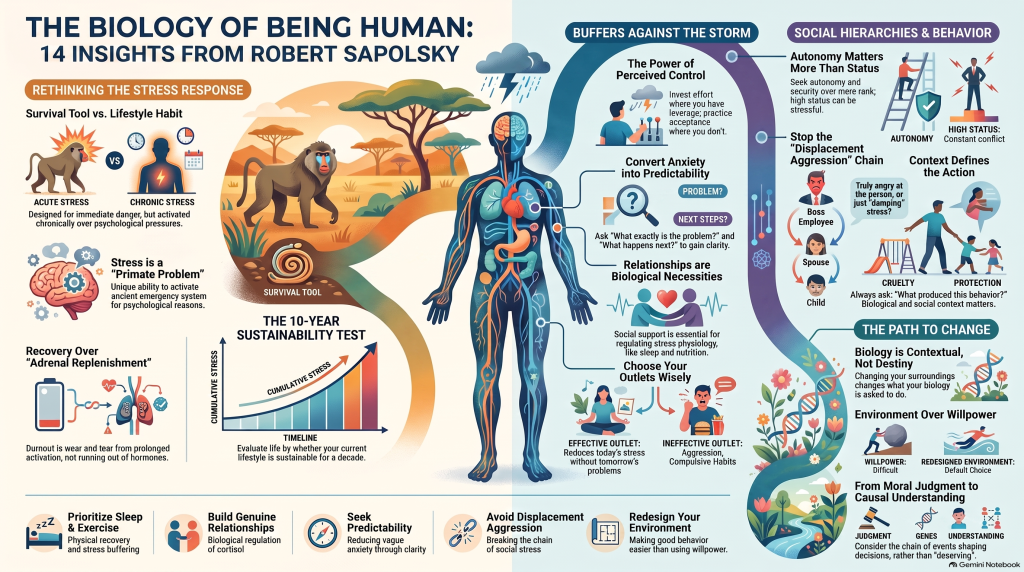 Robert Sapolsky’s work across stress biology, neuroscience, primate behaviour and human decision-making offers a powerful way to rethink everyday life. The central theme is simple: our biology is shaped by context, and many of our problems arise when systems designed for short-term survival become chronic ways of living.
1. The stress response is a survival tool, not a lifestyle
The stress response evolved to deal with immediate danger. It is excellent for escaping a predator, fighting an infection or responding to an acute crisis.
The problem is that humans can activate the same emergency physiology over deadlines, finances, status, relationships and imagined future threats.
Live differently: Do not aim to eliminate stress. Aim to stop living as though every problem is an emergency.
2. Stress is a uniquely powerful primate problem
Humans can activate stress physiology simply by thinking.
We can replay yesterday, anticipate tomorrow and repeatedly trigger the body in response to events that are not physically happening now.
Live differently: Ask yourself:
“Is the danger happening now, or am I mentally rehearsing it?”
3. Burnout is not about “running out” of hormones
Chronic exhaustion is not best understood as the adrenal glands becoming empty.
The greater problem is prolonged activation, dysregulation and cumulative physiological wear and tear.
Live differently: Think recovery, not “adrenal replenishment.”
Sleep, exercise, downtime and periods of genuine physiological disengagement matter more than supplementing an imaginary hormonal deficit.
4. Chronic stress accumulates
Stress is often manageable in isolated episodes.
But when stress becomes continuous, its effects accumulate across the cardiovascular, metabolic, immune and nervous systems.
This is the logic of allostatic load: the cost of repeatedly adapting to challenge.
Live differently: Use the 10-year test:
“If I live exactly like this for the next decade, what will it do to my body, relationships and mind?”
5. Perceived control changes stress
Stress becomes more tolerable when we feel that we have some influence over what happens next.
But trying to control everything can itself become pathological.
Live differently: Divide problems into two categories:
Where you have leverage → act.
Where you genuinely do not → practice acceptance.
Do not waste biological energy attempting to control the uncontrollable.
6. Predictability reduces anxiety
Uncertainty is enormously stressful.
Knowing what is happening, what comes next and how long something will last can make a difficult situation considerably easier to tolerate.
Live differently: Convert vague anxiety into concrete questions:
What exactly is the problem?
What happens next?
What can I do today?
Clarity itself can reduce stress.
7. Relationships are biological necessities
Social support is not merely pleasant.
Stable, trusting relationships can buffer stress responses and alter how threatening the environment feels.
Sapolsky’s primate work repeatedly shows that social connection matters biologically.
Live differently: Treat important relationships the way you treat sleep or exercise.
Do not sacrifice every relationship in the name of productivity and assume you can repair them later.
8. Autonomy matters more than status
High social status does not automatically mean low stress.
If high status requires constant competition, insecurity and defence, it can be deeply stressful.
What often matters more is autonomy, control, predictability and security.
Live differently: Do not chase rank for its own sake.
Choose work and relationships that give you more control over your time, attention and life.
9. Do not pass stress down the hierarchy
Sapolsky observed displacement aggression in primates.
An animal loses a confrontation with someone stronger and then attacks someone weaker. Humans often reproduce the same pattern:
Boss → employee → spouse → child → someone even more vulnerable.
Live differently: When irritated with someone, ask:
“Am I genuinely angry with this person, or are they simply the safest person available to receive my stress?”
Break the chain.
10. Context defines behaviour
The same physical action can mean completely different things depending on context.
An act can represent cruelty, defence, affection, protection or desperation.
Behaviour cannot be fully understood by observing the final action alone.
Live differently: Replace:
“What kind of person would do that?”
with:
“What circumstances produced that behaviour?”
Understanding does not mean excusing harmful behaviour. It means explaining it more intelligently.
11. Behaviour has a history
Any decision is influenced by what happened:
seconds before,
hours before,
years before,
during childhood,
during development,
and across the social environment in which the person lives.
Sleep, stress, hormones, upbringing, culture, trauma, education and biology all matter.
Live differently: Be slower to label people as simply:
lazy, weak, selfish, difficult or bad.
Behaviour usually has more history than we can see.
12. Biology is contextual, not destiny
Genes matter.
Hormones matter.
Brain circuits matter.
But none of them operate independently of environment.
Experience changes the brain. Social conditions alter physiology. Relationships affect stress responses.
Live differently: Do not ask only:
“What is wrong with me?”
Ask:
“What environment repeatedly produces this version of me?”
Change the surroundings, and biology may respond differently.
13. Environment often beats willpower
One of the most useful lessons from behavioural biology is that changing the environment can sometimes change behaviour more reliably than trying harder.
If distraction is always available, resisting distraction requires constant effort.
If healthy behaviour is difficult to access, discipline alone becomes expensive.
Live differently: Design your environment so that the better behaviour becomes the default.
Make desired actions easier.
Make destructive actions harder.
Do not turn every behavioural problem into a test of moral strength.
14. Move from moral judgement to causal understanding
This may be Sapolsky’s most challenging insight.
By the time someone makes a decision, an enormous chain of biological and environmental events has already shaped the brain making that decision.
Genes, development, childhood, socioeconomic circumstances, culture, hormones, stress and recent experience all contribute.
This does not require abandoning responsibility.
It means becoming more interested in causes than condemnation.
Live differently: Instead of asking:
“Who deserves blame?”
also ask:
“What chain of events made this outcome more likely, and what could we change to make a better outcome more likely next time?”
The Sapolsky Approach to Living
Put these ideas together and a practical philosophy emerges:
Prioritize sleep and exercise. Build genuine relationships. Seek autonomy. Create predictability. Use control where control is possible. Recover deliberately. Avoid passing stress onto weaker people. Design your environment rather than relying entirely on willpower. And understand behaviour through causes, context and biology rather than through simplistic moral judgement.
The deepest lesson may be:
Biology is powerful, but biology is contextual.
Change the context, and you change what your biology is being asked to do.